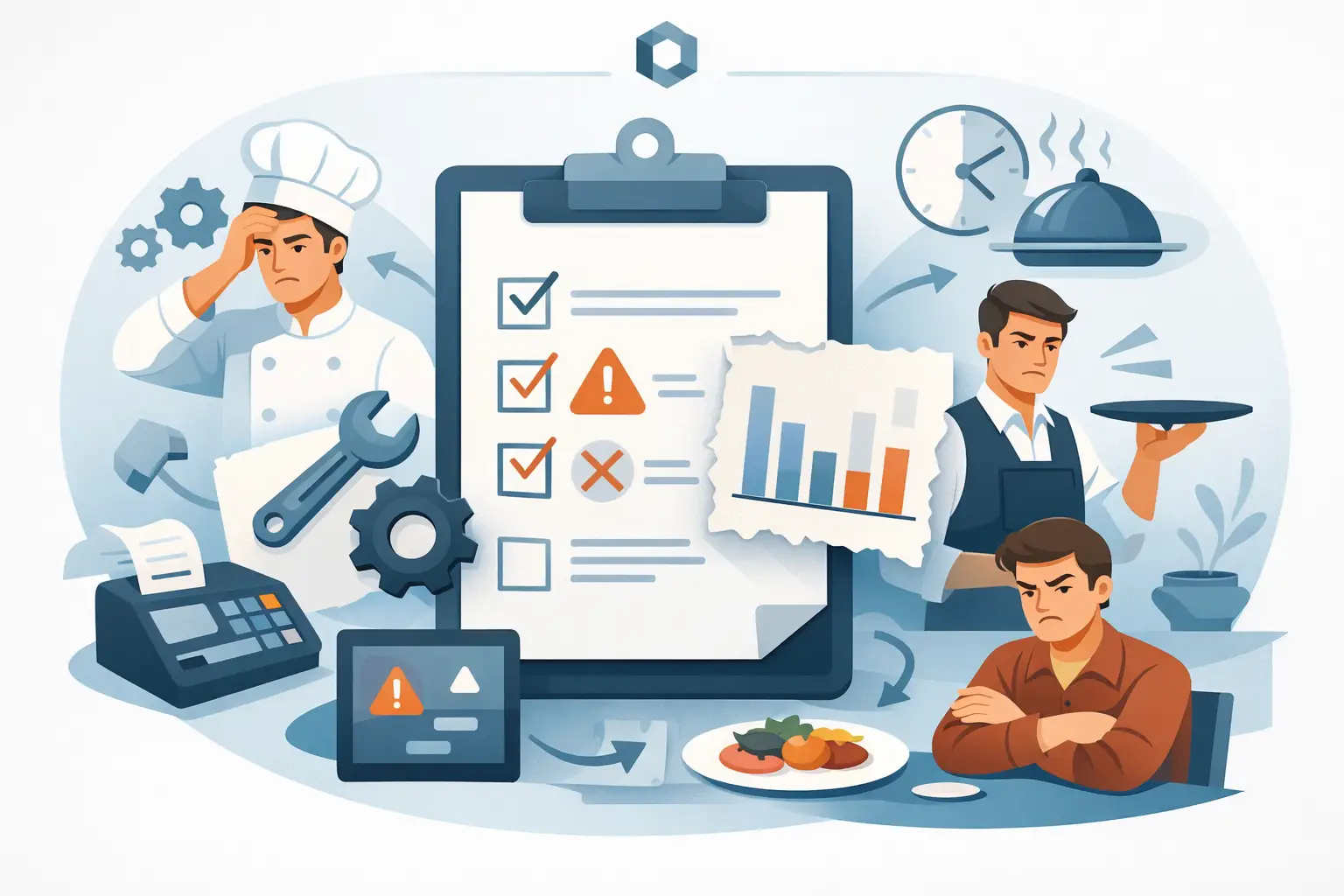
Restaurant SOP software should help people apply the current approved procedure and give managers a clear view of the exceptions. Storing a manual is part of that job. The more demanding part is keeping the standard usable when a colleague is new, an outlet changes its menu or a routine breaks down during service.
Start with a specific operating problem: two trainers teaching different opening checks, an unclear order handoff or an outdated recovery rule. Define the procedure, ownership and evidence before choosing how to deliver it. Software can support a clear standard; it cannot make an ambiguous instruction workable by itself.
What good restaurant SOP software actually does
Evaluate how the software supports access, training, execution and review. Each serves a different management need.
First, it centralizes operational knowledge in a way staff can actually use. That means menu details, service standards, allergy protocols, opening and closing procedures, brand scripts, outlet-specific rules, and training content are all accessible in one place. Not buried in PDFs. Not split across WhatsApp, shared folders, and memory.
Second, it supports onboarding and retraining without relying on whoever happens to be training that day. Most operators have seen the cost of informal training. One manager is thorough, another skips steps, and within two weeks the new hire is improvising. Software should standardize the training flow while still allowing outlet-level nuance.
Third, it should support execution, not just reference. A completed checklist without verification can hide an execution gap. A briefing without a receipt or understanding check may leave a critical update unconfirmed. A useful system connects procedures to actual workflows, accountability, and manager visibility.
Fourth, it should surface weak spots. If ten staff members keep searching the same policy, failing the same knowledge check, or missing the same upsell prompt, that is not a staff problem alone. Investigate whether the procedure, training or workflow needs adjustment. The system should help show patterns by role, outlet, shift and topic.
Standardise the procedure before the platform
Prioritise high-risk and frequent decisions using actual operating evidence. Review audit findings, repeat complaints, incidents, remakes, handover failures and the questions supervisors answer most often. Select a manageable starting set rather than launching a project to rewrite every historical policy at once.
Observe the work with experienced colleagues and new starters. Identify which actions protect safety, quality and the guest promise, and which are simply a particular manager's preference. A group standard should preserve the important controls without turning every personal habit into a mandatory step.
Every SOP should identify its trigger, applicable role and outlet, required actions, decision authority, escalation route and verification. Write in the language used at the station. “Handle complaints professionally” needs a usable sequence and a clear boundary for decisions outside the employee's authority.
An illustrative service-delay procedure could tell the server to confirm the status with the pass, give the guest an accurate update, involve the floor manager at the property's defined threshold and record the recovery as required. The timing and authority must come from the outlet's approved standard. The example is a structure, not a universal promise about service speed.
| SOP field | Question it should answer | | --- | --- | | Trigger | When does this procedure start? | | Scope | Which outlet, role and situation does it cover? | | Actions | What must happen, and in what order? | | Authority | What can the employee decide independently? | | Escalation | Who accepts the next decision when the limit is reached? | | Evidence | What shows the task or correction was completed correctly? | | Governance | Who owns the standard and approves its revision? |
For allergy requests, link to the approved allergen escalation process. A general menu-knowledge instruction should never replace the specific verification and handoff required for that request.
Control versions and legitimate outlet differences
Give every procedure a named operational owner. The owner confirms that it remains accurate, usable and aligned with applicable requirements. Culinary leadership may own recipe-related controls, operations may own the service sequence, and the appropriate specialist may own a finance or safety procedure.
Record approval, effective date, review date and superseded version. A menu, supplier, equipment or regulatory change can trigger an immediate review; it should not wait simply because the annual review date has not arrived. Make the approved version easy to recognise and withdraw outdated operational copies through a controlled process.
Separate the group standard from authorised local detail. A pool bar and a fine-dining restaurant may need different service pacing, equipment instructions and menu records. Shared safety principles and escalation expectations can remain consistent while the actual process reflects the outlet. Where requirements differ by jurisdiction, have the responsible local specialist validate the applicable rule.
When publishing a revision, identify the affected roles, linked training, briefing and checklist. Updating the SOP but leaving an old checklist in use creates a new conflict. Keep a record of what changed and how the relevant teams received and understood it.
Distinguish a knowledge gap from an execution gap
A knowledge gap means the employee does not know or cannot retrieve the current standard. An execution gap means the employee understands it but cannot apply it reliably. The response should reflect that distinction.
If a new server cannot locate the current modifier process, improve access and practise the decision. If the server can explain it but the POS lacks the required option, another lesson will not repair the interface. If a required cleaning step is routinely missed because equipment is unavailable, investigate the equipment and workflow.
Ask the colleague to explain the process and demonstrate the work under appropriate supervision. Review the conditions as well as the answer: staffing, time, tools, physical layout and conflicting instructions. Repeated reminders may create frustration when the actual obstacle remains unchanged.
Record the correction with an owner, due date and verification. “Staff reminded” is insufficient when the underlying problem is unclear authority. Define the agreed change and test whether the relevant handoff now works.
Make SOPs usable in learning and live work
Use a concise action reference linked to the complete approved procedure. A host should find the relevant reservation exception without opening an unrelated service manual. A night manager should find the current escalation contact and incident steps in the conditions of the night shift.
Introduce important changes through a realistic scenario in pre-shift. Ask what the employee would do next and who accepts the decision. Follow that with observation where risk or complexity requires it. A reading acknowledgement is useful evidence of receipt, but it does not prove practical capability.
For multilingual teams, use plain wording and operationally reviewed translations. Verify the meaning through explanation and demonstration. Keep decision authority and escalation consistent across language versions.
Compare platform categories by the problem they solve
A document repository can provide useful approval, version and search controls. A checklist tool can structure routine tasks and show recorded exceptions. An LMS can assign learning and retain training history. An Operational Intelligence (OI) platform may connect these signals with knowledge, briefings and manager reporting.
These categories overlap, and the label alone does not establish capability. Test the specific product. You may be able to improve the workflow with an existing repository and learning system, or you may need a connected environment because managers are maintaining several conflicting records.
Ask each supplier to demonstrate the same procedure change from approval to live use. Can an authorised owner publish it, direct it to the affected roles, update the linked checklist and retrieve the history? Can a supervisor see a failed scenario and assign follow-up? Can the manager verify the correction without copying information into another tracker?
Include a missing source, poor connectivity and two outlets with similar procedure names. Check how the system identifies scope and handles uncertainty. If it generates an answer with AI, it should reveal the approved source and version and route unresolved questions to the responsible person, rather than inventing an instruction.
What to look for in restaurant SOP software
If you are evaluating options, the most useful lens is not feature volume. It is whether the platform solves the most expensive points of failure in your operation.
Start with frontline usability. If the interface is clunky, teams will avoid it and managers will default back to verbal reminders. In hospitality, adoption lives or dies on speed. Can a server find an allergen answer quickly? Can a bartender confirm a promotion script before service? Can a banquet team review event-specific standards without waiting for a printed packet?
Next, look at role-based delivery. A room service attendant does not need the same SOP feed as a fine dining captain. A stewarding team needs different procedural clarity than a sommelier. Good software respects operational reality and delivers the right content to the right person.
Then assess manager visibility. This is where many systems fall short. They can assign content, but they cannot show whether the team understands it, uses it, or struggles with it. Operators need more than completion data. They need insight into readiness.
You should also test how the platform handles live operational rhythm. Can it support daily briefings, shift-critical updates, and recurring checklists without becoming another inbox? Can it help with audit readiness and standard verification, not just documentation? Confirm which functions are actually included, how they are maintained and whether they remove duplicate work.
Finally, consider how well the system handles multilingual and high-turnover environments. Test with the people who will use it, including relief staff, new starters and colleagues using different working languages.
Pilot, review and keep the standard alive
Start with one procedure and one outlet. Define the failure you want to reduce, clean the source content, and give the owner time to maintain it. Run the workflow across more than one shift and review questions with the employees doing the task.
Measure retrieval, scenario understanding, observed application, recurring failures and action closure. A rise in access can mean adoption improved or the procedure remains unclear; read the signal with context. Keep reviewing whether the standard is workable as menus, staffing and equipment change.
SmartHospitality Operational Intelligence (OI) can connect approved SOP knowledge with onboarding, briefings and manager reporting. It helps expose recurring uncertainty and organise follow-through while operators remain responsible for the standard, its application and its correction.