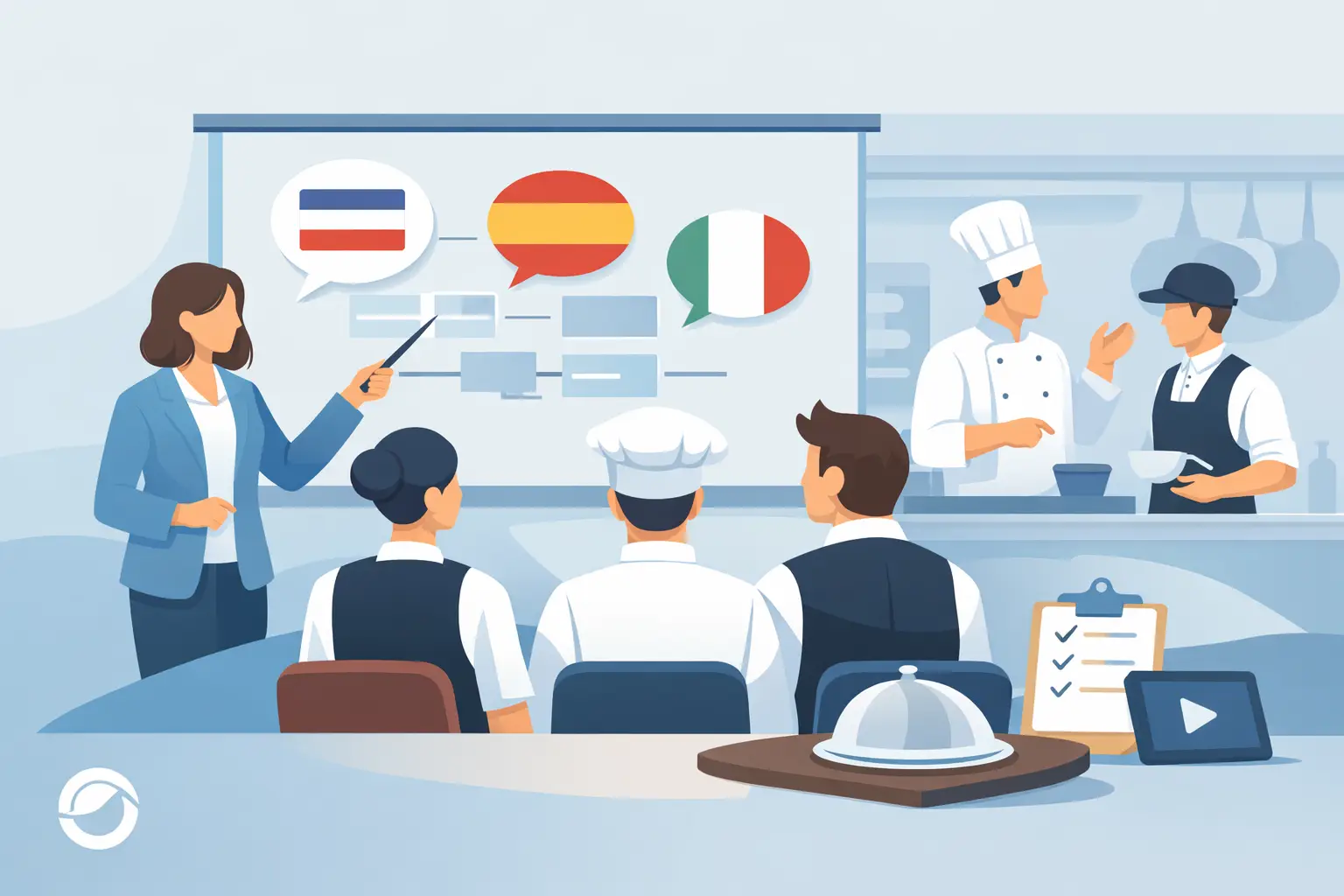
One server understands the wine script but misses the allergen modifier. Another can describe the special perfectly in Spanish yet hesitates when a guest asks follow-up questions in English. The problem is not effort. It is system design. If you are figuring out how to train multilingual restaurant teams, the real task is not translating a handbook. It is building a service operation where standards survive language differences, shift pressure, and turnover.
In restaurants, multilingual staffing is often treated as a communication challenge. In practice, it is a revenue, compliance, and consistency issue. When product knowledge lands unevenly across languages, upselling suffers. When allergy protocols are explained differently by manager, trainer, or shift lead, risk goes up. When new hires depend on whoever happens to be strongest in both languages that week, onboarding quality becomes random. None of that is fixed by asking bilingual employees to "help translate on the floor."
Why multilingual team training breaks down
Language access and process clarity need to be addressed together. A well-translated instruction can still fail if the underlying standard is contradictory or the manager has not taught it.
A typical training setup relies on verbal shadowing, manager explanations, and printed materials written in one primary language. That can work with a stable, highly tenured team. It usually fails in high-turnover environments, hotel outlets, banquets, or multi-unit operations where staffing changes daily and service complexity is high. The minute knowledge transfer depends on memory, personality, or informal translation, your operating standard starts drifting.
You may see gaps through missed modifier questions, incorrect course pacing, weak menu confidence, and delayed table touches because staff are stopping to clarify basic information. For leadership, the larger issue is visibility. If your team speaks multiple languages but your training system only measures completion, you still do not know what they actually understand.
How to train multilingual restaurant teams without lowering the standard
The first principle is simple: train to one operating standard, then support access in multiple languages. That is different from creating separate versions of the truth.
Your service sequence, allergy protocol, menu knowledge expectations, and upsell behaviors should remain identical regardless of the employee's first language. What changes is how clearly that knowledge is delivered, reinforced, and checked. Operators get into trouble when they let language adaptation become process improvisation. The goal is consistency, not customization for its own sake.
Start by identifying the knowledge that has the highest operational consequence. In most restaurants, that means allergens, modifiers, POS steps, service sequence, payments, opening and closing duties, and core menu descriptions. Fine dining and luxury hotel outlets should add wine, pacing standards, guest recovery language, and outlet-specific rituals. Banquets may need event flow, function sheet interpretation, and dietary exception handling. Train those first with absolute clarity.
Then strip out anything that creates unnecessary language load. Long manuals, vague phrasing, and manager-specific explanations slow learning and increase interpretation gaps. Strong multilingual training uses plain language, short modules, visual reinforcement, and repeated context. A server needs both the reason for a safety procedure and clear steps for applying it. Keep the short service reference beside the fuller approved procedure, including how to stop and escalate an uncertain answer.
Build training around moments that matter on the floor
The best multilingual training is organized by live service moments, not by corporate document categories.
Teach menu knowledge through guest questions. Teach allergy procedure through actual ordering scenarios. Teach upselling through pairing prompts and objection handling. Teach side work through shift-ready checklists. Staff retain more when training mirrors the reality of a busy service, especially if English is not their strongest language under pressure.
This is where many operators overestimate passive understanding. A team member may follow a classroom explanation and still struggle during a six-table turn when a guest changes an order three times. Training has to account for cognitive load. If a process is too word-heavy to recall mid-rush, it is not operationally ready.
Use bilingual support carefully
Bilingual supervisors and lead servers are valuable, but they should not become your training infrastructure.
When one or two team members carry the burden of translating every pre-shift, every SOP update, and every onboarding session, quality becomes inconsistent and those employees become bottlenecks. Worse, their translation may be accurate but incomplete, especially around technical menu language, allergy language, or policy nuance. That creates false confidence.
Use bilingual staff to validate understanding, clarify nuance, and flag where materials are failing. Do not rely on them to rebuild your training system shift by shift. Formalize key terms. Decide exactly how items, allergens, service steps, and escalation language should be described. If your kitchen says one thing, your managers another, and your bilingual trainers a third, staff may receive conflicting instructions.
Translate operational language, not just words
Direct translation is not enough in hospitality. Staff need to understand the operational meaning behind phrases.
"Fire table 42" or "86 halibut" may be obvious to seasoned operators and meaningless to newer employees if training is weak. The same applies to guest-facing language around doneness, substitutions, coursing, and allergy disclaimers. Build a controlled operational vocabulary for your outlets and teach it explicitly.
This matters just as much for service culture. If your brand standard expects anticipatory service, polished handoff language, or a specific recovery approach, train those behaviors with examples, not abstract labels. The phrase "read the table" is not a usable instruction unless you define what good looks like.
How to check understanding instead of assuming it
Completion is not comprehension. This is where multilingual restaurant training usually fails.
Managers often ask, "Does everyone understand?" and get a room full of nods. That is not validation. It is social pressure. The only useful test is observed behavior and scenario-based recall.
Use brief knowledge checks tied to real tasks. Ask servers to explain a dish and two modifications. Ask hosts to walk through an allergy handoff. Ask banquet staff to identify what changes when a BEO is updated mid-function. Ask bartenders to describe the top three premium upsell cues for the shift. If someone cannot perform the knowledge in context, the training is not finished.
The trade-off here is speed. Scenario checks take more discipline than sign-off sheets. But they save far more time than repeated manager intervention during service. They also show where more support is needed by task and role. Do not treat a language preference as a proxy for competence; investigate the instruction, supervision and working conditions before judging individual performance.
Make pre-shift the reinforcement engine
If onboarding is the foundation, pre-shift is where multilingual teams become consistent.
Too many pre-shifts are verbal dumps delivered fast, in one language, with no structure and no record of what was covered. That format almost guarantees uneven retention. A stronger model uses short, repeatable pre-shift content focused on one menu point, one service behavior, one commercial priority, and one risk item. Keep the language tight. Reinforce the same standards in multiple ways across the week.
Use a written briefing record alongside the spoken discussion. A late arrival should see the same menu changes, risk items and action owners. Record which version each language uses, and check that a change in one language does not leave another version behind. For a practical agenda, see how to run pre-shift meetings that work.
Choose tools that support the working language of each task
An employee may welcome guests comfortably in English while preferring equipment instructions in another language. Ask which language and format support accurate work for each important task. Also check reading confidence, hearing or visual access needs, available devices and connectivity. A long list of supported languages says little about whether the actual material works for this team.
Use the same live scenario to compare tools. Change one approved menu instruction, translate it, publish it and ask a server to retrieve the current answer. Then ask the manager to identify the version used and withdraw the outdated one. Evaluate the complete workflow, including the work required from local reviewers.
| Test | Evidence to ask for | | --- | --- | | Translation control | A named reviewer, source version and approval date for each language | | Point-of-work access | A relevant answer on the device and connection used during service | | Role relevance | Outlet-specific menu details beside the shared service standard | | Understanding | A scenario response or observed task, separate from a completion tick | | Manager follow-through | An unresolved question with an owner, due time and review record |
Machine translation can produce a draft. It should not become the authority for allergen details, chemical instructions or emergency procedures without qualified review. The system needs a clear fallback when a translation is unavailable or an answer is uncertain. Employees should know whom to contact and when work must pause under the approved procedure.
Start a pilot with one high-frequency service moment. Culinary leadership should validate ingredient and recipe information; the relevant department should own its service and equipment instructions. Test the material with an experienced bilingual operator and a newer colleague, then ask both to demonstrate the task. Their hesitation often identifies a missing step that a grammar review would miss.
Include hotel handoffs in the pilot where relevant: a revised banquet event order, a room-status change or a maintenance escalation. These examples test whether the tool carries the same instruction across departments, rather than simply presenting a restaurant handbook in two languages.
Train managers first
If managers are inconsistent, the team will be inconsistent in every language.
Multilingual training only works when leaders are aligned on wording, expectations, and follow-up. That means outlet managers, supervisors, and trainers need a tighter playbook than the hourly team. They should know exactly how to coach menu language, correct allergy handling, evaluate upsell attempts, and verify task completion. If each manager explains standards differently, language is not the root problem.
Managers also need to know when not to overcomplicate communication. Shorter instructions, cleaner checklists, and direct coaching usually outperform long explanations. Precision wins. Hospitality leaders often think being thorough means saying more. On the floor, saying less but saying it clearly is usually the higher standard.
Keep the system honest
The final discipline is measurement. If you want to know how to train multilingual restaurant teams effectively, track outcomes that expose whether training is actually landing.
Track correct task demonstrations, time needed to find an approved answer, unresolved questions and recurring ordering errors. Review incident and near-miss reports without rewarding teams for silence: more reports can reflect better reporting rather than worse execution. Compare similar roles and service conditions. A quiz score helps identify a learning gap; it does not replace observing the task.
There is no perfect system. Some teams need more visual training. Some outlets need more language support on wine, guest recovery, or technical menu descriptions. Some managers are strong teachers and some are not. But the answer is not to lower the standard until everyone can get through the shift. The answer is to build a training system that carries the standard clearly, repeatedly, and visibly across every language spoken in the building.
SmartHospitality.AI brings multilingual knowledge access into a wider Hospitality Operational Intelligence workflow. Evaluate it against the same practical tests: approved content, usable language support and visible follow-through when a team member needs help.