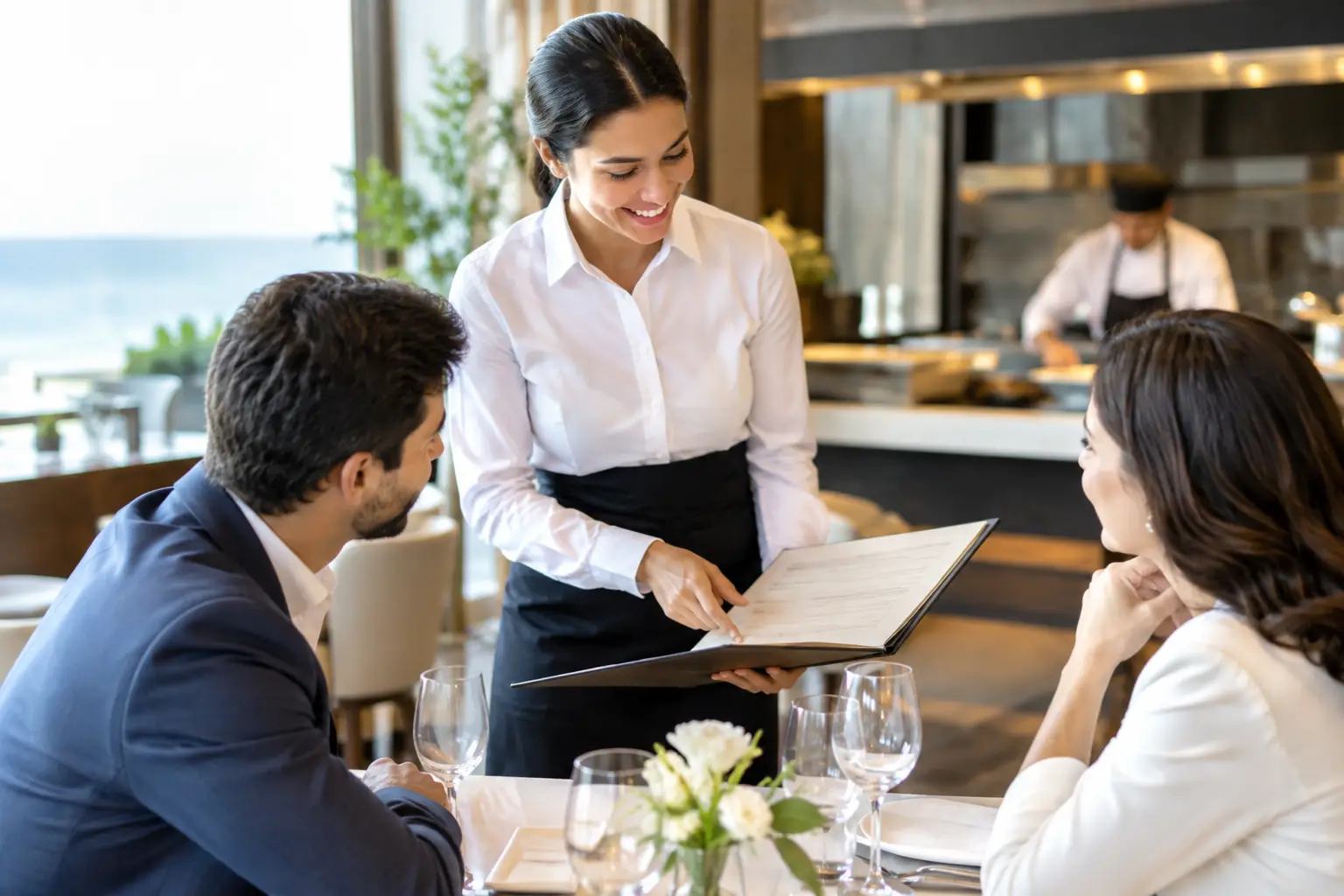
A server hesitates when a guest asks whether the sea bass has dairy. Another describes the signature cocktail differently than the bartender. A third suggests a side dish but cannot explain why it complements the entrée. These are not minor service-floor moments. They reveal the knowledge gaps that reduce guest trust, slow table decisions, create allergen exposure, and leave revenue on the table. To improve restaurant menu confidence, operators must treat menu knowledge as a live operational standard, not a one-time training subject.
For restaurant groups, hotels, resorts, and multi-outlet operations, the challenge becomes sharper as menus change, teams rotate, and service expectations rise. A polished menu is only as valuable as the team’s ability to represent it accurately at the table.
Menu confidence is an operational performance issue
Menu confidence is often mistaken for memorization. It is more practical than that. A confident team member can explain what a dish is, how it is prepared, which allergens or dietary considerations require care, what makes it distinctive, and when it is appropriate to recommend it.
That capability affects four commercial and operational outcomes at once: guest confidence, check average, service pace, and risk control. If a server needs to leave the table twice to answer basic menu questions, the guest experience loses momentum. If they avoid recommending premium items because they cannot describe them clearly, revenue optimization suffers. If allergen information is uncertain or improvised, the risk is far more serious.
The gap is rarely caused by a lack of effort. Most teams are managing fragmented knowledge. Recipes may sit with culinary teams, allergens in a binder, wine notes in a pre-shift handout, modifiers in the point-of-sale system, and service language in a manager’s memory. Staff are then expected to combine those sources during a busy service.
That is not a training problem alone. It is a knowledge management problem inside restaurant operations.
Why traditional menu training fades after opening week
A tasting session is valuable. So is a strong pre-shift briefing. Neither is enough on its own.
Teams forget details when they do not use them immediately. New hires may join after the tasting. Seasonal ingredients change. A chef adjusts a garnish, cooking method, or sauce. A supplier substitution affects an allergen answer. At the same time, managers are answering repetitive questions while trying to lead the floor, protect standards, and resolve guest issues.
The usual response is to create more documents, more briefings, and more tests. That can add administrative weight without solving the service-floor problem. What staff need is reliable, current guidance at the point where knowledge is required, supported by managers who can see where confidence is weak.
There is also a trade-off. An operation can attempt to give every employee every technical detail about every item, but this overwhelms new team members and creates uneven retention. The better approach is role-based depth. A host needs enough knowledge to set expectations and route dietary questions correctly. A server needs confident guest-facing descriptions, recommendation logic, and verified allergen guidance. A bartender needs product detail and pairing fluency. A manager needs the full operational view, including recurring knowledge gaps and items creating service friction.
Build menu knowledge around the guest conversation
The strongest menu education begins with the questions guests actually ask. Not every detail deserves equal priority. Start by identifying the dishes, drinks, modifiers, and dietary requests that create the most pauses in service.
For each menu item, teams should be able to access a clear operational profile: core ingredients, preparation and flavor description, major allergens, dietary suitability, possible modifications, signature story, pairing recommendations, and the most appropriate upsell or alternative. The wording must reflect the approved recipe and current operating standard. A compelling description is useful only if it is accurate.
Consider a guest asking for a gluten-free, dairy-free main course that still feels celebratory. A menu-confident server should not simply point to the lightest option or guess based on ingredients. They should know the approved choices, understand cross-contact procedures, recognize when culinary confirmation is required, and recommend a drink or side that strengthens the experience. This is where service confidence and allergen safety must operate together.
Train the language, not just the facts
Facts do not automatically become useful service language. “Contains citrus beurre blanc” is technically informative, but it does not help every server guide a guest. Teams need concise, natural phrasing that fits the brand and makes the value of the dish clear.
For example, a server might describe an entrée as: “The branzino is lightly roasted and finished with a bright lemon-herb sauce. It is a lighter choice, and I often recommend it with the grilled asparagus or a crisp white wine.” The description communicates flavor, preparation, guest fit, and a relevant next step without sounding rehearsed.
Managers should listen for three signs of real confidence: accuracy, clarity, and judgment. Accuracy protects the guest. Clarity keeps the interaction efficient. Judgment means the recommendation fits what the guest has said rather than defaulting to the highest-priced item.
Improve restaurant menu confidence through daily reinforcement
Menu knowledge should be part of the daily nervous system of the operation. The goal is not longer meetings. It is focused reinforcement that responds to what is changing and where the team needs support.
Pre-shift briefings are an effective place to introduce one new dish, one high-value recommendation, one allergen reminder, and one service scenario. A five-minute exercise can be more useful than a 30-minute lecture if staff are asked to answer realistic guest questions in their own words.
For example, a manager can ask: “A guest wants a non-alcoholic aperitif that is not sweet. What would you recommend, and what food item could you pair with it?” Or: “A guest says they have a nut allergy. What is your first response, and what is the approved escalation process?” These prompts test decision-making, not just recall.
Reinforcement also needs to continue after the briefing. In high-turnover environments, relying on one session creates uneven standards within days. OI Briefings and role-specific OI Knowledge give teams a more dependable way to access current operational guidance while allowing leadership to maintain consistency across outlets, shifts, and properties.
Measure behavior, not attendance
A completed training session does not prove menu confidence. Operators need evidence from the floor.
Start with a small number of measures that connect knowledge to performance. Track recommendation rates for priority items, average check movement, allergy-related escalation patterns, voids or remakes related to incorrect descriptions, guest comments, and the questions managers answer repeatedly. Compare performance by outlet, shift, role, and tenure where appropriate.
Numbers require context. A lower premium-wine attachment rate may signal weak wine knowledge, but it may also reflect a changed guest mix, menu pricing, or a supply issue. The point is not to judge teams on isolated figures. It is to identify where operational leadership should investigate.
Manager observation remains essential. During service, leaders should notice whether staff introduce a recommendation naturally, communicate dietary constraints correctly, and recover when they do not know an answer. “I will confirm that with the kitchen” is a confident response when it is followed quickly by the correct process. Guessing is not.
Give managers visibility before service failures repeat
The most expensive knowledge gaps are often invisible until a complaint, allergen incident, poor audit result, or disappointing revenue report makes them impossible to ignore. By then, managers are responding to consequences rather than leading proactively.
Hospitality Operational Intelligence creates a connected view of the information that is usually scattered across briefings, SOPs, training materials, and manager observations. It can help operational leaders see which menu topics are generating the most staff questions, where onboarding is incomplete, and which standards need reinforcement before they become guest-facing failures.
SmartHospitality.AI is designed around this operational reality: menu knowledge is not a static file. It is part of the wider system that connects onboarding, service standards, allergen safety, manager visibility, and revenue performance. The enabling technology matters, but the operating discipline matters more.
Make ownership clear across the operation
Menu confidence fails when everyone assumes someone else owns it. Culinary leaders own recipe accuracy and change communication. Beverage leaders own product and pairing standards. Front-of-house leaders own guest-facing language and service application. General managers and operations directors own the cadence, visibility, and accountability that keep the system active.
Before a menu change goes live, ask practical questions. Has every relevant role received the correct information? Are allergens and modifications verified? Can staff explain the item in guest language? Has the point-of-sale setup been checked? Do managers know the likely guest questions? If the answer is no, the menu is not operationally ready, regardless of how strong it looks on paper.
The best restaurants do not expect employees to perform from memory under pressure. They build an environment where accurate knowledge is easy to find, simple to use, and reinforced often enough to become instinct. When a guest asks the next difficult question, that discipline is what turns uncertainty into trust.