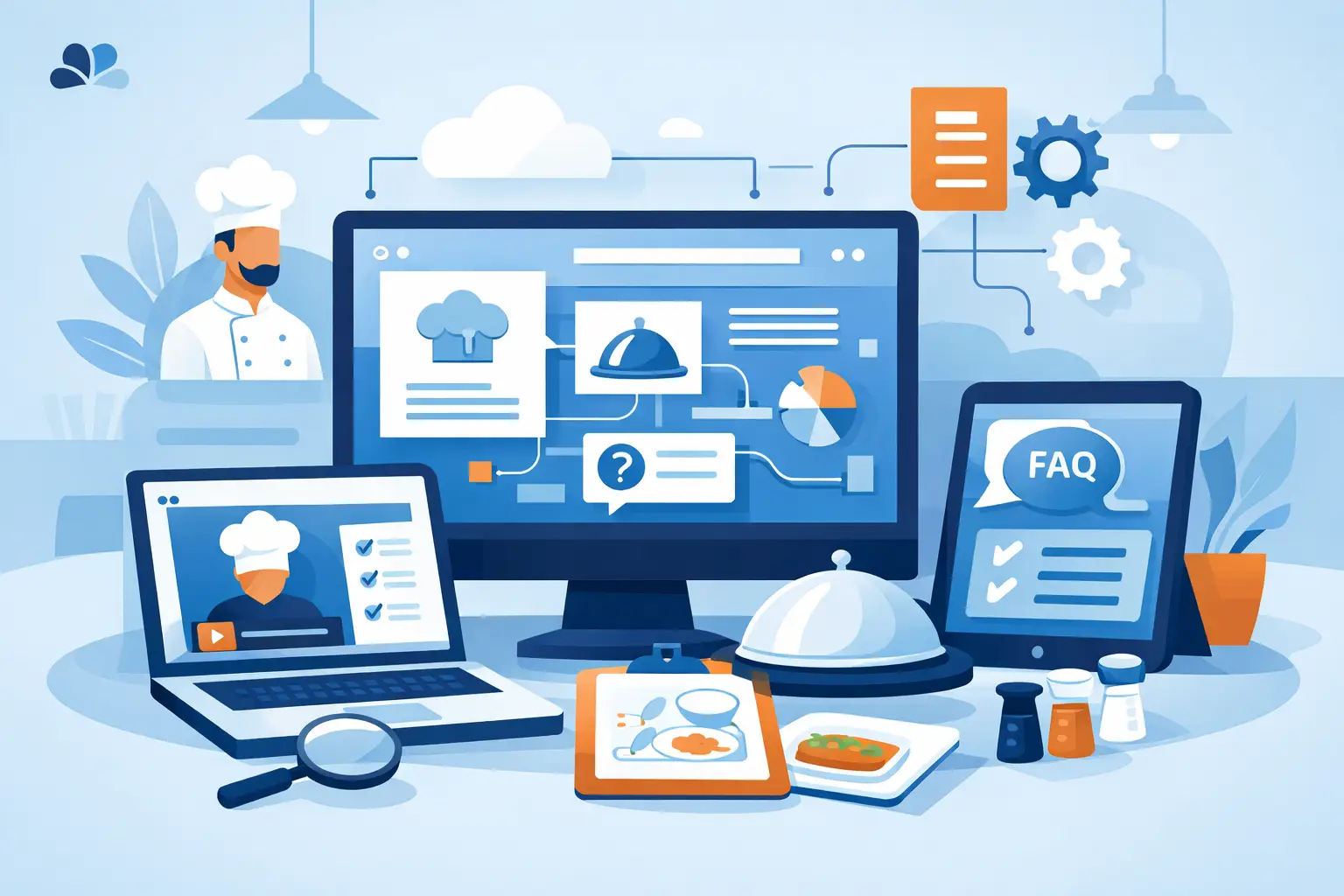
A server gets hit with a six-top at 7:12 p.m. One guest asks about dairy in the sauce, another wants a wine pairing, and a third asks whether the prix fixe can be modified for gluten sensitivity. If your answer still depends on finding the one manager who knows, your operation does not have a staffing problem. It has a knowledge delivery problem. That is exactly why the search for the best restaurant knowledge base software matters.
In restaurants, hotels, bars, banquets, and room service, knowledge is not a document problem. It is a speed, consistency, and risk problem. Teams need the right answer in the moment, under pressure, across languages, across shifts, and across outlets. When that does not happen, the cost shows up fast - lost upsells, broken service confidence, allergen exposure, comped dishes, uneven training, and managers spending half their shift repeating information that should already be systemized.
What makes the best restaurant knowledge base software different
A generic knowledge base can store files. That is not enough for hospitality. The best restaurant knowledge base software has to operate like part of service, not like a back-office archive.
That means speed matters more than storage. Staff should be able to find an answer in seconds, not click through folders full of PDFs. Search has to work the way restaurant employees think and ask questions. "Does the sea bass have nuts?" should return a clear answer, not a training manual. "What do I recommend with the ribeye?" should lead to pairings, modifiers, and selling language that can actually be used on the floor.
It also means content has to be operational, not academic. Teams do not need long policy language when the bar is four deep or a banquet captain is resetting a room. They need clean, verified answers tied to menu items, SOPs, service standards, opening checks, and brand expectations.
The final difference is accountability. If leaders cannot see what staff are searching for, what they are missing, or where knowledge gaps keep repeating, the system becomes passive. Good hospitality software should expose patterns managers can act on.
The real buying question is not software quality alone
Most buyers start by asking which platform has the best features. That is reasonable, but it is not the full decision. The better question is whether the software closes the operational gaps that hurt performance.
A restaurant group with high menu complexity may need stronger dish-level knowledge support than a casual concept with limited SKUs. A hotel F&B division may need one system that can support fine dining, banquets, room service, lobby bar, and pool operations without creating five separate training universes. A multi-unit operator may care less about beautiful content libraries and more about whether a platform can enforce standard answers across locations while still allowing outlet-level variation.
This is where many tools fall short. They are designed as broad HR systems, corporate wikis, or LMS products, then pushed into restaurant use. They can hold information, but they are not built around pre-shift urgency, live service questions, compliance friction, and multilingual staff turnover.
Features that actually matter on the floor
If you are evaluating the best restaurant knowledge base software, focus on what changes execution.
First, the system should deliver instant, role-specific answers. A bartender, banquet server, room service attendant, and food runner do not need the same level of detail. The right platform should surface the right information for the role and context, not overwhelm the team with everything at once.
Second, it should connect knowledge with training. A knowledge base that only answers questions is useful, but limited. The stronger model ties those answers into onboarding, quizzes, briefings, and repeat reinforcement so staff are not just retrieving information - they are retaining it.
Third, it should support compliance-sensitive content with tight control. Allergens, ingredients, modifiers, alcohol policy, and service recovery standards cannot live in old documents that may or may not be current. Version control and centralized updates are not nice to have when guest safety is on the line.
Fourth, managers need visibility. If ten people in one week searched for the same dish and still sold it poorly, that is not a staff issue alone. It is a leadership signal. The software should show weak spots by topic, outlet, and team so coaching becomes targeted instead of reactive.
Finally, it should fit hospitality workflows. Pre-shift briefings, checklists, SOP reinforcement, and audit readiness all intersect with knowledge. If the platform treats them as separate worlds, managers end up stitching together multiple tools and the team gets fragmented communication.
Best restaurant knowledge base software vs generic tools
There is a reason operators get frustrated after buying general-purpose software. Generic tools often look capable in demos because they check standard boxes - document hosting, search, permissions, maybe a training module. But hospitality is not a standard environment.
In a restaurant, information expires quickly. Menus change, features rotate, vendors shift, allergens need updates, and service standards evolve by outlet and meal period. A static wiki becomes stale fast unless it is built for frequent operational use.
There is also a difference between storing knowledge and driving performance. A generic platform may tell you where a file lives. It usually will not tell you whether your team understands the menu, whether managers are reinforcing the right points, or whether repeated confusion is creating revenue leakage at the table.
For restaurant leaders, that distinction matters. The best restaurant knowledge base software should not only reduce repetitive questions. It should improve service confidence, speed up onboarding, tighten compliance discipline, and increase consistency between your strongest manager and your weakest shift.
Where ROI shows up first
Buyers often expect value to show up in labor efficiency, and it does. Managers spend less time answering the same questions and retraining basics. New hires ramp faster. Cross-training becomes easier. Those are real gains.
But in many operations, the first meaningful ROI appears somewhere else.
It shows up in upselling. When servers know what they are selling and can speak confidently about ingredients, pairings, add-ons, and guest objections, average check moves.
It shows up in risk reduction. A team that can verify allergen and ingredient information quickly is less likely to improvise, guess, or give a dangerous answer under pressure.
It shows up in consistency. Guests may forgive a busy room. They do not forget when one server sounds informed and another sounds unsure about the same menu.
And it shows up in management discipline. When leaders can see what the team does not know, they stop managing by anecdote and start managing by evidence.
How to evaluate vendors without getting distracted
The cleanest buying process is to start with three questions.
What knowledge failures are costing us money or creating risk right now? How fast can this system be used during actual service? And can leadership see whether adoption is translating into better performance?
Those questions cut through polished sales language quickly. A platform may have attractive interfaces and broad functionality, but if staff cannot use it under pressure, or if managers cannot extract operational insight, it will become another underused system.
Ask to see how the software handles a live menu question, an allergen query, a pre-shift update, a training follow-up, and a manager review of team knowledge gaps. That sequence reveals far more than a general tour of features.
It is also worth looking hard at implementation effort. Some tools require so much manual setup that momentum dies before the system creates value. Others are easier to launch but too shallow to support serious hospitality standards. The right answer depends on the complexity of your business, but speed to adoption should be part of the evaluation, not an afterthought.
A purpose-built hospitality system usually wins
For independent restaurants with simple operations, a lightweight tool may be enough for a period of time. If your menu is stable, your management bench is strong, and training is highly hands-on, you can sometimes get by with basic systems.
But once you are dealing with multiple outlets, luxury service expectations, banquets, room service, multilingual teams, or audit pressure, the economics change. Knowledge stops being a side function and becomes part of the operating core.
That is why purpose-built hospitality platforms tend to outperform generic software in serious F&B environments. They are designed around the actual points of failure: inconsistent answers, weak onboarding, poor shift-to-shift visibility, and frontline uncertainty that quietly damages revenue and guest trust. SmartHospitality.AI is positioned in that category - not as a document repository, but as operating intelligence for teams that need knowledge, training, execution, and manager visibility working together.
The best software choice is the one that makes your operation calmer at 7:12 p.m., not just more organized on paper. If the system helps staff answer with confidence, managers coach with precision, and leaders spot risk before the guest does, you are not buying a knowledge base. You are buying control where hospitality performance is usually won or lost.