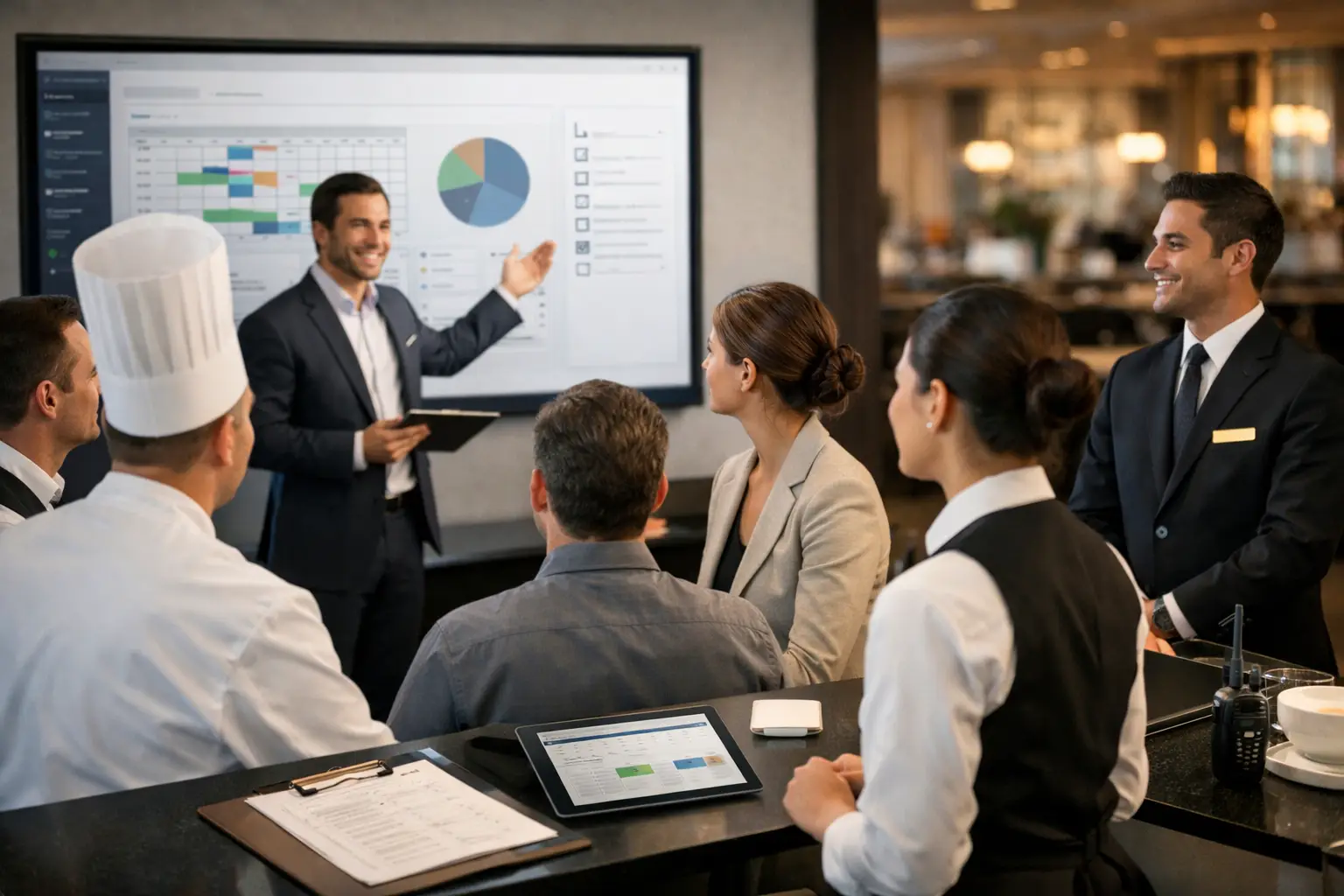
The best pre service briefing templates do more than give managers a place to write announcements. They turn the 10 minutes before doors open into a control point for revenue, allergen safety, guest recovery, and service consistency. Without that structure, a busy team starts service with partial information: one server knows the VIP note, another has heard about the 86 list, and nobody is fully certain which dish has changed.
For a single restaurant, that creates avoidable friction. Across a hotel, resort, cruise operation, or multi-unit group, it becomes a management blind spot. A useful briefing template gives every outlet the same operating rhythm while leaving room for the realities of that day’s business.
What makes a pre-service briefing worth the time?
The strongest briefing is not a reading of yesterday’s emails. It answers the questions staff will face on the floor: What is different today? What can create risk? What should we sell? Which guests require exceptional attention? And what does good execution look like in this service?
A manager who spends eight focused minutes aligning 20 colleagues can prevent a missed allergy declaration, a sold-out item being offered three times, or a high-value table receiving generic service. That is why the template needs a clear commercial and operational purpose, not just a signature line proving that a meeting occurred.
The right format depends on the operation. A 30-seat chef-driven restaurant may prioritize dish stories, pacing, and dietary detail. A 400-cover hotel breakfast operation needs staffing assignments, buffet standards, group movements, and guest complaints from the previous morning. The common discipline is the same: brief what changes behavior.
The 7 best pre service briefing templates
Each of the following templates serves a distinct service-floor need. They can be used independently, but mature operations usually combine several into one daily OI Briefing.
1. The daily service command briefing
Use this as the core template for every outlet and every shift. It establishes a single version of operational truth before service begins.
Include the date, shift, manager on duty, expected covers, reservations versus walk-ins, forecasted revenue, staffing gaps, weather or local events, and the service objective. Then record the 86 list, menu changes, equipment issues, and the one message every team member must retain.
For example: “Expected 180 covers, including a 40-person conference group at 7:00 p.m. Feature the grilled prawns as the preferred starter. Espresso machine two is offline. Maintain a 12-minute ticket-time target through the group arrival.”
This template is especially valuable when managers rotate, outlets share staff, or multiple departments affect the guest experience. It prevents information from remaining in one person’s notebook or memory.
2. The menu knowledge and upselling briefing
Many upselling targets fail because teams are told to “sell more” without being given the language, confidence, or product context to do it well. This template focuses the briefing on one or two commercially relevant products rather than trying to reteach the whole menu before every service.
Document the featured item, its ingredients, flavor profile, preparation, price, margin opportunity, recommended pairing, common guest question, and a natural selling phrase. The selling phrase matters because it bridges menu knowledge and live guest conversation.
A server should not need to invent the story at the table. For a seasonal cocktail, the briefing might state: “Recommend before ordering to guests who enjoy a dry, citrus-forward aperitif. Mention the house-infused grapefruit and rosemary. Pair with oysters or crudo.”
Track yesterday’s feature sales beside the day’s goal. That small feedback loop changes the briefing from an instruction into a revenue optimization habit.
3. The allergen and food safety briefing
Allergen safety cannot be treated as a generic reminder. “Be careful with allergies” is not a briefing standard. Teams need to know the specific risks, changes, escalation process, and responsible decision-maker for that shift.
This template should capture recipe or garnish changes, supplier substitutions, cross-contact risks, items that cannot be modified safely, equipment cleaning status, and the name of the chef or manager authorized to confirm special requests. Include one scenario question to check understanding, such as: “A guest with a shellfish allergy asks whether the fried calamari can be prepared separately. What is the correct response and escalation path?”
For hotel and resort operations, add banquet functions, children’s menus, room service, and buffet labeling where relevant. A properly run briefing reduces exposure because it makes food safety an active operational conversation, not a policy sitting in a folder.
4. The VIP, recovery, and guest intelligence briefing
Guest recognition is often lost in the handoff between reservations, front office, concierge, and the restaurant floor. This template brings the information into service without encouraging staff to over-script the guest experience.
Capture the guest name or table reference, occasion, preferences that are current and relevant, loyalty status where appropriate, previous service recovery notes, and the assigned owner. Keep the language discreet and practical. Staff need to know what action to take, not receive an unnecessary biography.
For instance: “Table 24: anniversary, returning guests, prefer a quiet location, previous concern about delayed mains. Floor manager to greet within two minutes; captain to confirm pacing after starters.”
The same template should identify at-risk situations. A delayed room, a reservation seating error, or a complaint from breakfast should never be rediscovered by an uninformed evening team. Guest recovery works best when it is deliberate, visible, and assigned.
5. The standards and service moment briefing
When standards decline, managers often respond with broad statements such as “focus on service” or “pay attention to details.” This template replaces vague direction with one observable service moment.
Choose a single standard for the shift: greeting time, chair placement, napkin handling, wine presentation, check-back timing, buffet replenishment, farewell language, or table reset. Define what good looks like, who owns it, and how supervisors will observe it.
A useful example is: “Tonight’s standard is first acknowledgment within 30 seconds, even when the host is occupied. Any team member may make eye contact, smile, and confirm that assistance is coming.” That instruction is specific enough to coach and audit.
Rotating one standard each day is more effective than delivering a long list that nobody can retain during a pressured service. Over time, this creates a measurable service culture rather than a collection of posters and policies.
6. The staffing, section, and handoff briefing
Service failures are frequently staffing design failures. The team may have enough people on paper, but the wrong experience mix in a high-volume section, no clear runner coverage, or unclear responsibility for a private event.
Use this template to map sections, stations, opening responsibilities, breaks, runners, bar support, host coverage, event ownership, and escalation contacts. Note trainees and pair them with a named coach rather than leaving them to learn in the busiest part of the room.
This is also where hotel restaurants should identify cross-department handoffs. If a group is arriving from a meeting room, who confirms the count? If room service is under pressure, who communicates realistic delivery times? If a guest requests a late breakfast after buffet close, who has authority to approve an alternative?
Clarity before the first order reduces repetitive manager questions during the rush.
7. The post-service learning loop template
Pre-service briefings improve quickly when they include evidence from the service before. This short template turns operational observations into tomorrow’s action rather than allowing the same issues to recur.
Record actual covers and revenue against forecast, feature sales, major guest feedback, allergy or food safety incidents, 86 issues, ticket-time pressure points, staffing constraints, and one lesson for the next shift. Keep it factual and brief.
A productive entry might read: “Friday dinner: 212 covers against 185 forecast. Feature sold 14, below goal of 25. Team introduced it too late in the conversation. Two guests asked for the unavailable halibut after menus had not been updated. Action: print replacement inserts before Saturday service and brief feature as an aperitif recommendation.”
This is where Hospitality Operational Intelligence becomes more valuable than a static document. Platforms such as SmartHospitality.AI can connect OI Briefings with SOP knowledge, outlet reporting, onboarding content, and manager visibility, so recurring issues become visible across shifts and properties. The objective is not more paperwork. It is faster operational learning.
How to keep briefing templates from becoming paperwork
A template fails when it is too long, too generic, or completed after the meeting. Managers should prepare it before the team arrives, use it as the structure for a live conversation, and confirm understanding through targeted questions. If the briefing takes more than 10 to 12 minutes every day, it is probably attempting to solve problems that belong in training, coaching, or a separate manager meeting.
Use consistent core fields across outlets so leadership can compare patterns, but allow limited outlet-specific sections. A lobby bar needs a different commercial focus from an all-day dining restaurant. Standardization should strengthen operational standards, not erase professional judgment.
Most importantly, review whether the briefing changed an outcome. Did the team sell the feature? Did the buffet stay within standard? Did the team correctly handle a dietary request? Did a known VIP receive the intended welcome? Those are the measures that justify the pre-service meeting.
A well-run briefing is the daily nervous system of hospitality operations: concise, current, and connected to the floor. Give managers a format that helps them lead the shift in front of them, then use what the shift teaches to make tomorrow’s service sharper.