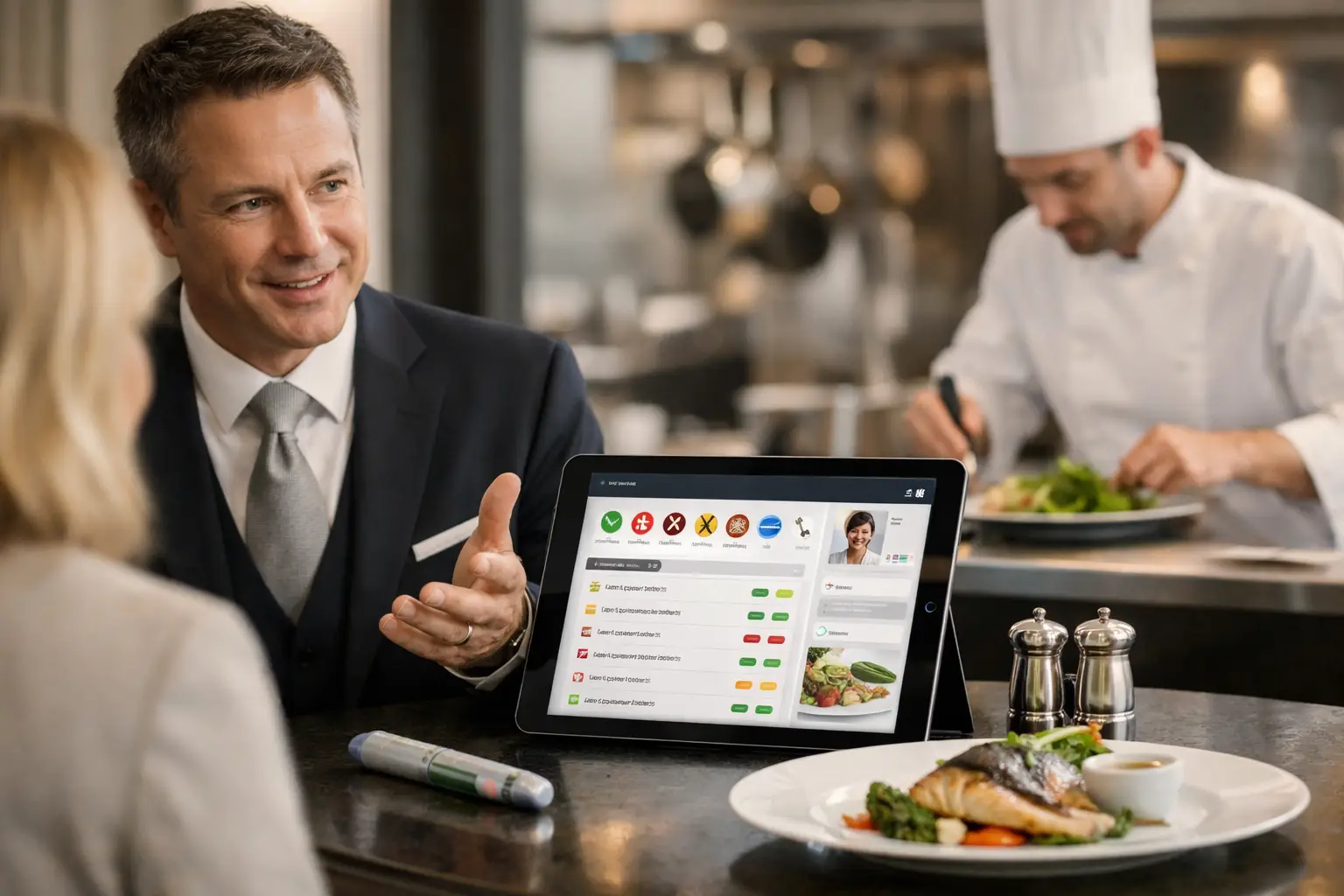
An allergy disclosure must remain attached to an order from the first conversation through kitchen verification, preparation and delivery. In a hotel, that process may cross a restaurant, central kitchen, banquet team and room-service shift. A menu symbol or POS flag is helpful, but neither carries the whole responsibility.
The top allergy communication systems combine controlled ingredient information with clear handoffs and a defined escalation route. The practical test is whether a new server can retrieve the current information, record the guest's request accurately and involve the authorised person when the answer is uncertain.
What Makes an Allergy Communication System Effective?
An allergy communication system is only as strong as its weakest handoff. A beautifully designed allergen matrix has limited value if a new server cannot find it during service. A point-of-sale alert is useful, but insufficient if the ticket does not tell the chef what safe modification is possible or whether cross-contact risk remains.
Effective systems create one controlled source of truth for ingredients, allergens, recipes, substitutions, and service protocols. They also make accountability visible. Leaders should be able to see whether teams have completed allergen briefings, understood updated menu information, and followed the escalation process when a guest’s request cannot be safely accommodated.
The operating standard is simple: staff must know what to say, what to record, who to notify, and when to stop and escalate. Any system that leaves one of those questions unclear creates exposure.
Communication systems to combine in your operation
There is no single best option for every operation. A 40-seat independent restaurant has different needs from a resort with six outlets, banqueting, room service, pool dining, and multilingual seasonal teams. The strongest approach is often a connected combination of the following systems.
1. Allergen Matrices and Controlled Recipe Specifications
A central allergen matrix remains the foundation. It maps every menu item against recognized allergens and should include recipe versions, garnishes, sauces, bases, and approved substitutions. It must be owned by culinary leadership and updated every time a supplier, recipe, or plating specification changes.
This system is highly effective for chef verification, menu development, and audit readiness. It gives the operation a factual reference point rather than relying on memory. Its weakness is accessibility. A spreadsheet in a manager’s inbox or a binder in the back office will not support a server facing a guest at 8:30 p.m.
For multi-outlet businesses, build matrix governance around version control. The breakfast menu, minibar selection, banquet menu, and rooftop bar menu all need their own current records. One outdated sauce specification can invalidate the confidence of the entire system.
2. Guest-Facing Menu Allergen Information
Printed menu symbols, digital menus, and allergen guides can help guests identify likely concerns before ordering. They reduce friction at the table and demonstrate that the operation takes dietary safety seriously.
But menu icons are an entry point, not a final answer. They often cannot account for cross-contact, supplier changes, special requests, or a dish that can be modified only under certain conditions. Staff should never interpret a symbol as permission to make assumptions.
The best guest-facing information uses clear language and directs the conversation toward verification. A guest who asks about a gluten-free item may also need information about preparation conditions and cross-contact. Staff should record the stated requirement and follow the approved escalation process without making medical judgments.
3. POS Allergy Alerts and Kitchen Ticket Flags
A properly configured POS can turn an allergy disclosure into an immediate, documented signal. When the server records the allergy, the order should visibly flag the requirement for the kitchen and, where appropriate, trigger a manager check. This reduces reliance on verbal relays that can be lost in a noisy dining room.
The trade-off is alert quality. If routine preferences and allergy disclosures look identical, critical information can become difficult to recognise. Operators need disciplined modifier design, with clear categories for allergy disclosures, intolerances, preferences and special preparation instructions. Record the guest's own description; staff should not decide medical severity or downgrade a declared allergy.
POS flags also need a service protocol behind them. The ticket should not simply state “ALLERGY.” It should direct the team toward confirmation: which allergen, which dish, what modification is requested, and what the authorised kitchen lead has verified about the preparation and its limitations. Clear ticket language protects speed as well as safety because it reduces back-and-forth during the busiest period of service.
4. Pre-Shift Allergy Briefings and Escalation Scripts
The most reliable communication still begins before the doors open. A short, focused pre-shift briefing can cover new menu items, ingredient substitutions, sold-out alternatives, known supplier changes, and any allergen-related guest notes for the day.
This is especially valuable in hotels, where staff may move between breakfast, lounge, banquet, in-room dining, and events. The same employee can encounter different menus and different preparation conditions in one shift. A consistent briefing process keeps allergen knowledge connected to the actual operation, not just a training record completed months earlier.
Teams also need an escalation script. For example, a server should know to thank the guest for sharing the allergy, avoid promising a dish is safe before verification, notify the manager or designated lead, and return only after the kitchen confirms the answer. This protects the guest and gives less experienced staff a professional, repeatable response.
Govern changes before they reach the guest
Maintain the connection between the recipe, current supplier specification and allergen record. Include sauces, garnishes, bought-in components, cooking media and approved substitutions. Similar product names do not establish that two products have the same ingredients.
Give each record an owner, version, approval date and outlet scope. A breakfast dish and a banquet dish with the same name may use different recipes. When a supplier substitute arrives, the responsible culinary or food-safety lead must review the information through the approved process before staff communicate an answer based on it. If information is missing or conflicting, pause the relevant use or claim and escalate.
The Food Standards Agency's allergen guidance covers England, Northern Ireland and Wales and stresses current ingredient records and management of cross-contamination. Its best-practice guidance for non-prepacked food recommends written information supported by a conversation. Other locations have their own requirements; confirm those that apply to your operation.
Close every handoff in the order journey
Use the property's approved allergen escalation process to define who owns each step. The message is not complete merely because it was sent. The next person must receive it, understand it and accept the action.
| Step | Operational control | | --- | --- | | Receive | Confirm the guest's stated allergen and request without diagnosing or minimising it | | Record | Use the approved allergy field or order process; check the correct guest and dish | | Escalate | Involve the designated manager and kitchen lead as required | | Verify | Check current approved ingredients and actual preparation conditions | | Decide | Communicate the verified option or the limitation honestly | | Prepare | Keep the instruction visible and apply approved preparation controls | | Release and deliver | Complete the required pass check and identify the correct guest | | Follow up | Record uncertainty, incidents and near misses for correction |
A simple repeat-back can catch a misunderstanding early: “To confirm, you have told me about a nut allergy. I will ask our designated kitchen lead to check this dish and its preparation before we confirm an option.” This acknowledges the request without promising a result before verification.
Do not replace an allergy declaration with an ordinary omission modifier. “No cheese” may describe a requested adjustment; it does not convey everything relevant to a stated milk allergy. Configure the ordering process so the kitchen receives the original requirement and any approved modification clearly.
At the pass, apply the property's release and identification procedure. If a garnish, plate or instruction does not match, pause delivery and involve the responsible lead. Do not improvise a correction and assume the original controls still hold.
Reduce dependence on memory and unclear modifiers
Repeated modifier errors deserve a process review. Compare guest wording, POS choices and kitchen-ticket language. A common request should have a clear structured option where practical, while unusual requests need an escalation route. Too many options can slow entry; too few push important detail into inconsistent free text.
Train the decision points as well as the buttons. Ask a server to demonstrate what happens if the guest changes a request after the order is sent, or if the POS option does not describe the declared allergen. Check that the amended instruction reaches the kitchen and that the earlier ticket cannot be mistaken for the current order.
Use pre-shift to cover actual changes: a new ingredient, an unavailable approved substitute, an event menu or the designated escalation lead. Ask a colleague to explain the next action, rather than treating silence as understanding. Include agency and relief staff who may know another outlet's process but not this one.
Ingredient information and preparation conditions are separate
An allergen absent from the recipe does not establish that the dish can be prepared without cross-contact. The responsible team must consider the actual kitchen setup and the approved controls, including equipment, utensils, storage, preparation surfaces and service handling. A menu description cannot verify those conditions.
Use only claims supported by the operation's approved controls and applicable requirements. If the kitchen cannot verify or accommodate the request, say so clearly. Do not pressure a colleague to give reassurance because the guest is important or service is busy. A vegan label also should not be treated as an automatic allergen-free assurance.
For buffets, check individual dish information and presentation after setup and replenishment. For banquets, connect the declared requirements with the event record and the actual guest at delivery. For room service, keep the instruction through tray assembly, transport and handover. Each format needs controls appropriate to its own risks.
Test the whole process and learn from near misses
Run realistic scenarios: a late disclosure, an unclear supplier label, a changed garnish, an incorrect modifier and an allergy-marked order handed to a runner unfamiliar with the table. Observe where the process pauses correctly and where somebody assumes another colleague has checked.
Record a recovered error even when the plate never reaches the guest. Identify whether the cause was information quality, order capture, kitchen interpretation, preparation or release. Assign a corrective-action owner and verify the change in a later scenario or observation. A rising number of reported near misses can reflect better reporting, so interpret the count alongside what happened and how the team responded.
Keep the approved emergency-response procedure accessible and train the responsible roles before an incident. If a guest reports symptoms, activate that procedure and seek emergency assistance as required. Employees should not improvise medical advice or wait to establish blame before escalating.
Technology can retrieve approved records and route uncertainty, but it should never invent an allergen answer, infer suitability from missing information or authorise a safety decision. Evaluate whether it exposes the source and version, handles missing information clearly and directs staff to the designated human authority.
SmartHospitality Operational Intelligence (OI) can connect approved menu knowledge, onboarding, briefings and manager reporting around this workflow. Used within clear culinary and food-safety authority, it helps teams find verified information and identify recurring gaps without replacing the people responsible for the decision.