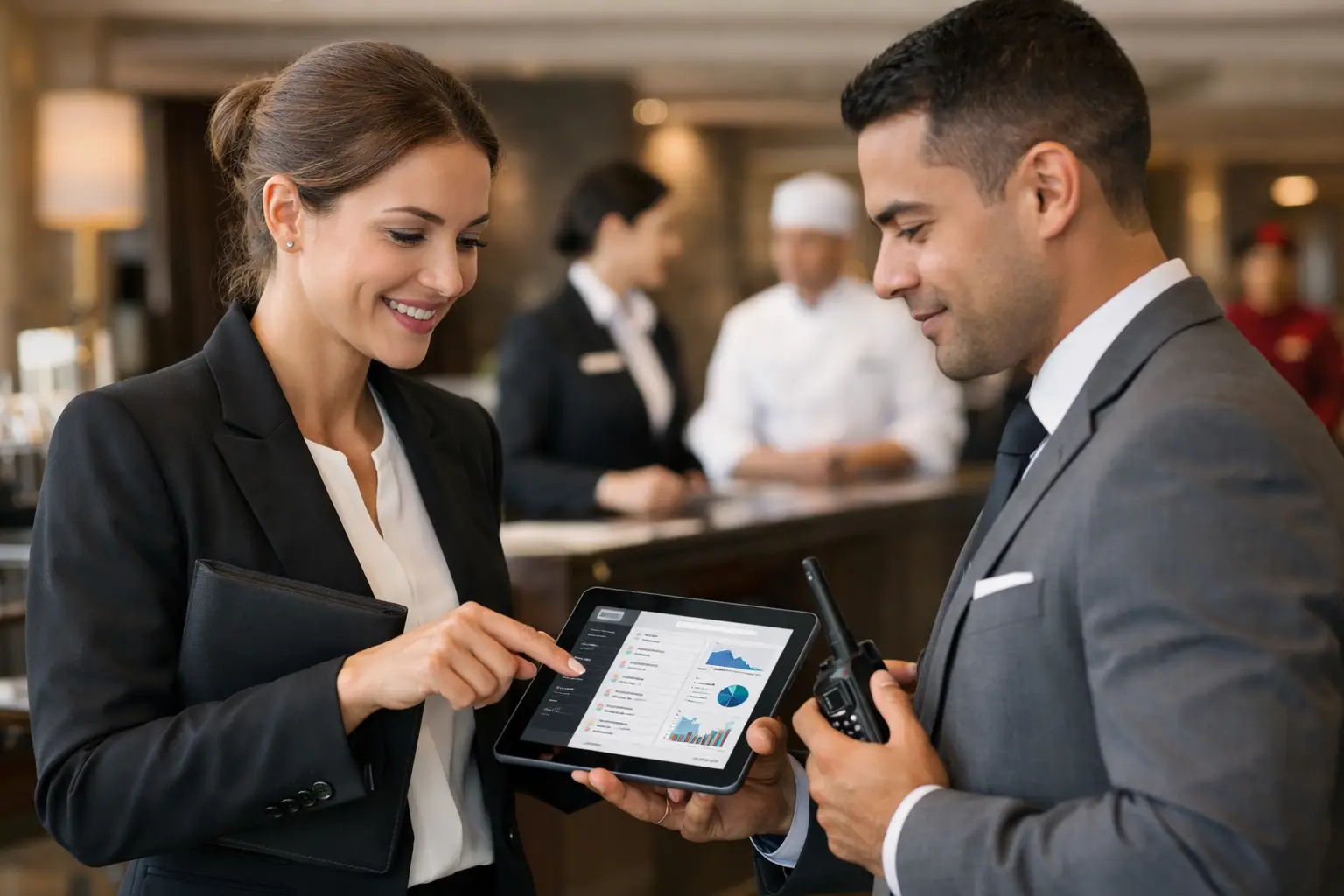
A guest should never have to repeat a complaint because the evening team did not tell the morning team what happened. Yet this is exactly how small handover failures become recovery costs, negative reviews, lost covers, allergen exposure, and frustrated managers.
Knowing how to standardize shift handovers is not about adding another form at the end of a demanding shift. It is about creating a dependable operating rhythm: the right information reaches the right person, in a consistent format, early enough for action. For a hotel, restaurant group, resort, or cruise operation, that rhythm protects the guest experience while giving leaders a clearer view of what is actually happening on the floor.
Why informal handovers create operational risk
Many hospitality teams rely on a verbal exchange, a notebook behind reception, a group message, or the departing supervisor's memory. These methods can work when a single experienced manager oversees a stable team. They break down quickly across multiple shifts, outlets, languages, seasonal staffing patterns, and high-volume service periods.
The issue is not that teams do not communicate. The issue is that they communicate inconsistently. One supervisor mentions a VIP arrival and skips the room move that still needs approval. A server flags an allergy concern verbally but no one records the corrective action. A restaurant manager says a private event had slow drink service, but the next manager receives no detail on the cause, the guest recovery offered, or the staffing adjustment needed tomorrow.
Those gaps create three direct business costs. First, they weaken service consistency because the incoming team starts from partial knowledge. Second, they create compliance exposure when food safety, cash, security, maintenance, or incident information is not documented and assigned. Third, they obscure patterns from operational leadership. If the same issue appears on five handovers but lives in five separate conversations, it is not visible as a trend.
A standardized handover turns dispersed operational information into usable Operating Intelligence. It gives teams continuity during service and gives leaders evidence for better decisions.
Start with the decisions the next shift must make
The most common mistake is building a handover around everything that happened. That produces long notes, low completion rates, and little accountability. A strong handover is built around what the incoming shift needs to know, decide, own, or escalate.
Ask each department head a simple question: what information, if missed, would damage the next shift's guest experience, revenue, safety, or readiness? The answer will differ by operation.
Front office may need unresolved guest concerns, room status exceptions, early arrivals, late departures, VIP preferences, transport arrangements, payment issues, and maintenance disruptions. Restaurant teams may need reservation changes, large-party notes, 86 items, menu substitutions, allergen incidents, guest recovery actions, equipment faults, stock pressure, and expected covers. Housekeeping may need priority rooms, out-of-order inventory, lost property, deep-cleaning requirements, and quality defects.
Do not force every department into identical fields. Standardize the structure and accountability, then allow relevant operational detail by function. A concierge handover should not read like a banqueting handover. Both, however, should show what happened, what remains open, who owns the next action, and when it must be completed.
Define one handover standard across the operation
A handover standard should be short enough to use during a busy close and detailed enough to prevent ambiguity. It needs a fixed submission time, a named sender and receiver, a channel that the team can reliably access, and a clear escalation path.
For most hospitality operations, every handover should capture at least these six elements:
- Shift context: date, outlet or department, shift lead, staffing exceptions, volume, and any material service conditions.
- Guest priorities: unresolved complaints, VIPs, special requests, recovery commitments, and promised follow-up times.
- Safety and compliance: allergies, incidents, cash discrepancies, security concerns, sanitation issues, and required reporting.
- Service and revenue: covers, occupancy pressure, upselling opportunities, group activity, service bottlenecks, and stock constraints.
- Open actions: the task, named owner, deadline, and status.
- Escalations and lessons: matters requiring management attention and repeat issues that should change tomorrow's briefing or procedure.
The decisive field is ownership. “Follow up with guest” is not a handover. “Front office manager to call Mr. Chen in room 814 by 9:30 a.m. regarding minibar charge, with authorization to remove disputed item if required” is actionable. It gives the receiving team a commitment they can execute and a manager a record they can review.
Make the handover a two-way control point
A handover is incomplete when it is submitted. It is complete when the incoming lead has reviewed it, accepted the open actions, and asked the questions that prevent a surprise later in the shift.
Where schedules overlap, protect 10 to 15 minutes for a live handover between shift leaders. This is particularly valuable at front desk, room service, banqueting, bars, security, and high-volume restaurant operations. The written record preserves accuracy; the conversation provides context, urgency, and judgment.
Where teams cannot overlap, such as overnight operations or geographically distributed outlets, use a documented acknowledgment process. The incoming supervisor should confirm receipt and flag any unclear items before taking full control of the shift. This creates accountability without turning managers into administrators.
The handover should also feed the pre-shift briefing. If the prior shift reports repeated confusion over a tasting-menu modifier, the next team needs a concise service briefing before doors open. If the breakfast team reports three guests waiting too long for coffee, the lunch manager needs to adjust station coverage, not simply record another complaint.
Build exception-based reporting, not a diary
Teams disengage from handovers when they are asked to report a normal shift in excessive detail. The standard should focus attention on exceptions, risks, and opportunities.
A quiet dinner service with no outstanding concerns may require only a short update. A high-pressure evening involving a sold-out dining room, two allergy-related modifications, a delayed supplier delivery, and a dissatisfied suite guest requires a fuller record. The format should expand when operational complexity rises, not because the template demands empty commentary.
This is where Hospitality Operational Intelligence has an advantage over disconnected notes and static documents. OI Briefings can bring forward relevant knowledge, while OI Reports can show whether an issue is isolated or recurring across days, outlets, or properties. The technology is not the handover itself. It is the operational layer that makes the information usable beyond one shift.
SmartHospitality.AI is designed around this principle: staff knowledge, operating standards, briefings, manager visibility, and decision support should connect. For a multi-outlet operation, that means a recurring wine availability issue, a recurring allergen question, or a recurring late check-in complaint can be recognized as an operational pattern rather than accepted as daily noise.
Train for judgment, then audit for quality
A template alone will not improve handovers. Team members need to understand what belongs in one and why. During onboarding, use real scenarios from the operation: a guest whose birthday amenity was missed, an unresolved card authorization, a broken glasswasher before peak service, or a guest with a severe nut allergy whose menu modifications need confirmation.
Ask new supervisors to write the handover entry, then assess it against three questions: Can the next person understand the situation? Is there a named owner and deadline? Would a manager have enough evidence to confirm the issue was handled correctly?
Managers should review handover quality routinely, but selectively. A daily review may be necessary in a newly opened property, a seasonal resort, or an operation under audit pressure. Mature teams may use weekly sampling combined with reviews of serious incidents and recurring themes. The goal is not to police writing. It is to identify weak ownership, incomplete escalation, and standards that are no longer clear.
Measure the outcome, not just completion. Useful measures include acknowledgment rates, overdue action items, repeated guest issues, unresolved maintenance carryovers, allergen-related exceptions, and the time taken to close service recovery cases. If handovers are completed at 100 percent but the same complaints keep appearing, the process is producing records rather than operational control.
Standardize the cadence, not every conversation
The best handover system is disciplined without becoming rigid. A luxury hotel may need a detailed front office handover because every guest preference and recovery decision carries brand consequences. A quick-service multi-unit restaurant may need a leaner model focused on labor, cash, equipment, inventory, and local guest issues. Banqueting teams need event-specific handovers that follow the lifecycle from setup to service to breakdown and billing.
Set a non-negotiable cadence: when the handover is completed, when it is reviewed, which issues must be escalated immediately, and how open actions are closed. Then tailor the content to operational reality. That balance is what enables adoption.
When the next shift walks in already informed, ownership is clear, and recurring issues are visible to leadership, handovers stop being a closing chore. They become part of the daily nervous system of operational excellence.