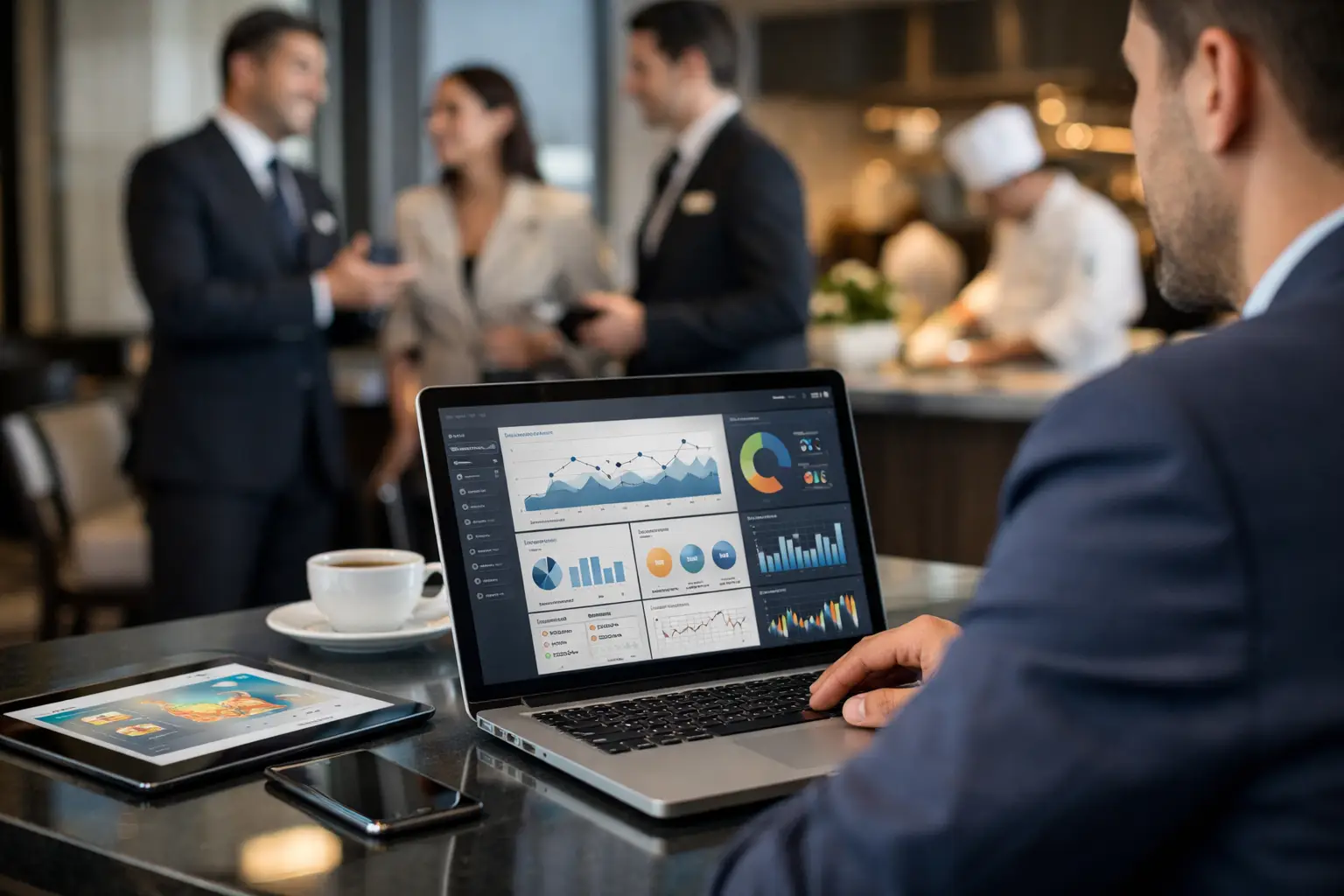
Friday at 7:30 p.m., the dining room is full, a guest asks about a menu allergen, a new server hesitates on a wine pairing, and a manager is already tied up fixing a missed pre-shift detail. That is where the question of what is hospitality intelligence stops being theoretical. In real operations, it is the difference between a team that performs under pressure and one that leaks revenue, confidence, and guest trust.
Hospitality intelligence is the operating layer that turns daily service data, staff knowledge, training standards, and execution signals into practical management control. It helps operators see what teams know, what they are missing, where service risk is building, and where performance can be improved before problems hit the guest.
That definition matters because many operators hear the word intelligence and think dashboards, market trends, or BI tools. Those have value, but they only cover part of the picture. In hospitality, intelligence has to live much closer to the floor. It has to show whether the team can answer menu questions correctly, execute standards consistently, complete critical checks, and carry brand expectations through every shift.
What is hospitality intelligence in practice?
In practice, hospitality intelligence is a system for operational awareness. It connects the parts of the business that usually sit in separate places - onboarding, SOPs, training, pre-shift communication, checklists, compliance routines, and manager oversight - and turns them into one usable view of readiness.
For an owner or general manager, that means less guessing. You are not relying on whether a supervisor says the team is ready. You can see whether staff completed required training, where knowledge gaps are recurring, whether pre-shift priorities were understood, and which outlets or managers are drifting from standard.
For an F&B director, it means being able to track performance in the areas that quietly move margin. Are servers confidently upselling high-contribution items? Are menu descriptions accurate? Are new hires getting to productive speed quickly, or are experienced staff carrying the floor while training happens informally? Are audit-related tasks actually being completed, or just assumed?
That is why hospitality intelligence is not just reporting. It is decision support for live operations.
Why the old way breaks down
Most service teams are still managed through a patchwork of documents, messaging apps, binders, memory, and manager follow-up. That approach can survive in a stable operation with low turnover and a highly experienced team. In most hospitality environments, that is not reality.
Multi-outlet hotels, fine dining restaurants, banquets, bars, and room service teams deal with constant change. Menus update. Promotions rotate. Staff mix shifts by daypart. Temporary workers come in. Language differences create uneven understanding. Managers spend hours answering the same questions because the knowledge never becomes operationally accessible.
The cost is not always obvious on a P&L line. It shows up as missed bottle sales because the server lacked confidence, a comp because an expectation was mishandled, slower table turns because someone had to find a manager, or an allergen near-miss because the answer was guessed instead of verified. It also shows up in labor waste when strong managers spend their shift repeating information instead of leading the floor.
Without hospitality intelligence, operators often discover problems after the fact. A guest complaint exposes a training failure. An audit reveals checklist drift. A weak sales week uncovers uneven team knowledge. By then, the damage has already been done.
The core components of hospitality intelligence
A useful hospitality intelligence framework usually combines several operational signals.
The first is staff knowledge visibility. Managers need to know what employees actually understand about menus, modifiers, allergens, pairings, service steps, and house standards. Not what was distributed. Not what was trained once. What is retained and usable in service.
The second is onboarding and training control. High-turnover environments cannot afford slow ramp-up or inconsistent coaching. Intelligence means seeing where onboarding is incomplete, which topics create repeat confusion, and how quickly new hires are becoming floor-ready.
The third is shift execution. Pre-shift briefings, opening duties, side work, and compliance checks should not exist as isolated routines. They should create a signal. If an outlet repeatedly misses certain checks or managers are uneven in execution, leadership needs that visibility quickly.
The fourth is audit readiness. In hospitality, compliance is not a paper exercise. Food safety, allergen discipline, brand standards, and documented procedures all carry operational and reputational risk. Intelligence helps operators spot weak points before an inspection, incident, or guest complaint forces the issue.
The fifth is manager performance visibility. Strong operations do not just measure frontline staff. They measure whether managers are actually driving readiness, following through, and maintaining standards across shifts.
When those signals are connected, leadership gains a much clearer picture of operational health.
What hospitality intelligence is not
It is not a generic learning management system. Most LMS platforms can store training content, but they are not built around live service realities, floor communication, outlet-specific execution, or audit pressure.
It is not just a checklist app. Checklists can confirm that a task was marked complete, but they do not tell you whether staff knew why the task mattered, whether recurring knowledge gaps are putting service at risk, or whether managers are coaching effectively.
It is also not traditional business intelligence alone. Revenue dashboards can tell you what happened. Hospitality intelligence should help explain why it happened on the floor and what to correct before the next shift.
That distinction matters when operators evaluate systems. If the tool does not reduce repeated staff questions, improve readiness, and surface operational blind spots, it may be useful software, but it is not hospitality intelligence in the full sense.
Why it matters now
The pressure on hospitality teams is higher than it was even a few years ago. Guests expect accuracy, speed, personalization, and professionalism at once. Labor remains tight. Many teams are younger, less experienced, or more transient. At the same time, standards around allergens, food handling, and brand consistency have only become more serious.
That combination creates a management problem. Leaders cannot personally catch every gap in every outlet on every shift. They need a daily nervous system for the operation - something that tells them where the floor is strong, where it is exposed, and where intervention will have the biggest impact.
This is where the commercial value becomes clear. Better intelligence supports stronger upselling, faster onboarding, fewer preventable mistakes, better audit posture, and less manager firefighting. Not every operation will see the same gain in the same area. A luxury outlet may care most about service precision and guest confidence. A banquet-heavy property may value consistency across rotating teams. A multi-unit group may prioritize manager accountability and standardization. But in each case, the principle is the same: what leadership can see, leadership can improve.
How to tell if your operation needs hospitality intelligence
Most operators do not use that phrase when the pain first appears. They describe symptoms.
They say managers spend too much time answering repetitive questions. They say new hires take too long to get confident. They say standards are strong on some shifts and soft on others. They say upselling is inconsistent, audits create stress, or outlet leaders report readiness without much proof behind it.
If that sounds familiar, the issue is not just training. It is lack of operational visibility.
A healthy operation should be able to answer a few basic questions quickly. What does the team not know right now? Which outlet is slipping on execution? Are pre-shift priorities landing? Where is compliance exposure rising? Which managers are driving standards, and which are relying on personality and patchwork follow-up?
If those answers are hard to get, hospitality intelligence is likely the missing layer.
What good implementation looks like
The best implementations start with the highest-cost friction points, not with technology for its own sake. That usually means menu knowledge, allergen response, onboarding consistency, pre-shift communication, and checklist discipline.
From there, operators should connect intelligence to management routines. Data without action creates noise. Outlet leaders need clear review habits, escalation paths, and accountability standards. If one location has repeated knowledge gaps or weak audit routines, the system should make that visible early enough to correct it.
There is also a trade-off to manage. Too much measurement can create admin burden and staff fatigue. Too little leaves leaders blind. The right balance depends on service complexity, brand standards, and team turnover. Fine dining and luxury hotel environments often need more precision. Smaller independent concepts may need a lighter structure. The principle is the same either way: collect signals that improve execution, not data for its own sake.
Platforms built specifically for hospitality tend to perform better here because they reflect real service workflows. That operator-first design is why systems like SmartHospitality.AI are gaining attention. They are built around the pressure points leaders actually manage: knowledge gaps, shift readiness, compliance exposure, and manager visibility.
The real point of hospitality intelligence
The real point is not to create more reports. It is to create fewer preventable failures.
When a guest asks a question, when a server recommends a pairing, when a banquet team executes under time pressure, when an inspector walks in, when a manager hands over to the next shift - those moments reveal whether the operation is truly under control. Hospitality intelligence gives leadership a way to see and shape those moments before they become costly.
Strong hospitality has always depended on standards, judgment, and disciplined execution. What has changed is the scale and speed at which operators are expected to deliver them. The teams that win are not simply working harder. They are running with clearer visibility, faster correction, and better control where it counts most.
For the operational framework, five pillars and maturity model, see what Operational Intelligence means in hospitality.