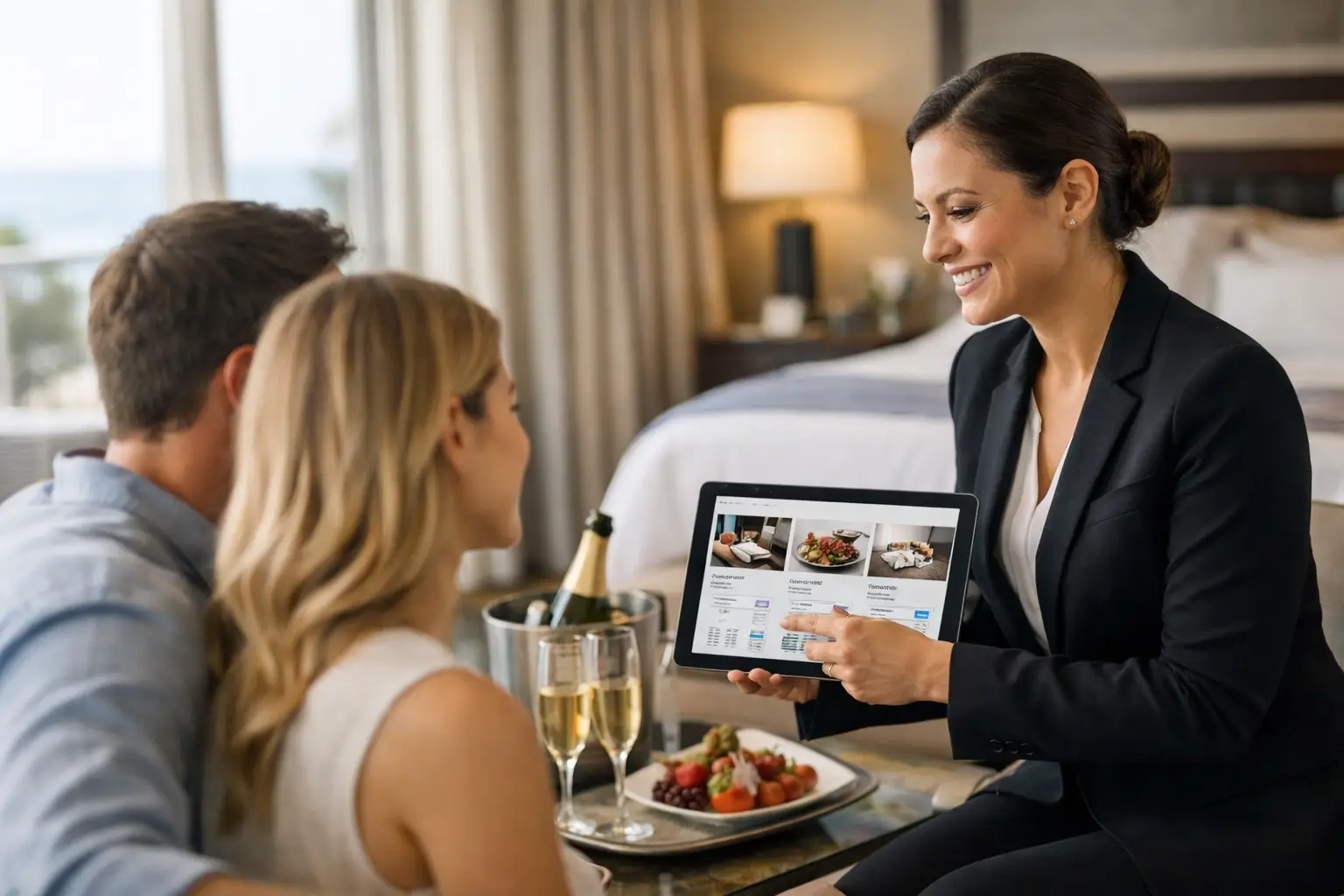
A guest checking in after a delayed flight does not want a sales pitch. They want speed, recognition, and a clear sense that the hotel understands their situation. Yet this is precisely where revenue is often lost: the front desk knows an upgrade is available, but lacks the guest context, confidence, or language to present it well.
Learning how to improve hotel upselling is not about asking teams to sell harder. It is about giving them the operational knowledge to make relevant recommendations at the right moment, with the confidence that comes from clear standards and current information. When that capability is inconsistent, hotels leave ancillary revenue on the table while placing more pressure on already busy teams.
Hotel upselling is an operational discipline
Upselling is often treated as a front-office metric. In reality, it is the outcome of connected hotel operations. Reservations, front desk, housekeeping, concierge, restaurants, spa, and room service all influence whether a guest sees value in an upgrade or an additional purchase.
Consider a simple scenario. A couple arrives for a weekend stay and has booked a standard room. The front desk agent can see a suite is available, but does not know whether the suite includes a terrace, whether late checkout is possible, or which restaurant service would best fit the guests' arrival time. Rather than risk giving incomplete information, the agent says nothing. The opportunity disappears.
That is not a motivation problem. It is a knowledge management problem.
The strongest upselling cultures make useful information available at the point of service. They define what each offer includes, who it suits, when it can be offered, how it should be priced, and where the operational limits sit. Staff do not need a long sales script. They need the confidence to connect a genuine guest need to a relevant option.
Start with revenue leakage, not sales targets
A higher upsell target may create activity, but it does not necessarily create better guest experience or sustainable revenue. Before setting targets, leadership should identify where the revenue leakage occurs.
Is the hotel failing to offer room upgrades? Are agents offering them too late? Are spa appointments going unused because teams do not know current availability? Is the restaurant losing covers because arrivals are not being directed toward the right dining option? Are package inclusions so unclear that staff avoid discussing them?
These questions require manager visibility across departments, not a monthly total from one report. A hotel may show acceptable upgrade revenue while still missing its most valuable opportunities: premium suites on low-demand nights, early-arrival spa bookings, private transfers, celebration packages, or incremental food and beverage spend.
A useful operating view separates four measures: offer rate, acceptance rate, average incremental value, and guest feedback. If the offer rate is low, the problem is usually knowledge, confidence, or workflow. If the offer rate is high but acceptance is low, the offer may be poorly matched, poorly timed, or poorly priced. If revenue rises while feedback falls, the hotel has crossed into pressure rather than service.
How to improve hotel upselling through guest relevance
The best hotel upsell answers a practical question the guest already has. Can I rest before my meeting? Is there somewhere suitable for dinner tonight? Can my family have more space? Can you make this anniversary feel special? Can I leave later tomorrow?
That means teams should be trained to recognize signals, not recite promotions. A business traveler arriving at 8:00 a.m. may value early access, breakfast, pressing, or a quiet workspace. A family may value connecting rooms, an extra bed, flexible dining, or pool access. A guest arriving after a long-haul flight may value a transfer, a spa treatment, or a room category with a better arrival experience.
Relevance also requires restraint. A room upgrade is not automatically appropriate for a guest who has clearly stated they are leaving early for an airport departure. A premium tasting menu may be a poor recommendation when a family needs a fast meal before bedtime. Service intelligence includes knowing when not to sell.
Give staff a reason, not a script
Scripts can help new team members begin a conversation, but they fail when every guest hears the same wording. Train teams on the reason behind the recommendation instead.
For example, instead of instructing agents to say, “Would you like to upgrade to a suite?” give them the operational context: “For guests arriving early after international travel, the suite category provides more space to settle in, a separate living area, and priority access when available.” The agent can then adapt the language naturally.
This approach matters particularly in luxury hospitality, where guests quickly recognize transactional language. The recommendation should sound like informed care, not a quota being met.
Build product knowledge that survives busy shifts
Most hotel teams have access to information somewhere. The issue is whether it is accurate, current, and usable during a live guest interaction. A static binder, a forgotten shared folder, or a briefing delivered three weeks ago does not support a busy arrival period.
Each revenue-driving offer should have a short, operationally clear knowledge standard. It should include the guest benefit, inclusions, exclusions, available dates or hours, price guidance, capacity limits, booking process, and escalation point. It should also explain service implications. If an upgrade includes lounge access, does the agent know its operating hours, dress expectations, family policy, and whether breakfast is included?
This is where Hospitality Operational Intelligence becomes commercially important. OI connects approved operational knowledge with onboarding, pre-shift briefings, manager guidance, and performance visibility. Rather than hoping every employee remembers a changing promotion or outlet detail, leaders can make the current recommendation logic part of the daily operating rhythm.
For a multi-property group, this is especially valuable. Corporate may set the commercial strategy, but each property must translate it into local room inventory, outlet capacity, seasonal experiences, and service standards. One message cannot simply be copied across every hotel.
Improve timing across the guest journey
The front desk is valuable, but it should not carry the entire upselling burden. Hotels that depend solely on check-in conversations limit both revenue and relevance.
Before arrival, reservations and guest relations can identify practical opportunities based on length of stay, party type, purpose of travel, and booked category. During arrival, front desk teams can address immediate needs such as room access, upgrades, transportation, breakfast, or dining. Once the guest is settled, concierge, housekeeping, spa, and food and beverage teams can make more specific recommendations based on observed preferences.
The trade-off is coordination. More touchpoints can create duplicate offers, contradictory information, or an experience that feels relentless. Operational standards should specify ownership. If the front desk has already discussed an upgrade, another colleague should not repeat it. If a guest declines a spa offer, that preference should be visible where appropriate.
A disciplined approach treats upselling as part of the guest journey, not a series of isolated sales attempts.
Make pre-shift briefings commercially useful
Pre-shift briefings are one of the most underused revenue tools in hotel operations. Too often, they are dominated by arrivals, VIPs, maintenance issues, and staffing gaps. Those topics matter, but commercial context should be equally practical.
A useful briefing identifies what is sellable today and why. It may note available suite categories, spa capacity after 3:00 p.m., an underbooked restaurant period, a weather-related alternative experience, or an event that affects access and demand. It should also clarify which offers are not appropriate because capacity is tight or delivery would compromise service.
The objective is not to turn every briefing into a sales meeting. It is to ensure staff can make promises the operation can keep. That protects guest trust and prevents the common failure where an employee sells an experience only for another department to explain that it is unavailable, restricted, or incorrectly described.
Coach behavior, not just results
Revenue reports tell managers what happened. They rarely explain why. A decline in upgrade conversion could reflect weak language, poor inventory, unclear pricing, low confidence among new hires, or a guest mix that does not fit the offer.
Managers need to observe the service behavior behind the number. Are team members asking one useful question before making a recommendation? Do they explain the benefit in guest terms? Do they check operational availability before confirming? Do they know when to stop?
Short coaching loops work better than quarterly reminders. Review one offer, one guest scenario, and one service standard during the shift. Recognize an employee who protected the guest experience by declining to oversell just as clearly as one who generated revenue. This establishes the right commercial culture: informed, ethical, and consistent.
SmartHospitality.AI supports this discipline as an Operational Intelligence platform by bringing OI Knowledge, OI Briefings, OI Recommendations, and OI Reports into one operating layer. Leaders can strengthen the connection between what teams are told, what they can access during service, and what managers can see across the property.
Protect the guest experience as the commercial standard
Upselling fails when leaders treat it as an extraction exercise. The immediate result may look positive, but repeat business, reputation, and staff confidence suffer when guests feel pushed into purchases they do not value.
The better standard is simple: would the guest understand why this recommendation was made for them? If the answer is yes, the offer is likely relevant. If the answer is no, more training or clearer operational guidance is needed.
Every well-timed recommendation is a test of operational excellence. Give teams current knowledge, clear boundaries, and the visibility to act with judgment, and hotel upselling becomes what it should be: a better stay for the guest and a healthier revenue line for the operation.