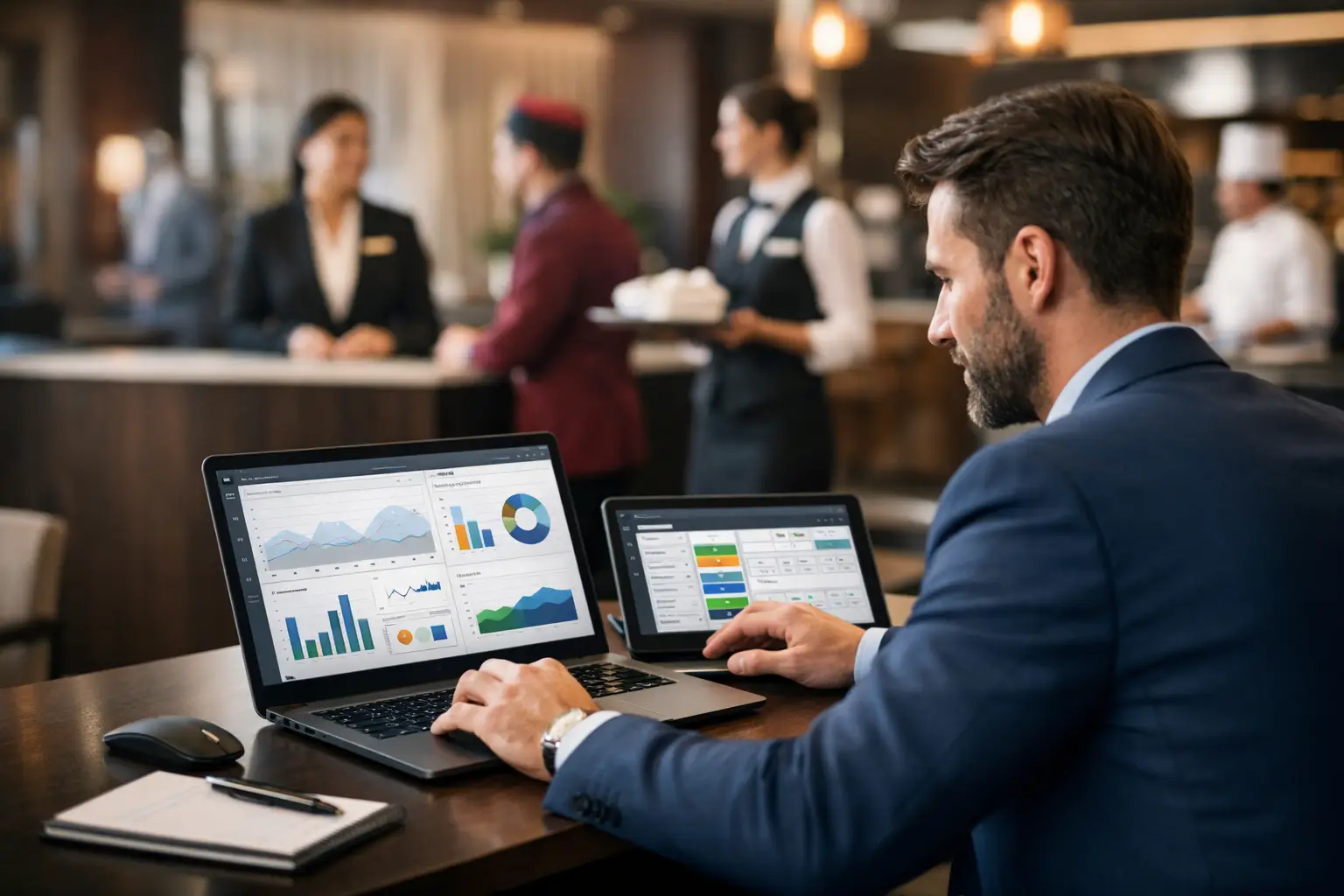
A hotel can have excellent brand standards, detailed SOPs and experienced managers, yet still lose revenue and guest confidence during a single busy service.
A bartender cannot explain a premium spirit, a server gives uncertain allergen guidance, or a new room service colleague misses an important recovery procedure. This is where hospitality software is truly judged: not by its feature list, but by whether it helps teams perform correctly when the operation is under pressure.
Traditional systems typically hold information in separate places. Training sits in one system, SOPs in another, daily updates arrive through chat groups, and reporting depends on managers chasing answers after service.
The result is a knowledge gap between what leadership expects and what frontline teams can confidently deliver.
Key takeaways
- Traditional hospitality software performs essential functions, but operational information often remains divided across different systems.
- Completing training or storing an SOP does not automatically mean employees are ready to apply it during service.
- Operational Intelligence connects approved knowledge, daily routines and operational signals to support better decisions.
- OI complements established systems such as PMS, POS, CRM, RMS and LMS rather than replacing them.
Why hospitality software often falls short
Hospitality software is a broad term covering different systems used across hotels and restaurants. A property management system manages reservations, rooms and guest stays. A point-of-sale system processes orders and payments. Revenue management software supports pricing decisions, while CRM platforms organize guest relationships and learning management systems record formal training.
These systems perform essential functions, but even an integrated technology stack may not create a clear picture of what employees currently know, where standards are weakening or what managers should address before the next service.
A checklist can confirm task completion, and a learning platform can record training activity, but neither result alone proves that a colleague is ready to apply the correct standard under operational pressure.
For a multi-outlet hotel or restaurant group, this gap can be expensive. Menu changes may reach some teams but not others. A new allergen procedure may be understood by the day shift and missed by the evening team. Managers spend valuable floor time answering the same questions about products, service steps and policies instead of coaching performance and protecting the guest experience.
The problem is not necessarily a lack of software or documentation. It is a lack of Operational Intelligence.
The missing layer between systems and execution
Hospitality organizations already have systems of record. What they often lack is a system that helps turn the information held across those systems into confident daily execution.
Hospitality Operational Intelligence connects the knowledge, routines and performance signals that shape the operating day. It gives leaders a practical way to turn standards into accessible guidance, structured learning, pre-shift priorities and visible areas requiring intervention.
OI does not need to replace the PMS, POS, CRM, RMS or other established platforms. Its purpose is to connect operational knowledge with the people expected to apply it.
This distinction matters. Storing a procedure is not the same as helping a colleague follow it. Recording that training was completed is not the same as knowing that the person is ready to apply that knowledge during service.
Hospitality software becomes more valuable when it closes the distance between information and action.
Hospitality software should support the operating moment
Consider a restaurant launching a revised tasting menu.
The operational requirement is not simply to upload the menu PDF. Teams need to understand the ingredients, preparation methods, allergens, pairing recommendations, pricing, guest-facing language and possible substitutions. Managers need confidence that this information has reached the right employees and that weak areas can be identified before a high-value dinner service.
An OI platform brings those needs into one operational flow. The Knowledge Library makes approved standards and answers easier to find. Role-specific Onboarding helps new colleagues build confidence faster. Pre-shift Briefings help managers prepare teams for the service ahead. OI Insights and Reports reveal recurring questions, readiness gaps and areas requiring management intervention.
In this model, the PMS remains responsible for reservations and rooms, the POS remains responsible for transactions, and the LMS retains formal learning records. OI does not duplicate their purpose. It connects the approved operational knowledge and relevant signals available to it so the next decision can be made with better context.
The technology may make information faster to retrieve and easier to personalize, but the real value remains operational: better decisions, stronger service consistency and fewer preventable failures.
The business case is built on avoided leakage
Hospitality leaders should evaluate operational technology against identifiable sources of leakage rather than relying on vague promises of efficiency.
In food and beverage, weak product knowledge can reduce upselling opportunities and average-check potential. In hotels, inconsistent handovers can lead to missed preferences, recovery costs and avoidable complaints. Across both environments, uncertain allergen communication creates a serious safety and compliance exposure.
There is also a management cost.
When every outlet leader repeatedly answers the same routine questions, follows up on the same knowledge gaps and manually assembles evidence for audits, leadership capacity is consumed by repetition.
This becomes particularly damaging in high-turnover environments, where new employees must begin contributing safely and confidently without placing additional pressure on already stretched managers.
The correct measure is not simply how many people log into a system. It is whether teams execute standards more reliably, managers identify risks earlier and leaders can act on evidence rather than anecdotes.
Completion does not always mean readiness
Many learning systems measure completion: whether an employee opened a module, watched a video or passed a short assessment.
That information is useful, but completion alone is limited evidence of operational readiness.
A colleague may complete training and still hesitate when explaining a dish to a guest. A manager may publish an update without knowing whether the evening team understood it. An SOP may be available somewhere in the organization while remaining difficult to find during an urgent operating situation.
Operational Intelligence connects learning with execution. It helps leaders see which questions repeatedly appear, where teams require reinforcement and whether briefings are addressing current commercial, service and compliance priorities.
This turns training from an isolated administrative activity into part of the daily operating system.
Audit readiness should be part of normal operations
An audit should not trigger a last-minute search for documents, training records and evidence of compliance.
When SOPs, learning evidence, operational updates and completed records are organized as part of everyday management practice, audit preparation becomes a continuous discipline rather than a periodic crisis.
The same structure that supports an audit can also support better daily management. Leaders gain clearer visibility of what has been communicated, what has been completed and where follow-up remains necessary.
What to look for in Hospitality Operational Intelligence
A useful platform should reflect the realities of hospitality operations:
- Multilingual and multicultural teams
- Multiple properties, outlets, departments and shifts
- Frequently changing menus, promotions and procedures
- Seasonal recruitment and employee turnover
- Demanding brand and compliance standards
- Limited preparation time before service
Critical knowledge should be available in context. Employees should not have to search through complex folders or wait for a manager to answer a routine operational question.
The platform should also respect organizational structure and access boundaries. The right information should reach the right colleague according to role, location and responsibility, while sensitive or controlled material remains protected.
Most importantly, the platform should connect knowledge, learning, communication and reporting. A collection of disconnected features will not create Operational Intelligence unless the information can form a useful picture of operational readiness and risk.
Frequently asked questions
What is hospitality software?
Hospitality software is a broad category of technology used to manage hotel and restaurant activities, including reservations, payments, pricing, guest relationships, workforce administration, training and daily operations.
Is Operational Intelligence the same as a PMS?
No. A property management system manages areas such as reservations, rooms, billing and guest stays. Operational Intelligence connects approved knowledge, operational context and frontline activity to help teams make better daily decisions.
Does Operational Intelligence replace existing hotel systems?
No. OI is designed to complement systems such as PMS, POS, CRM, RMS and LMS platforms. It helps close the gap between the information held by an organization and the way employees apply standards during operations.
What should hotels look for when selecting operational software?
Hotels should evaluate whether the software makes approved information easy to access, supports different roles and locations, protects controlled information, connects learning with execution and gives managers evidence they can act upon.
From hospitality software to Operational Intelligence
SmartHospitality.AI is built around this model: an Operational Intelligence layer for hospitality organizations that need to connect employee knowledge, onboarding, briefings, operational reporting and decision support.
Its purpose is not to replace experienced managers or automate management judgment. Hospitality remains a human business.
The purpose is to give operational leaders a clearer daily nervous system: one that helps protect standards, revenue, safety and guest trust while enabling employees to perform with greater confidence.
The next generation of hospitality software will not win simply because it provides another place to store information. It will earn its position by helping the right colleague apply the right standard at the exact moment service demands it.
That is the shift from hospitality software to Hospitality Operational Intelligence.