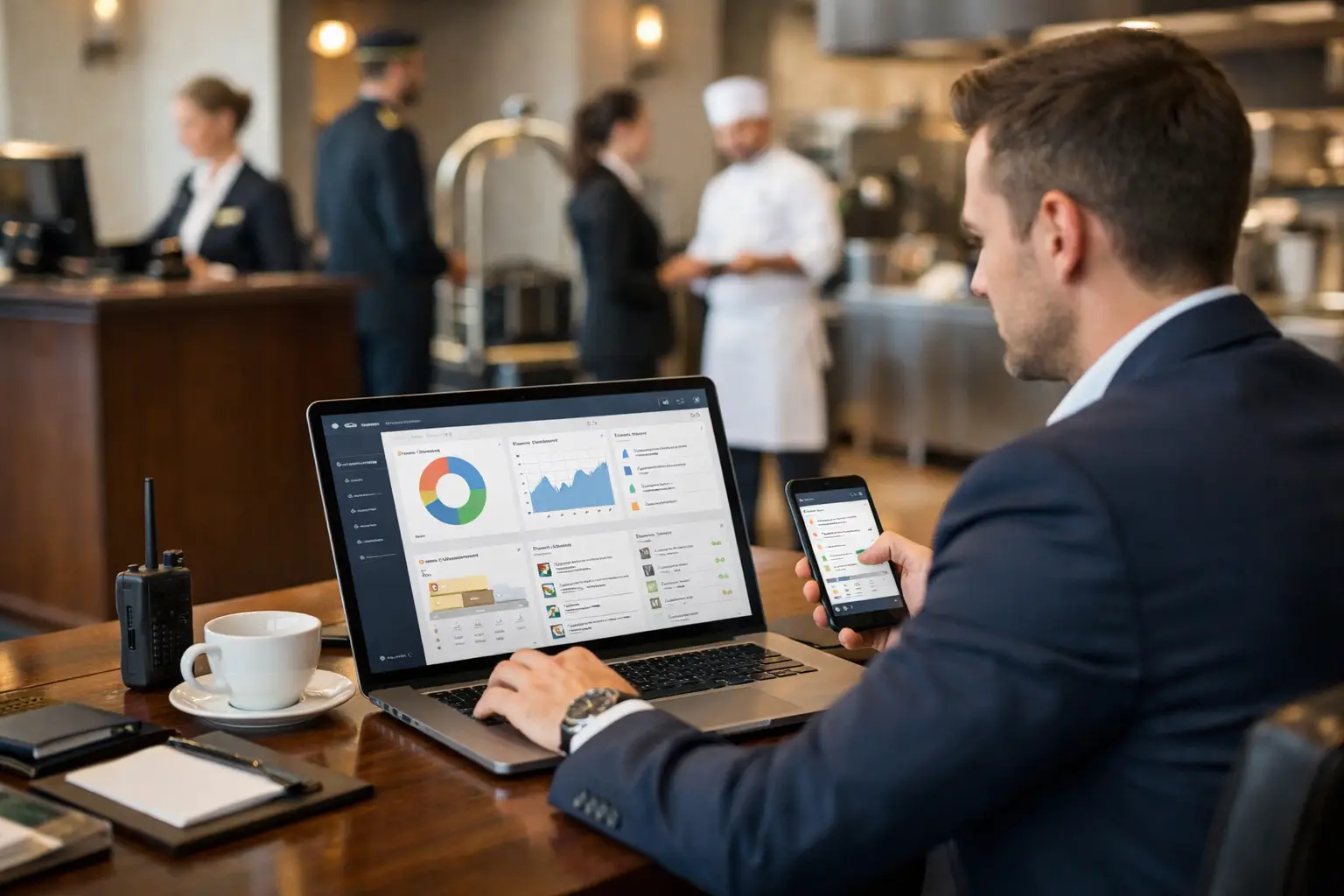
At 6:45 p.m., a front office manager is handling a late-arrival complaint, the restaurant is short one server, and a guest asks whether a menu item contains a specific allergen. This is where hotel operations software either proves its value or becomes another system employees avoid. The real requirement is not more digital activity. It is reliable operational control when the hotel is under pressure.
For hotel leaders, the cost of inconsistent execution is rarely isolated to one department. A weak pre-shift briefing affects service recovery. Unclear allergen knowledge creates safety exposure. Poor menu confidence leaves revenue on the table. Outdated SOPs create audit risk. When managers spend their day answering the same operational questions, leadership visibility disappears exactly when it is needed most.
Why Traditional Hotel Systems Leave Operational Gaps
Hotels already run on a substantial technology stack. Property management, point-of-sale, procurement, maintenance, finance, guest messaging, and workforce systems all have defined roles. Yet most do not solve a central operational problem: how does the organization ensure that every employee can find, understand, and apply the right standard during a live shift?
A policy stored in a shared drive is not operational knowledge. A training completion record does not prove that a new server can explain a wine pairing, that a receptionist understands a VIP arrival protocol, or that a banquet captain knows the latest event setup standard. Documentation may exist, but access, comprehension, and application often break down between the office and the service floor.
This gap becomes more costly in multi-outlet properties. A resort may operate restaurants, bars, room service, pool service, banquets, spa retail, and events, each with different standards and revenue opportunities. A luxury hotel may need precise service language, escalation procedures, and brand rituals across multiple guest touchpoints. The operating challenge is not simply distributing information. It is turning information into consistent action.
What Hotel Operations Software Should Actually Do
Effective hotel operations software should function as the daily nervous system for operational standards. It should connect the knowledge teams need with the briefings, coaching, reporting, and leadership decisions that shape performance.
That means an operator should be able to examine a recurring issue, such as weak beverage upselling or inconsistent allergen responses, identify the knowledge gap, provide the relevant operational guidance, reinforce it in pre-shift communication, and review whether execution improves. This is a closed operational loop, not a static library of documents.
The strongest approach is Hospitality Operational Intelligence, or OI. OI brings together operational knowledge, onboarding, daily briefings, manager visibility, audit readiness, reporting, and recommendations in one connected operating layer. Artificial intelligence supports this capability behind the scenes, but the business outcome is Operational Intelligence: better-informed teams, faster management decisions, and more dependable execution.
OI Knowledge: Answers at the Point of Service
Frontline teams cannot pause a busy service period to search through folders, wait for a manager, or rely on memory. They need clear answers that reflect current standards. This matters for allergen procedures, menu descriptions, room service standards, service recovery, brand protocols, product knowledge, and upselling language.
For example, if a guest asks whether a dish can be adapted for an allergy, the employee needs more than an ingredient list. They need the approved procedure, cross-contact considerations, escalation requirements, and the right language for communicating with the guest and kitchen. In a high-risk situation, partial knowledge is not enough.
OI Onboarding: Faster Readiness, Not Faster Paperwork
Hospitality turnover makes onboarding a permanent operational responsibility. The issue is not whether new hires receive information. It is whether they become effective in the environment they are joining.
A new colleague in a luxury restaurant needs to understand the menu, service sequence, guest recognition expectations, reservation notes, product story, and recovery standards. A new front desk agent needs property-specific knowledge, local operating procedures, and confidence handling common guest scenarios. Each role requires practical readiness, not a generic orientation.
Operational Intelligence allows leaders to organize knowledge around the actual work employees perform. It also helps managers see where confidence or understanding is weak before those gaps become guest complaints, lost revenue, or inconsistent service.
OI Briefings: Make Pre-Shift Time Count
Pre-shift meetings are one of the most underused control points in hotel operations. Too often, they become a rushed exchange of announcements: a VIP arrival, a function change, a maintenance issue, a reminder about uniforms. Important, but insufficient.
A focused OI Briefing can connect the day’s operational reality to specific employee actions. If occupancy is high, arrivals are concentrated, a restaurant has an event menu, or a particular guest segment is expected, the briefing should reinforce the relevant standards and commercial opportunities. If guest feedback identified a recurring issue the previous day, managers should be able to address it before the next service period begins.
The trade-off is discipline. Briefings must remain useful enough that teams pay attention. Sending too much information creates noise; sending only generic reminders misses the opportunity. The right briefing is short, specific, and tied to the shift ahead.
The Commercial Case Is Larger Than Efficiency
Hotel operations software is often evaluated as a time-saving purchase. Time savings matter, especially when managers are repeatedly interrupted for the same answers. But the more significant value often sits in revenue protection, service consistency, and risk reduction.
Consider a restaurant team that lacks confidence recommending premium beverages, explaining menu ingredients, or suggesting add-ons. The result is not usually an obvious failure. It is a series of missed moments across hundreds of covers. A small improvement in average check, consistently applied, can materially change outlet performance over a month or season.
The same pattern applies to guest recovery. If employees understand the approved response for a delayed room, an unavailable amenity, or a service breakdown, they can act with greater confidence and bring managers in at the correct point. The guest experiences a controlled response rather than visible confusion.
Audit readiness follows a similar logic. Standards that are only reviewed immediately before an inspection are not embedded standards. Leaders need evidence that procedures are current, communicated, understood, and reinforced through daily operations. That is particularly valuable for brands managing food safety, allergen exposure, quality standards, franchise requirements, or multiple properties.
How to Evaluate Hotel Operations Software
The right platform depends on the complexity of the operation. A limited-service property may prioritize consistent onboarding and front office standards. A full-service urban hotel may need stronger coordination across food and beverage, banquets, room service, and guest services. Resorts, cruise operators, and multi-property groups often need multilingual access, outlet-specific standards, and leadership reporting across large teams.
When evaluating options, start with operational questions rather than feature lists. Can managers identify the questions employees ask most often? Can knowledge be organized by role, outlet, and service scenario? Can leaders reinforce standards through pre-shift communication? Can the organization see where knowledge gaps, compliance risks, or service inconsistencies are developing?
Also examine adoption honestly. If the platform requires managers to spend hours building content, updating duplicate records, or manually chasing engagement, it may add administrative friction. Good operational software should reduce repetitive management work while making leadership more present in the operation.
SmartHospitality.AI is built around this OI model for hotels and complex hospitality businesses. It is designed by operators who understand that a banquet standard, a bar service protocol, an allergen question, and a luxury guest request do not exist as abstract data points. They are live decisions made by employees during service.
Start With One Costly Operational Gap
A broad transformation plan is not always the best first move. Start with the gap that is costing the operation most today. It may be inconsistent new-hire readiness, recurring guest complaints, weak menu knowledge, audit exposure, or managers overwhelmed by repetitive questions.
Define the standard, make it accessible where work happens, reinforce it through relevant briefings, and review the results. Once leaders can see a direct connection between operational knowledge and service performance, expanding the model becomes a practical management decision rather than a technology project.
The best hotel operations software does not ask leaders to manage more systems. It gives them a clearer view of how standards travel from leadership intent to frontline execution, one shift at a time.