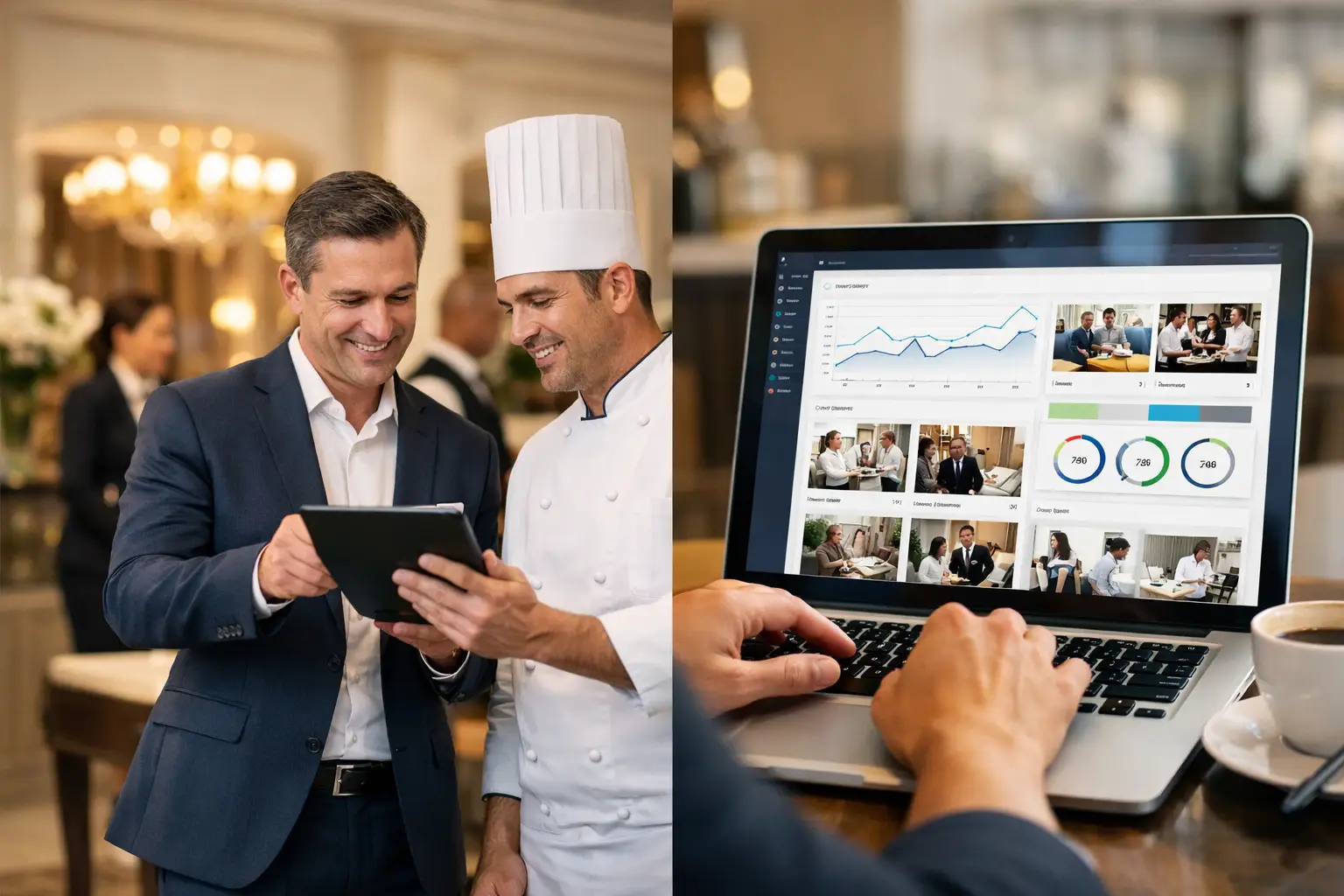
A restaurant manager is five minutes from service when a server asks about an allergen substitution, a new bartender needs the current signature cocktail spec, and the GM wants to know whether yesterday’s briefing was actually understood. This is where the difference between operational intelligence vs hospitality LMS becomes commercially significant. One system can deliver a training module. The other can support the operating decision happening on the floor, in the moment it matters.
Hospitality businesses have invested heavily in learning platforms because training matters. But hotels, restaurants, resorts, cruise operations, and multi-unit groups do not run on training alone. They run on current knowledge, clear standards, manager visibility, disciplined follow-through, and the ability to turn operational information into better daily decisions.
Operational Intelligence vs Hospitality LMS: The Core Difference
A hospitality learning management system is primarily designed to organize, distribute, and track learning. It can assign courses, store training content, record completion, and sometimes assess whether an employee passed a quiz. For structured onboarding, regulatory modules, and recurring certification requirements, that function has real value.
Operational Intelligence is broader because the operational challenge is broader. It connects the knowledge a team needs with the conditions under which they need it: a pre-shift briefing, a guest question, a change in menu availability, an upcoming audit, a service recovery issue, or a manager’s need to identify recurring performance gaps.
The distinction is not that one is better in every circumstance. It is that they answer different questions.
An LMS answers: Has this person completed the assigned learning?
Hospitality Operational Intelligence answers: Does this team have the right current knowledge, are operational standards being applied, where are the risks, and what should leadership address next?
That difference becomes more pronounced in high-turnover environments, multilingual teams, complex food and beverage operations, luxury service settings, and multi-property organizations where local inconsistency can quickly become brand inconsistency.
Completion Is Not Operational Readiness
A completed course does not guarantee that a server can explain a dish with confidence at 8:15 p.m. It does not guarantee that a front desk agent understands the latest VIP arrival protocol, or that a banquet captain can find the correct event sequence when a client changes timing on the day of service.
This is the gap many operators recognize but struggle to measure. Teams may show strong training-completion percentages while managers still answer the same questions repeatedly, correct avoidable service errors, and chase SOP compliance before inspections.
In practical terms, completion is an administrative metric. Operational readiness is a performance condition.
Consider menu knowledge. An LMS may assign a seasonal menu course to every server. That is useful. Yet the commercial outcome depends on whether the server can retrieve accurate allergen information, describe the cooking method, recommend a pairing, and make an appropriate upsell during a live guest interaction. If the information is difficult to access, outdated, or disconnected from the pre-shift conversation, the training record will not protect revenue or guest trust.
Operational Intelligence brings knowledge management closer to the service floor. It creates a connected source for operational standards, product knowledge, briefings, procedures, and decision support, while giving managers visibility into where knowledge is weak or inconsistently applied.
Hospitality Does Not Operate in Training Cycles
Traditional learning is often organized around onboarding, annual compliance, new menu launches, and periodic refreshers. Hotel and restaurant operations move faster than that.
A breakfast team needs different information from a dinner team. A resort’s pool operation changes with weather, occupancy, events, and guest mix. A cruise outlet must maintain standards across changing teams, constrained storage, and tightly controlled compliance procedures. A restaurant group may update an ingredient, a wine vintage, an allergen notice, or a promotion in one outlet while another outlet is operating a different version.
These are not simply learning events. They are operating events.
A Hospitality Operational Intelligence platform supports the daily nervous system of the operation. OI Briefings can focus teams on what matters for that shift. OI Knowledge can provide a reliable reference point when staff need answers. OI Insights and OI Reports can give managers a clearer view of recurring questions, knowledge gaps, training needs, and operational exposure.
The result is not less leadership. It is better-equipped leadership. Managers spend less time acting as a human search engine and more time coaching, observing service, developing people, and resolving the exceptions that genuinely require judgment.
The Hidden Cost of Disconnected Systems
Most hospitality organizations do not lack information. They lack a connected way to make information useful.
SOPs may sit in shared folders. Menu specs may live in PDFs. Training modules may be contained in an LMS. Pre-shift notes may be sent through messaging groups. Audit records may be managed in separate spreadsheets. Managers then become the bridge between systems, answering the same questions and manually translating information into action.
That fragmentation creates costs that rarely appear as a single line item:
- Service inconsistency when teams work from old or incomplete information.
- Revenue leakage when staff lack the confidence to recommend, upsell, or explain products well.
- Compliance exposure when allergen, safety, or procedure knowledge cannot be accessed and reinforced reliably.
- Management friction when leaders repeatedly chase confirmation, explain standards, and prepare for audits from scratch.
For a single independent venue, these problems may be manageable through strong hands-on leadership. At scale, they become harder to control. A brand with 20 outlets cannot depend on each manager maintaining knowledge standards through memory, personal files, and informal conversations alone.
This is where Operational Intelligence is a category rather than a feature. It treats knowledge, communication, training reinforcement, audit readiness, and manager visibility as connected operational disciplines.
Where an LMS Still Fits
The comparison should not suggest that every learning management system has no place in hospitality. An LMS can be appropriate when the primary need is formal content delivery, mandatory training assignments, certificates, and completion tracking.
It may be sufficient for a business with stable teams, straightforward menus, limited operational complexity, and a small number of locations. It can also remain part of a wider technology environment where enterprise learning requirements are deeply established.
The limitation appears when operators expect the LMS to solve issues it was not designed to solve. A course library does not automatically create current, accessible operational knowledge. Completion data does not automatically reveal why one outlet has weak upselling, inconsistent guest recovery, or repeated audit findings. A quiz does not replace the daily reinforcement needed to maintain service standards under pressure.
For many organizations, the right question is not whether to replace an LMS immediately. It is whether the business has an operational intelligence layer that connects learning to execution.
What Leaders Should Evaluate Instead
When assessing hospitality technology, leaders should begin with the moments where operations break down, not with a feature checklist. Ask where managers lose time, where staff hesitate, where standards vary, and where leadership lacks evidence of what is happening across outlets.
A useful platform should help teams work with the operational reality they face every day. That means current SOP access, structured OI Onboarding, relevant shift communication, knowledge reinforcement, manager-level reporting, and practical OI Recommendations that turn patterns into next actions.
The quality of the underlying content matters as much as the technology. Hospitality teams do not need abstract corporate language when a guest is waiting or an audit is approaching. They need instructions that reflect actual hotel operations and restaurant operations: what to say, what to check, what standard applies, and when to escalate.
SmartHospitality.AI was built around this operating reality, treating Operational Intelligence as the layer that brings staff knowledge, standards, briefings, visibility, and decision support into one connected environment. The engine behind OI can make knowledge easier to surface and analyze, but the operational outcome remains the point: stronger execution, better manager focus, and more consistent guest experiences.
The Better Measure: Can the Team Perform?
Hospitality leaders should continue to track training completion, particularly where compliance requires it. But completion should not be the final measure of capability.
The stronger measure is whether the team can perform to standard during a busy shift, across languages, outlets, and changing conditions. Can a new employee find the correct answer without delaying a guest? Can a manager identify the knowledge gaps behind weak performance? Can the business demonstrate audit readiness without a last-minute scramble? Can leadership see where standards are slipping before reviews reveal the damage?
Those are operational questions, and they require operational intelligence. The organizations that build this capability will not merely train more efficiently. They will lead with clearer visibility, protect service consistency, and give their people the support to perform when hospitality is at its most demanding.