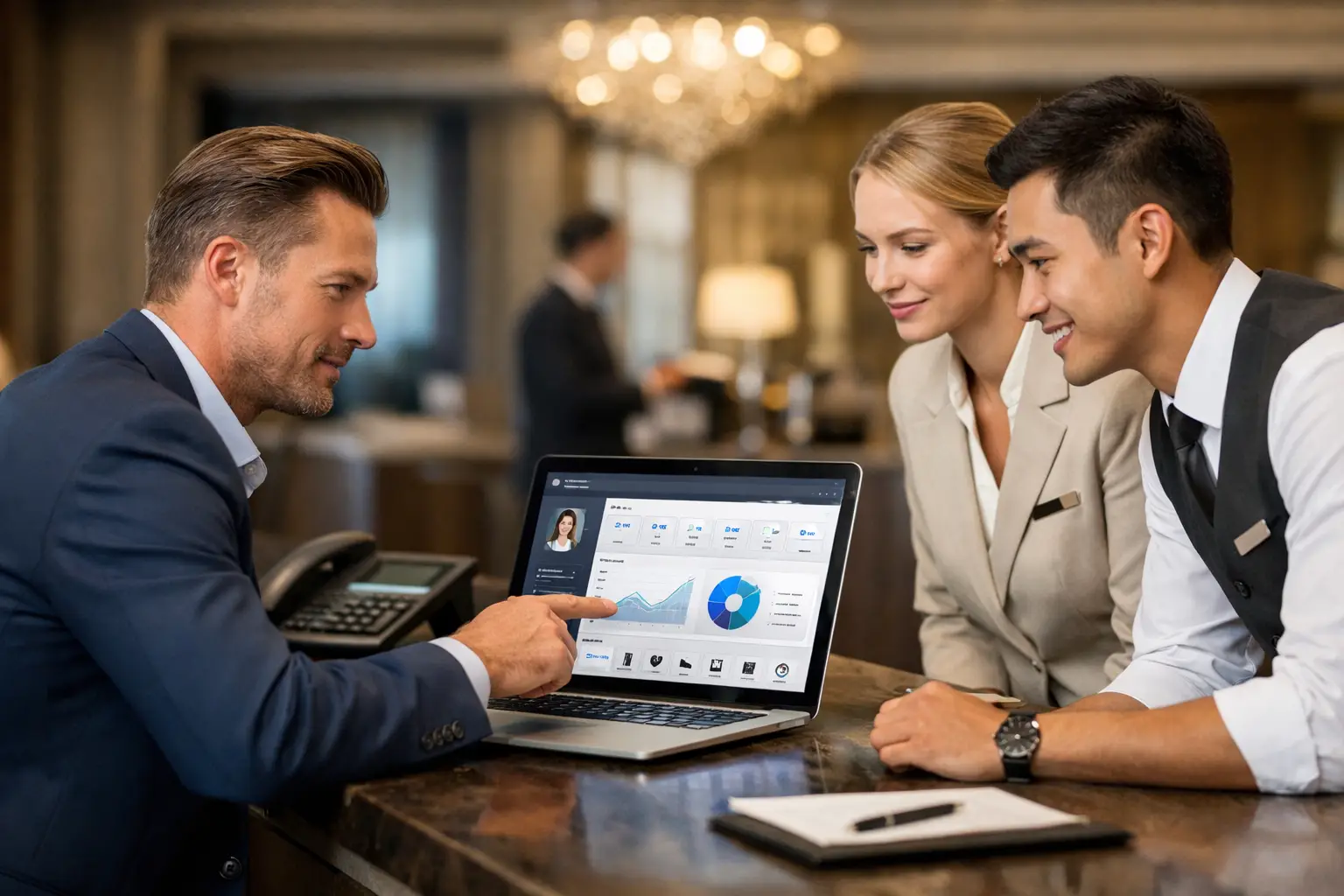
A server is standing beside a table with a guest asking whether a dish contains sesame. A new front-desk agent needs the late-checkout policy for a specific rate. A bartender asks what spirit can replace an out-of-stock ingredient without breaking the cocktail standard. These are not technology questions. They are service, revenue, safety, and brand-protection questions. So, can AI answer staff questions? Yes, but only when the answers are grounded in the operation’s approved knowledge and delivered with the controls hospitality requires.
For hotel and restaurant leaders, the issue is not whether a system can generate a plausible response. It is whether a team member can receive a reliable answer during a live service moment, know when to escalate, and act without creating guest disappointment, compliance exposure, or an avoidable manager call.
That distinction is where Hospitality Operational Intelligence becomes materially different from simply giving staff access to a general-purpose AI tool.
Can AI Answer Staff Questions Reliably?
It can, provided the organization treats staff questions as an operational knowledge-management challenge rather than a conversational novelty.
Hospitality teams ask the same categories of questions every day: What are the allergen details? Which wine pairs with this menu item? What is the recovery process for a delayed room? How is a VIP amenity presented? What is the procedure before a health inspection? What does the brand standard require for a complaint, a cash discrepancy, or a room service delay?
In a well-run property or restaurant group, the source material for those answers already exists somewhere. It may be in SOP documents, menu specifications, pre-shift notes, training binders, brand manuals, opening checklists, audit files, emails, or the knowledge held by two experienced managers. The operational problem is that this information is fragmented, difficult to find, and inconsistently interpreted during a busy shift.
An Operational Intelligence platform brings approved operational knowledge into a usable, governed layer. The OI Assistant can then help staff locate and understand the relevant standard in plain language, while managers retain ownership of the underlying policy, content, and escalation rules.
That matters because a fast answer is not automatically a safe answer. If the system does not have a current, approved source for an allergen question, the correct operational response may be: do not serve the item until the chef or manager verifies it. A strong operating model makes that escalation clear rather than inventing certainty.
The quality of the answer depends on the quality of the operation
AI does not repair an unclear SOP, an outdated menu matrix, or conflicting instructions from different departments. It exposes those weaknesses quickly.
This is useful. When team members repeatedly ask the same question, leadership gains evidence of a knowledge gap. If five outlets interpret a promotion differently, the issue is not staff effort. It is a standardization failure. If every new hire asks how to handle a particular guest request, onboarding has not made the process practical enough for service conditions.
Operational Intelligence turns these moments into manager visibility. Leaders can see where questions are originating, which policies create confusion, what content is missing, and where refresher training or an OI Briefing is needed before the next shift.
Where Staff Questions Carry the Highest Risk
Not all questions deserve the same response model. A recommendation for an upsell can be helpful with supporting guidance. A question involving food allergens, guest security, payment handling, medical incidents, employment matters, or local legal requirements needs stricter controls.
Consider a restaurant server who asks, “Is the truffle pasta dairy-free?” The answer cannot be based on a menu description, an old recipe, or a confident-sounding assumption. It must reflect the current recipe, garnish, cross-contact guidance, and approved substitution rules. If the information is incomplete, the operational standard should direct the server to the chef or manager immediately.
The same principle applies at a hotel front desk. “Can I waive this cancellation fee?” may depend on the booking channel, loyalty tier, local policy, occupancy conditions, and authorization level. A useful OI response can identify the policy and the authorized next step. It should not give a junior employee permission that the organization has not granted.
This is why the goal is not full autonomy. The goal is better decisions at the point of work, with clear boundaries around decisions that require managerial judgment.
From Repetitive Questions to Operating Intelligence
Managers often become the daily nervous system of an operation because all knowledge flows through them. During service, that can mean answering the same questions repeatedly while also managing guest recovery, staffing coverage, quality checks, and revenue performance.
The cost is larger than interruption. Each unanswered or inconsistently answered question creates variation. Variation affects service consistency. It can weaken upselling, delay response times, undermine confidence in new staff, and leave leaders with little visibility into what their teams actually do not know.
A connected Hospitality Operational Intelligence approach changes the workflow. Staff access relevant OI Knowledge when the question arises. Managers use OI Insights to identify recurring friction. Leaders issue OI Briefings when menus, promotions, standards, or risks change. OI Reports show whether the same knowledge gaps persist across departments, outlets, or properties.
For example, if beverage teams regularly ask about premium wine pairings, the response should not stop at a one-time answer. The operation can identify the pattern, strengthen product knowledge, issue a focused pre-shift briefing, and measure whether recommendation confidence and beverage performance improve. That is revenue optimization through operational learning, not simply question answering.
What Good Implementation Looks Like
The fastest way to create unreliable answers is to load unreviewed documents into a system and assume the work is complete. Hospitality operators need a disciplined approach.
Start with the questions that create the most service friction or operational risk. For many businesses, this includes menu and allergen knowledge, guest recovery procedures, opening and closing standards, brand service rituals, promotions, and audit-critical processes. These are high-frequency, high-consequence areas where clarity changes daily execution.
Next, assign content ownership. Culinary leaders should validate recipe, allergen, and substitution guidance. Front-office leaders should own arrival, recovery, and escalation standards. Finance or senior operations leaders should govern cash and authorization policies. Knowledge must have accountable owners and review dates, especially where menus, regulations, and promotions change frequently.
Then define escalation paths in the answer itself. A staff member should understand not only what to do, but also when they must stop and involve a supervisor. This is particularly important for allergens, safety, guest privacy, discounts, complaints with financial exposure, and exceptions to policy.
Finally, measure operational outcomes rather than treating usage volume as the main success metric. Leaders should look for fewer repeat manager questions, faster onboarding readiness, improved audit performance, reduced policy variation, stronger menu knowledge, and more consistent guest handling. The right measures will vary by operation, but they should connect directly to service quality, risk, labor productivity, or revenue.
The Limits Matter as Much as the Benefits
An Operational Intelligence platform should support professional judgment, not flatten it. A luxury resort handling a distressed guest, a cruise operation managing a safety event, or a restaurant navigating a complex dietary request may require context that no written standard can fully capture.
There is also a human dimension. The best hospitality teams do not recite policies at guests. They apply standards with warmth, discretion, and situational awareness. Technology can make the standard easier to access; operational leadership teaches teams how to deliver it.
Language is another consideration for global operators. Multilingual teams benefit when critical knowledge is easy to understand in the language used on the floor. Yet translation must preserve operational meaning, particularly for allergy, safety, and compliance procedures. This requires review, not assumption.
A Better Standard for Staff Support
The right question is not whether a system can answer anything a staff member asks. It is whether it can help the team answer the questions that matter with approved, current, operationally useful guidance.
SmartHospitality.AI is built around that standard: Hospitality Operational Intelligence that connects staff knowledge, OI Onboarding, standards, manager visibility, audit readiness, and decision support across the operation. The value is not a more impressive conversation. It is a more capable team, fewer preventable gaps, and leaders who can see where performance needs attention.
When a staff member asks a question during service, the operation has a choice. It can rely on memory, interruption, and inconsistent interpretation, or it can make the right knowledge available while preserving the judgment and escalation discipline that hospitality demands. The second approach is how standards survive the reality of a busy shift.