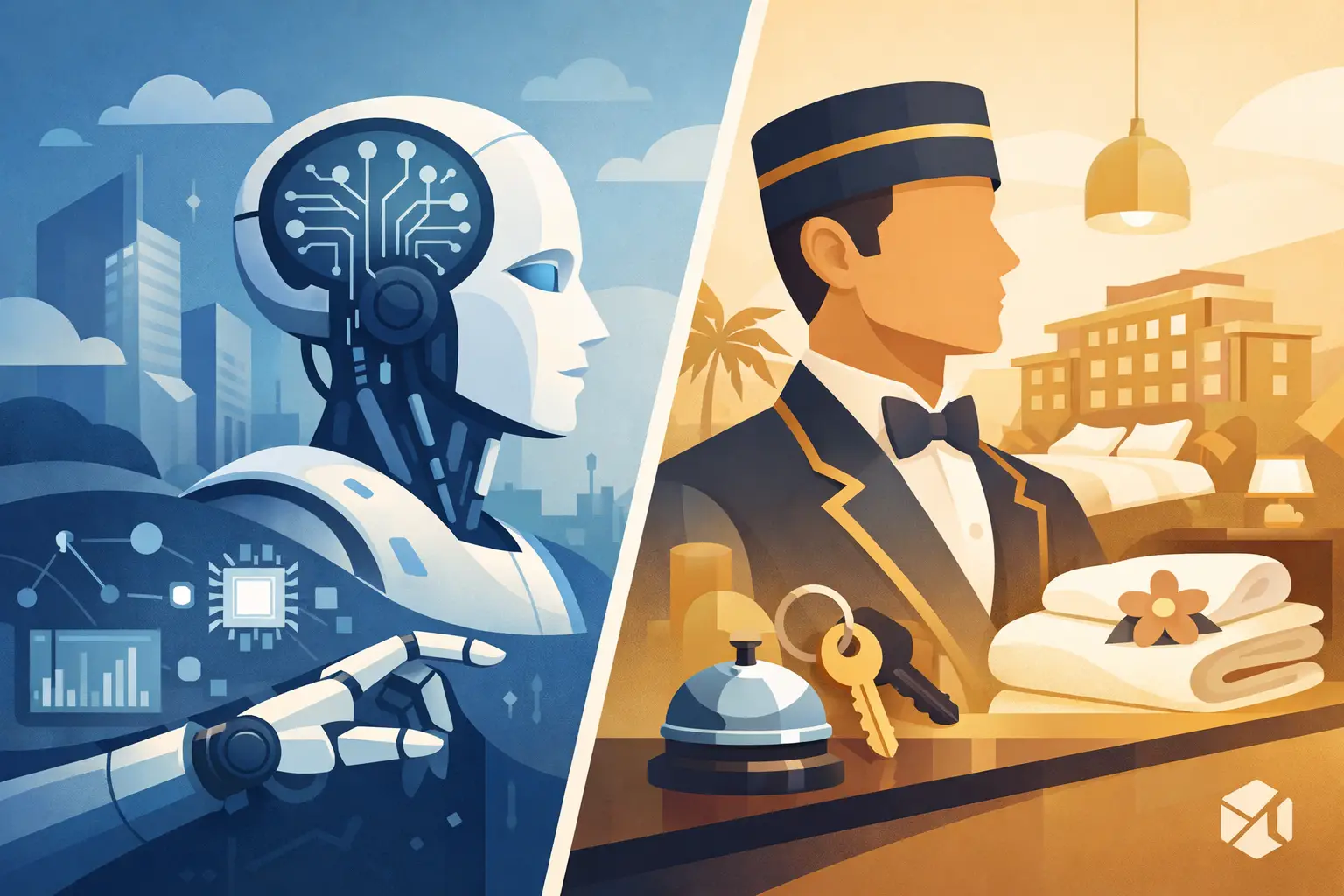
Hospitality teams do not lose money because they lack content. They lose money because they lack operational clarity at the exact moment service decisions are made. That is why AI is not Equal OI. A chatbot can answer a question. Operating intelligence can protect an allergen interaction, improve an upsell, tighten pre-shift execution, and show leadership where knowledge gaps are costing revenue.
That distinction matters more than most operators realize. The market is crowded with AI promises, but food and beverage leaders are not buying novelty. They are trying to reduce manager firefighting, standardize execution across shifts, and keep service quality intact under turnover pressure. In that environment, generic AI is often impressive in demos and unreliable in live operations.
AI Is Not Equal OI
Artificial intelligence is a broad technical capability. It can generate text, summarize policies, answer common questions, and automate simple interactions. Useful? Yes. Enough for hospitality operations? Usually not.
Operating intelligence is narrower and more valuable. It connects knowledge to workflow, accountability, timing, and measurable performance. In a restaurant, banquet operation, or hotel outlet, information has to do more than exist. It has to reach the right employee, in the right context, with the right standard behind it. Then management needs visibility into whether that knowledge was understood, applied, and reinforced.
If a new server asks whether a dish can be modified for a guest with a nut allergy, the risk is not the absence of an answer. The risk is an unverified answer, delivered without control, with no record of the knowledge gap and no way to retrain the team before the next service. That is the difference between AI output and operating intelligence.
Where Generic AI Breaks on the Floor
Generic AI tools usually fail in the places operators care about most: consistency, compliance, and execution under pressure. They are not built around the pace and consequence of hospitality work.
First, they do not naturally reflect service-critical nuance. A menu item is not just ingredients on a list. It includes preparation standards, modifier rules, pairing opportunities, allergy flags, timing expectations, and brand-specific language. If the system cannot deliver that detail accurately, staff confidence drops and managers get pulled back into repetitive questions.
Second, generic AI rarely creates accountability. It might provide an answer, but it does not automatically connect that answer to onboarding, pre-shift reinforcement, checklist follow-through, or manager visibility. Operators need to know not just what was asked, but what the question reveals. Which outlet is weak on wine knowledge? Which shift keeps missing allergen protocols? Which manager is coaching well, and which one is guessing?
Third, AI alone does not create audit readiness. Passing an internal review, brand standard check, or food safety inspection depends on repeatable behaviors. That means knowledge support, training reinforcement, documented execution, and leadership oversight have to work together. A disconnected AI tool cannot carry that burden.
What OI Looks Like in Real Hospitality Operations
Operating intelligence acts more like a daily nervous system than a standalone feature. It supports the floor before service, during service, and after service review.
Before service, it sharpens readiness. Teams get structured briefings, targeted knowledge reinforcement, and clear priorities for the shift. That matters in environments where menu changes, VIP notes, banquet specifics, and staffing gaps can all hit at once.
During service, it reduces hesitation. Staff can access trusted answers quickly, without breaking flow or creating table-side uncertainty. That protects both revenue and guest trust. A server who knows the right pairing, a bartender who understands modifier standards, and a banquet captain who can confirm execution details without chasing a manager all contribute to stronger performance.
After service, OI gives leadership something most teams lack: visibility. Not gut feel. Not anecdotal feedback. Actual insight into what the team knows, where standards are slipping, and which managers are driving improvement. That is where the business case gets real. Revenue leakage, inconsistent onboarding, and compliance exposure are rarely random. They usually trace back to unmanaged knowledge gaps.
Why This Matters Financially
For hospitality leaders, this is not a language debate about AI terminology. It is a margin issue.
Every repeated staff question absorbs management time. Every weak upsell is lost contribution. Every inconsistent onboarding cycle delays productivity. Every uncertain allergen response creates risk that no operator can afford. When teams rely on tribal knowledge, verbal handoffs, or scattered documents, performance becomes uneven across shifts and outlets.
Operating intelligence closes that gap by turning information into execution. That means faster ramp-up for new hires, stronger consistency in guest-facing knowledge, better pre-shift alignment, and clearer accountability for managers. In a high-turnover, multilingual environment, those gains compound quickly.
This is exactly why purpose-built systems matter. A hospitality operation does not need one more generic AI layer sitting beside the workflow. It needs intelligence embedded into the workflow itself. That is the difference between a tool that sounds modern and a system that improves service, audit readiness, and outlet performance.
SmartHospitality.AI is built around that operator reality. Not AI for its own sake, but operating intelligence designed for the actual pressure points of food and beverage teams.
The strongest operators already understand the principle. Technology should reduce chaos, not add another dashboard. If a system cannot make service standards easier to execute and easier to manage, it is not solving the problem that matters.