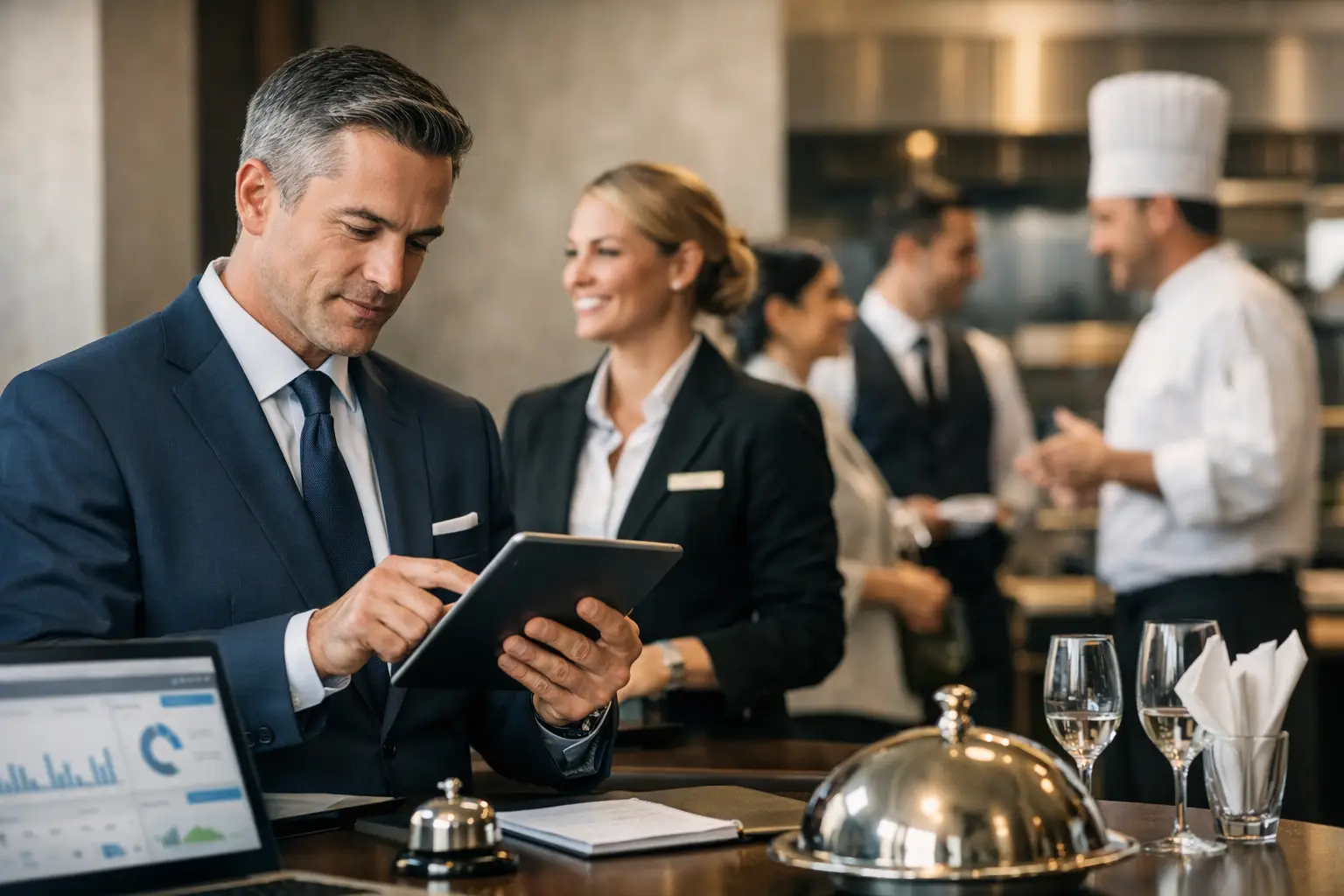
A guest should not receive a different standard of welcome because the strongest server is off, the breakfast supervisor is covering an event, or a new front desk agent is working a busy arrival period. That is the central purpose of a hospitality service standards guide: to convert the intended guest experience into repeatable actions that hold up across shifts, outlets, languages, and staffing changes.
For hotel and restaurant leaders, the issue is not whether service standards exist. Most operations have them somewhere: in a binder, a shared drive, a training presentation, or the memory of a long-serving manager. The operational risk begins when those standards are difficult to find, hard to apply under pressure, and impossible to verify consistently.
Why service standards fail on the floor
Service inconsistency rarely comes from a lack of effort. It comes from a gap between a written expectation and the decisions employees must make in real time. A host knows they should acknowledge guests quickly, but what happens when the phone rings, a delivery driver arrives, and a walk-in party is waiting? A room service agent understands allergen procedures in theory, but can they confidently answer a guest asking whether a sauce contains sesame during the evening rush?
Vague standards create variable judgment. Statements such as “provide exceptional service” or “be attentive” may reflect the brand ambition, but they do not tell an employee what good looks like at 7:15 a.m. during a sold-out breakfast or 10 minutes before a banquet service begins.
The commercial cost is equally practical. Missed menu knowledge reduces appropriate recommendations. Weak handovers create recovery failures. Inconsistent allergen communication creates compliance exposure. Managers then spend their shifts answering the same questions, correcting avoidable errors, and reconstructing what happened after a guest complaint.
A useful service standard therefore has to do more than describe a value. It must direct behavior, clarify ownership, and create evidence that leaders can review.
The hospitality service standards guide: build around moments that matter
The most effective hospitality service standards guide is organized around guest moments and operational risk, not department charts alone. Guests do not experience your organization as separate SOP folders. They experience arrival, ordering, waiting, dining, payment, recovery, and departure.
Start by mapping the points where inconsistency has the greatest effect on guest satisfaction, revenue, safety, or brand perception. For a hotel, this may include reservation confirmation, arrival recognition, check-in, luggage handling, breakfast service, room service ordering, complaint recovery, and departure. For a restaurant group, it may include greeting, table pacing, menu guidance, allergy escalation, beverage recommendations, bill presentation, and farewell.
Then write standards at the level of observable behavior. “Greet guests warmly” is not measurable enough. For example, a property might choose: “Acknowledge an arriving guest promptly, explain the expected wait and identify who will help next.” If you specify a time target, make it your approved service-model target, not a claimed universal hotel requirement. Give staff accessible alternatives where a guest’s communication needs differ.
The right level of detail depends on the service model. A luxury resort may require staff to use a guest’s preferred name only after confirmation, while a high-volume casual restaurant may prioritize fast recognition and accurate queue communication. Standardization should protect the brand promise, not force every property or outlet into unnatural language.
Define the non-negotiables and the judgment zones
Not every service behavior needs a script. Over-scripted teams can sound mechanical and may struggle when a guest’s needs fall outside the expected pattern. The better approach is to separate non-negotiables from judgment zones.
Non-negotiables are actions that must occur every time because they protect safety, compliance, revenue, or core brand delivery. Examples include allergen confirmation, payment security, complaint escalation thresholds, responsible alcohol service, and documented handovers.
Judgment zones are where trained employees should adapt to the guest and context. The exact wording of a welcome, the style of a menu recommendation, or the way a concierge builds rapport may vary. Define the outcome, the limits, and the decision authority. This gives staff confidence without removing professionalism or personality.
Write standards that teams can use under pressure
A standard should answer five operational questions: what triggers the action, who owns it, what steps are required, when should it happen, and what must be recorded or escalated?
Consider an allergy request. A weak standard says, “Take allergies seriously.” A usable standard identifies the trigger at booking, ordering, or service; assigns accountability to the employee receiving the request; requires confirmation against the current approved allergen information; specifies manager and kitchen communication; prohibits unsupported assurances; and records the request in the relevant guest or order workflow.
This structure matters because a standard is only as effective as its weakest handoff. The server may ask the right question, but if the kitchen receives incomplete information or the shift manager is unaware of a high-risk request, the process has already failed.
Use plain language and keep critical instructions close to the task. During pre-shift briefing, employees need the day’s menu changes, VIP notes, sold-out items, service priorities, and known operational risks. They do not need to search through a 40-page manual to find the current answer.
Connect standards to onboarding, briefing, and coaching
Publishing SOPs is not implementation. Teams need repeated exposure in the moments where knowledge is used: onboarding, pre-shift briefings, service recovery, manager coaching, and audit preparation.
Onboarding should introduce the service philosophy, but it must quickly move into role-specific practice. A new bartender needs more than a brand presentation. They need clear guidance on product knowledge, guest engagement, responsible service, allergy communication, opening and closing controls, and escalation paths. A new front office agent needs practical language for managing early arrivals, payment disputes, room concerns, and loyalty recognition.
Pre-shift briefings are the daily bridge between standards and current operations. The strongest briefings do not repeat generic reminders. They focus on what has changed and where performance could break: a revised menu item, a group arrival, a maintenance issue, a high-volume event, a recurring guest complaint, or a service goal for the shift.
Coaching should also be evidence-based. Instead of telling a server to “improve upselling,” a manager can observe whether the employee made a relevant recommendation, explained value clearly, checked for guest cues, and recorded the outcome. The conversation becomes specific, fair, and measurable.
Measure whether standards are working
A service standard that cannot be measured becomes a statement of intent. Measurement does not mean reducing hospitality to a scorecard. It means giving operational leaders enough visibility to identify where the guest experience, compliance, or revenue process is weakening.
Track a balanced set of indicators. Guest feedback and complaint themes show the guest-facing result. Mystery shop or manager observations show behavior. Knowledge checks reveal whether employees know the standard. Audit findings identify compliance gaps. Upsell conversion, average check, beverage mix, and attachment rates indicate whether product knowledge is translating into revenue.
Look for patterns across properties, shifts, roles, and service periods. If one outlet has strong guest scores but persistent allergen documentation gaps, the operation has a safety risk that positive feedback does not erase. If a property has high training completion but managers still answer the same menu and SOP questions daily, the knowledge is not accessible at the point of need.
This is where Hospitality Operational Intelligence becomes materially different from static manuals or isolated training records. An OI approach connects standards, staff knowledge, daily briefings, performance signals, audit readiness, and manager visibility into one operating view. The value depends on connecting records to a management response: identify a gap, assign an owner, check the result and update guidance when necessary.
Implement brand standards without losing local relevance
Give each standard a named owner, an approved version and a review date. Group requirements and local instructions should appear together: the brand may set a consistent welcome and recovery principle, while the property supplies its actual room-status process, contact names and decision limits. Local law and required safety procedures must be checked for the relevant jurisdiction; a corporate handbook is not a substitute for that review.
Use a simple implementation record:
| Field | Example for a room move | | --- | --- | | Trigger | Guest reports an unresolved room concern | | Shared expectation | Explain next steps clearly and avoid unsupported promises | | Local instruction | Confirm an available room and its readiness through the approved property workflow | | Decision authority | Duty manager approves the move and any recovery within current limits | | Handoff | Front office records the action; housekeeping confirms room status | | Verification | Incoming supervisor checks that the guest received the agreed follow-up |
These are illustrative fields, not a prescribed brand standard. Test the actual procedure with the departments involved. If they cannot agree on who makes the final decision, resolve that before training the wider team.
Roll out one guest moment at a time. Observe the existing process, remove conflicting instructions, prepare role-specific guidance and rehearse a normal case plus an exception. Include the night shift and a newer colleague in the pilot. Publish the approved version, withdraw obsolete copies and make the next briefing show what changed.
Diagnose inconsistency before adding more training
When two employees give different answers, check what each could see. Was an old package description still in the desk folder? Did the banquet amendment reach the captain but not the serving team? Was the recovery limit clear to front office and reservations? A reminder to “be consistent” will not fix an unresolved ownership or version problem.
Separate knowledge gaps from capacity and process constraints. An employee may know the greeting standard but lack cover when arrivals, phones and luggage requests converge. That calls for a staffing or workflow decision as well as coaching. Ask what happened, when it happened and what support was available; avoid attributing every variation to attitude.
The useful idea behind a “perfect operation” is repeatable readiness and visible correction, not a claim of flawless service. Staff understand the priority, can obtain a reliable answer and know their decision limits. Managers can see exceptions and intervene. A missed standard is recorded and followed through instead of disappearing into a polished overall score.
Review standards after real operational events
Service standards should be stable, but they should not be frozen. Review them after complaint trends, audit findings, menu changes, new property openings, incident reports, and major event periods. The goal is not to rewrite procedures constantly. It is to remove ambiguity that the operation has exposed.
Ask practical questions after each review: Did the employee have the right information? Was ownership clear? Did the handoff work? Could a manager see the issue early enough to intervene? Did the standard support the guest experience while protecting the business?
When standards are treated as the daily nervous system of hospitality operations, they stop being compliance documents. They become the shared operating language that allows teams to deliver confident, consistent service even when the shift is busy, the team is new, and the guest expectation is high.
SmartHospitality.AI supports a Hospitality Operational Intelligence approach to knowledge, briefings and manager follow-through. Assess its fit by testing how an approved service standard reaches staff and how an exception is resolved during a real shift.