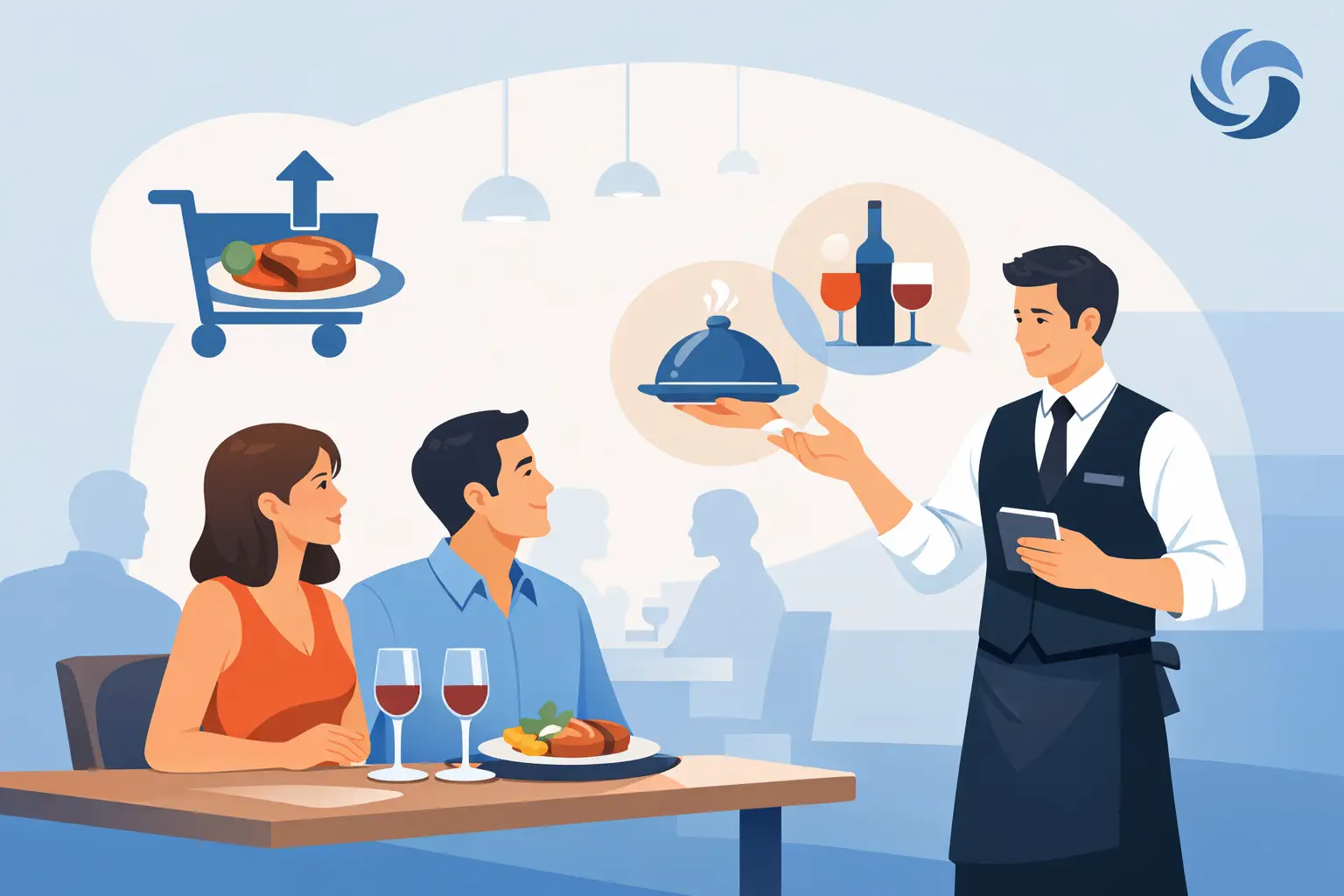
To improve server upselling, improve the quality of the recommendation. Staff need accurate product knowledge, a useful moment to offer it and the judgement to stop when the guest declines. The manager's job is to remove uncertainty and coach the interaction, then evaluate the result with context.
For hotel and restaurant F&B teams, this means a practical process rather than a generic instruction to sell more. A relevant side, beverage or experience should make sense to the guest and be priced clearly before acceptance.
How to improve server upselling without sounding scripted
Most operators say they want better upselling, but what they really want is better recommendation quality. Guests do not want to be sold at. They want to be guided by someone who knows the menu, reads the table, and makes the next decision easier.
That distinction matters because aggressive scripts often backfire. If a server is trained to push add-ons on every table, guests feel it. Service gets stiff. The recommendation may lose relevance. Worse, weaker servers start skipping the script entirely because it feels unnatural in live service.
The better approach is to train recommendation pathways, not canned lines. A server should know which cocktail naturally leads into which appetizer, which side improves the guest experience with a given entree, and which dessert closes a business dinner differently than a date night. Upselling works when it feels like hospitality, not retail.
For example, an illustrative recommendation might explain how an optional sauce changes the dish, state its actual current price and ask whether that fits the guest's preference. Explain value and price together; do not make a paid addition sound included.
The real reasons servers miss upsell opportunities
When upselling underperforms, leadership often defaults to motivation. They assume the team is not trying hard enough. On the floor, the causes are usually more operational.
First, product knowledge is often too shallow. Servers cannot confidently recommend what they do not understand. If they do not know flavor profile, portion logic, premium modifiers, allergens, prep style, or pairing options, they will default to order taking. This is especially common in properties with menu complexity, multilingual teams, or constant menu engineering changes.
Second, pre-shift training is frequently too broad. Managers cover eighty-six items, VIP notes, labor pressure, and a new special, then wonder why nobody remembers the high-margin add-on for the halibut feature. Upselling improvement does not come from more information. It comes from sharper information, repeated consistently.
Third, managers often lack visibility into who knows what. They may sense that one section sells better than another, but they cannot see whether the gap comes from weak wine confidence, poor timing, menu ignorance, or lack of follow-through. Without that visibility, coaching becomes generic. Make coaching specific to the observed behaviour rather than assuming a sales figure explains the cause.
Finally, service pressure matters. During peak periods, a server with weak menu fluency does not upsell because upselling takes cognitive effort. Under stress, people simplify. They grab the order, enter it fast, and move on. If your upsell process only works on slow Tuesdays, it is not a real operating standard.
Build upselling around menu fluency
Build recommendations on current, verified menu knowledge. Not memorization for its own sake, but practical command of what to recommend, when, and why.
Servers need to know your menu in commercial terms, not just culinary terms. They should know your high-margin items, premium modifiers, pairing opportunities, and common guest decision points. They should also know the friction points. Which dishes need expectation-setting? Which cocktails convert best as a first recommendation? Which sides lift satisfaction and check average together?
This is where many teams get stuck. They train ingredients, but not selling logic. A server may know that a sauce contains shallots, but not know that it is the easiest upgrade to mention when a guest orders a steak. That is a training design issue, not a talent issue.
Strong operators organize menu knowledge into usable prompts. If a guest orders oysters, what should follow? If a table is celebrating, what should follow? If a guest hesitates between two entrees, what premium suggestion fits naturally? Once these pathways are clear, upselling stops feeling improvised.
Train timing, not just offers
Poor timing kills more upsells than poor wording. A recommendation made too early feels random. Too late, and the window is gone.
Practise the moments that suit the service sequence. Beverage suggestions can help while guests consider the menu; a side can be discussed with the main-course choice; dessert belongs before the table has clearly finished its visit. Adapt to the guest's pace rather than treating these moments as a compulsory sales sequence.
Timing also depends on service style. In fine dining, a recommendation may need more restraint and narrative. In upscale casual, speed and confidence matter more. In room service or banquets, the upsell framework may be tighter because the guest interaction is shorter or more transactional. There is no universal script because the operating environment changes the guest’s buying rhythm.
That is why role-play matters when it is done well. Not theater. Not awkward classroom selling drills. Real service scenarios based on your actual menu, your actual guest mix, and your actual check-building priorities.
Coach the middle, not just the top and bottom
Most teams have obvious stars and obvious strugglers. Coach from the specific opportunities you observe, including among employees whose performance appears average.
Your top servers are already selling. Your bottom performers may need foundational remediation. Employees may already have useful guest skills but need a clearer product explanation or better timing. They do not need a speech about selling more. They need direction like, "You’re strong on entree confidence but you miss beverage attach opportunities in the first two minutes," or, "Your dessert language is too closed-ended. Offer a point of view instead of asking if they want dessert."
This requires observation and pattern recognition. Managers need to spend time watching interactions, reviewing sales mix by server, and comparing behavior to results. If one server sells more sparkling water, another drives appetizer attach, and another never lands premium sides, those are coachable patterns.
The trap is overcorrecting with pressure. If coaching becomes public scorekeeping or constant selling talk, service quality can suffer. Good coaching sharpens confidence. Bad coaching creates desperation. Guests can tell the difference immediately.
Track offers and outcomes separately
Total sales and average check do not prove recommendation quality. A server may receive larger parties, premium bookings or a favourable section. Define the eligible opportunity and compare similar service periods before drawing conclusions about performance.
| Measure | Example calculation | What to check alongside it | | --- | --- | --- | | Category attachment | Orders with the defined add-on divided by eligible base orders | Availability, guest mix and accurate eligibility | | Offer rate | Observed relevant offers divided by sampled eligible opportunities | Timing and whether the offer fitted the guest | | Acceptance rate | Accepted offers divided by recorded offers | Price, value and freedom to decline | | Incremental value | Defined additional sales divided by covers | Discounts, returns and relevant product cost |
POS sales show what was recorded, but usually not whether staff made a recommendation. Use a modest sample of manager observations to understand that part of the process. Keep the denominator consistent: do not compare tables with individual covers or include unavailable products as opportunities staff failed to convert.
A lower attachment rate may reflect the guest's purpose or budget. Higher revenue may reflect a price change. Pair the scorecard with service feedback, returns and observations so the team is not rewarded for unsuitable recommendations.
Separate missed opportunities from revenue and margin leakage
A suitable recommendation that was never made is a missed opportunity. A billable addition served but not entered is a recording or collection problem. Overpouring, portion drift and remakes can reduce margin even when sales are recorded correctly. These effects need different controls.
For an unrecorded modifier, inspect POS configuration, order entry and pass-to-server communication. For repeated remakes, review the relevant dish, station and request type. For weak recommendations, check knowledge, availability, timing and guest fit. Do not combine all three into one assumed upselling loss or invent an amount the business cannot substantiate.
Authorised guest recovery also deserves context. A legitimate comp is different from an unsupported discount or a recurring concession caused by the same avoidable service failure. Retain the reason and approval so managers can investigate the pattern without removing appropriate discretion.
Coordinate recommendations across the hotel
Hotel upselling extends beyond the dining room. Reservations, front desk, concierge, spa and F&B may each have a useful opportunity, but repeated offers can make the stay feel relentless. Define who owns a recommendation and how a relevant decline or acceptance reaches the next team within appropriate access controls.
Confirm availability, terms and authority before making a promise. A late checkout depends on the property's actual policy and operating capacity; an upgrade depends on available inventory and approved pricing. Staff should know who can authorise an exception rather than treating a product description as permission.
An illustrative practice case could compare two outlets with different beverage attachment. Before assuming one team sells better, check stock, guest mix, price, product knowledge and the observed conversation. Then coach one specific barrier and review comparable service periods. This is a diagnostic example, not a claim about a customer result.
Run a focused improvement cycle
Start with one outlet and a small number of relevant opportunities. Establish a baseline and validate how the sales data is classified. Observe what prevents the recommendation: unclear value, unavailable stock, awkward order entry or a moment that does not fit the guest.
Use pre-shift to practise one product and one guest situation using approved facts and current prices. Include a budget concern, a dietary request and a guest who declines. Recognition should include good restraint as well as a sale.
Review the next shifts with the same definitions. If knowledge improved but attachment did not, investigate availability or guest fit before adding pressure. Keep menu knowledge and the allergy workflow current; commercial objectives never override verification or appropriate escalation.
SmartHospitality Operational Intelligence (OI) can connect product knowledge, briefings and manager reporting around this coaching cycle. It helps leaders identify practical barriers and follow through while teams remain responsible for relevant recommendations, accurate terms and the guest's freedom to choose.