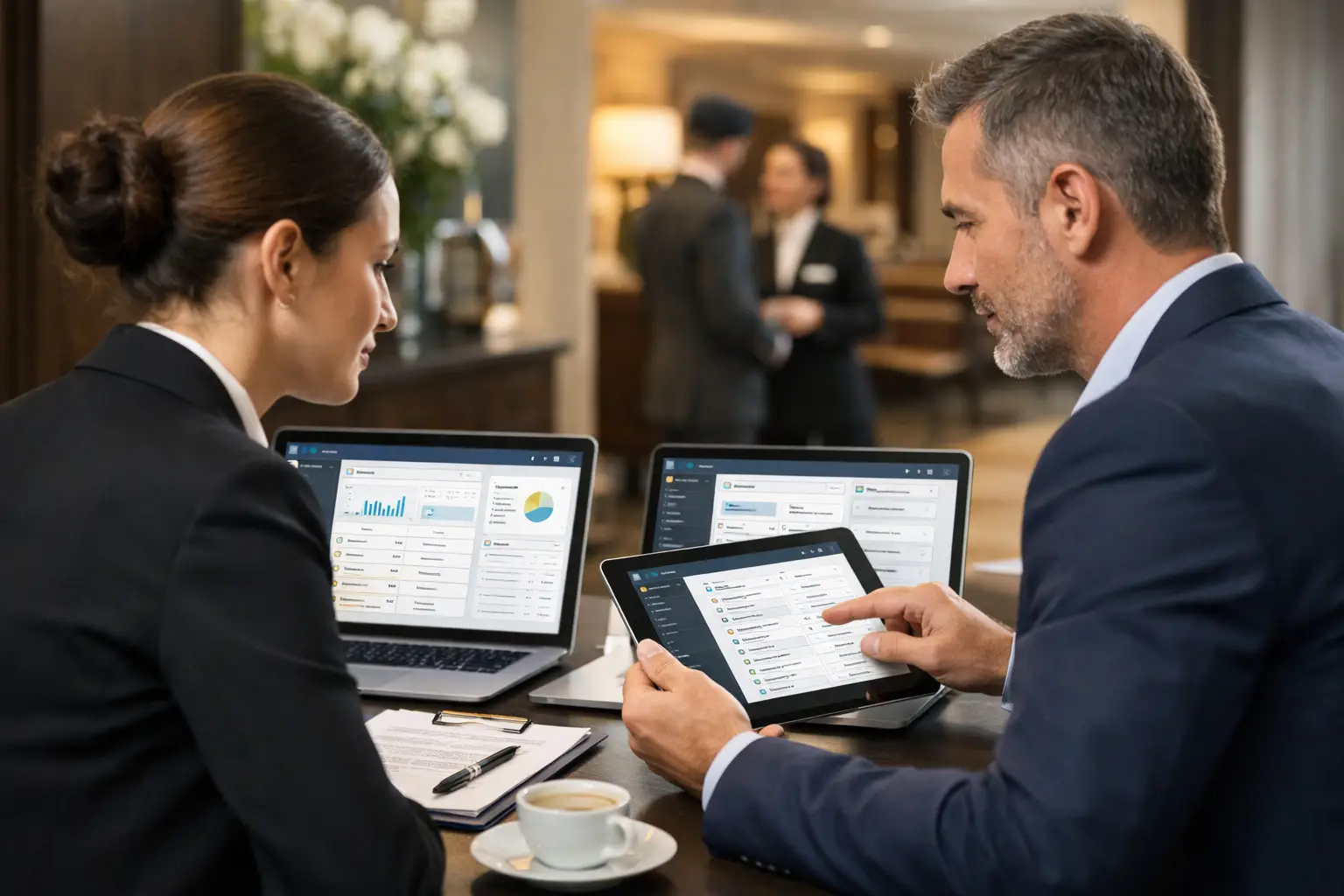
A hotel SOP platform comparison should begin where operational failures actually begin: on the floor, during a busy shift, when a colleague cannot find the current answer quickly enough. A front desk agent gives an inconsistent late-checkout response. A server cannot confidently explain a menu allergen. A night manager spends 20 minutes locating the correct incident procedure. These are not isolated training issues. They are daily gaps in operating intelligence.
For hotel operators, the question is not simply which platform can store standard operating procedures. Most systems can store documents. The real question is whether the platform helps teams access, understand, apply, verify, and improve standards at the moment performance matters.
Why a hotel SOP platform comparison needs a wider lens
Traditional SOP management has often meant folders, PDFs, shared drives, printed manuals, and the occasional signed acknowledgement. This model creates a false sense of control. Leadership may know the procedure exists, while the employee facing a guest may be working from memory, an outdated version, or informal advice from a colleague.
A useful comparison therefore separates document storage from operational execution. A platform may be strong at publishing content but weak at confirming comprehension. It may deliver training modules but provide no visibility into recurring knowledge gaps. It may support audits but fail to connect audit findings to the briefing, coaching, or procedure that would prevent the same issue next week.
For a single property with stable teams and simple service delivery, a well-organized document library may be sufficient for a period. For multi-outlet hotels, resorts, restaurant groups, cruise operations, and luxury brands, that approach quickly becomes expensive. Every repeated manager question, inconsistent guest interaction, missed upsell, or incomplete compliance step adds friction to service and leadership time.
The stronger category is Hospitality Operational Intelligence. OI connects SOP knowledge with onboarding, operational training, pre-shift briefings, audit readiness, manager visibility, reporting, and decision support. It treats standards not as static files but as a living operating system.
The four platform categories operators will encounter
Document and policy repositories
These systems centralize files, control versions, and allow teams to search for policies. Their advantage is straightforward: they reduce the chaos of disconnected folders and make formal documentation easier to govern.
Their limitation is equally clear. Finding a document does not prove a colleague understands how to perform the procedure under pressure. A 25-page room service manual may be accurate, but it is rarely the right format for an agent handling a guest recovery call at 11:30 p.m. Repositories are useful records systems. They are not, by themselves, a daily nervous system for hotel operations.
Checklist and inspection tools
Checklist platforms can improve routine execution for opening duties, room inspections, hygiene controls, and shift handovers. They are particularly useful where a manager must verify that a defined set of actions occurred.
But a completed checkbox is not the same as operational competence. If a steward marks an allergen-control step complete without understanding cross-contact risk, the compliance exposure remains. If an outlet manager sees repeated failed checks, a checklist alone may not explain whether the cause is knowledge, equipment, staffing, process design, or accountability. These tools address verification well but usually have a narrow view of the knowledge behind the task.
Learning and onboarding systems
Training platforms organize courses, track completions, and provide a structured onboarding path. They solve a real problem, especially when high turnover makes manager-led induction inconsistent. Their reporting can show who completed a module and when.
Completion, however, is a lagging signal. It does not tell an F&B director whether the team can recommend a wine pairing, explain the day’s featured dish, or follow the revised VIP amenity standard. Training must be connected to live operations, role-specific reference knowledge, manager coaching, and measurable performance patterns. Otherwise, a course becomes an event rather than a capability.
Hospitality Operational Intelligence platforms
An OI platform is designed around the operational questions leaders need answered every day. What does the team need to know before this shift? Which procedures are generating uncertainty? Where are audit risks appearing? What should a manager reinforce in the next briefing? Which outlets have completed onboarding but still show weak menu knowledge or service consistency?
This category brings SOPs, training, briefings, assessments, operational reporting, and manager guidance into one connected environment. The technology behind it can accelerate retrieval, organize information, and surface recommendations, but the product value is operational intelligence: better decisions and more consistent execution.
Compare capabilities, not feature counts
Feature lists make every platform look similar. Operators should instead test the workflow from the perspective of a new colleague, a department head, and a general manager.
Start with knowledge access. Can a housekeeper, bartender, concierge, or banquet captain locate an approved answer in seconds, in the language and format they can use? Content should be role-specific, current, easy to scan, and governed by clear ownership. Search matters, but so does the structure of the knowledge base. If every answer is buried inside long manuals, speed will remain poor.
Next, examine knowledge reinforcement. Strong platforms do more than distribute SOPs. They turn standards into practical onboarding, quick checks, role-based learning, and pre-shift content. Consider a restaurant launching a revised tasting menu. The relevant system should help leaders brief ingredients, selling points, dietary restrictions, pairing guidance, and service sequence before the first table is seated. It should also reveal where confidence is weak before that weakness reaches the guest.
Then assess audit readiness. A platform should make it easier to demonstrate the current standard, confirm that required teams received it, and identify open issues before an audit. That does not eliminate operational responsibility. It gives managers a clearer line of sight between the standard, the evidence, and the corrective action.
Finally, ask what leaders can see. Department dashboards that only report logins and completions rarely help an operator run a property. Useful visibility highlights patterns: repeated questions by topic, weak assessment areas, overdue operational actions, outlet-level differences, and trends that require intervention. The value is not more data. It is knowing where to focus the next manager conversation.
A practical hotel SOP platform comparison framework
Use a live scenario rather than a polished product demonstration. Ask each provider to show how its platform handles a procedure change, such as an updated allergen escalation process or a revised guest complaint protocol.
The comparison should follow the complete operational cycle. Can an authorized leader update the standard without creating confusion? Can the affected roles receive the change in a usable form? Can managers confirm understanding, reinforce it in a briefing, and see where questions or errors persist? Can leadership produce a clear record if an audit, complaint, or incident requires review?
Evaluate these six areas together:
- SOP governance: version control, approval pathways, ownership, and controlled publishing.
- Role-based knowledge: fast access to relevant standards for each department and outlet.
- OI onboarding and training: practical learning connected to the standards staff must apply.
- Briefings and reinforcement: tools that turn changing priorities into usable shift communication.
- Audit readiness: evidence, corrective-action visibility, and clear accountability.
- OI insights and reports: operational signals that help leaders spot gaps before they become guest-facing failures.
If a platform performs well in only one or two of these areas, it may still be a useful part of the technology stack. The issue is whether it can address the full operational problem you are trying to solve. Buying a checklist tool to solve knowledge inconsistency, for example, often creates another disconnected system for managers to maintain.
Calculate the cost of disconnected standards
The business case is usually hiding in plain sight. Take a 300-room hotel with 120 operational employees. If each employee loses just eight minutes per shift searching for information, clarifying a procedure, or waiting for a manager’s answer, that is 16 labor hours of friction each day. Even before assigning a labor value, leadership can see the opportunity cost: less time for guests, quality checks, selling, coaching, and recovery.
The more serious cost is variation. One inconsistent response to a guest is manageable. Repeated variation across reception, housekeeping, bars, banquets, and room service changes the character of the brand. In luxury operations, service consistency is not a soft measure. It protects rate integrity, loyalty, reputation, and the confidence of teams expected to perform at a high level.
An effective platform should also reduce the management burden created by avoidable questions. Managers should still lead, coach, and make judgment calls. They should not have to act as a human search engine for every routine standard, menu detail, or process clarification.
What implementation should look like
Do not begin by migrating every policy ever written. Start with the areas where knowledge gaps carry the highest commercial or operational risk: allergen protocols, guest recovery, brand standards, menu knowledge, upselling, safety procedures, and onboarding for high-turnover roles.
Assign content ownership before publishing. An SOP with no owner becomes outdated quickly, particularly when menus, promotions, compliance requirements, and service procedures change. Build a review rhythm that reflects reality: some information needs annual review, while operational notices and product knowledge may need updating weekly or daily.
Then define success in operational terms. Measure time to competency for new hires, recurring question volume, assessment performance, audit findings, manager time spent on repeat clarification, and department-specific service issues. SmartHospitality.AI approaches this through Hospitality Operational Intelligence, linking OI Knowledge, OI Onboarding, OI Briefings, OI Insights, and OI Reports so leaders can act on the signals, not merely collect them.
The best choice will depend on property complexity, existing systems, compliance exposure, team languages, and the standard of service the brand promises. But the decision should be clear: select a platform that helps standards live in the shift, not one that leaves them sitting in a folder after the kickoff meeting.