A guest tells a server they have a severe nut allergy. The server knows the menu, but the garnish has changed since yesterday, the banquet kitchen is using a substitute sauce, and the manager is handling three other service issues. This is where food safety platforms either prove their value or expose their limits. The real risk is rarely a missing form. It is a breakdown in knowledge, communication, verification, and leadership visibility at the exact moment a decision must be made.
For hotels, restaurant groups, resorts, cruise operators, and multi-outlet food and beverage businesses, food safety cannot live in a binder, a shared folder, or the memory of one experienced chef. It must operate as part of the daily nervous system of the business. That means connecting standards to the people preparing, serving, supervising, and auditing food every day.
Why Food Safety Breaks Down During Service
Most hospitality operators already have food safety procedures. They have temperature logs, cleaning schedules, allergen matrices, supplier specifications, and escalation processes. The problem is operational execution, particularly when standards move between shifts, departments, languages, and locations.
A chef may understand the required cooling process, while a night supervisor assumes it has been completed. A newly hired server may recognize common allergens but not know the current ingredients in a limited-time menu item. A restaurant manager may review a completed opening check but have no indication that the same refrigeration exception has appeared three times that week.
These are not isolated training failures. They are visibility failures. They create guest safety exposure, audit findings, wasted product, service disruption, and avoidable pressure on managers who must constantly answer the same operational questions.
The cost can travel quickly. One incorrect allergen response can damage guest trust. One missing corrective-action record can weaken an audit. Repeated temperature variance can turn into product loss, equipment downtime, or a larger compliance issue. In a multi-unit operation, inconsistency multiplies faster than leadership teams can manually inspect it.
What Food Safety Platforms Should Actually Do
A food safety platform should not simply digitize paperwork. Digital records are useful, but records alone do not improve decisions during a busy breakfast rush, a sold-out dinner service, or a large banquet turnover.
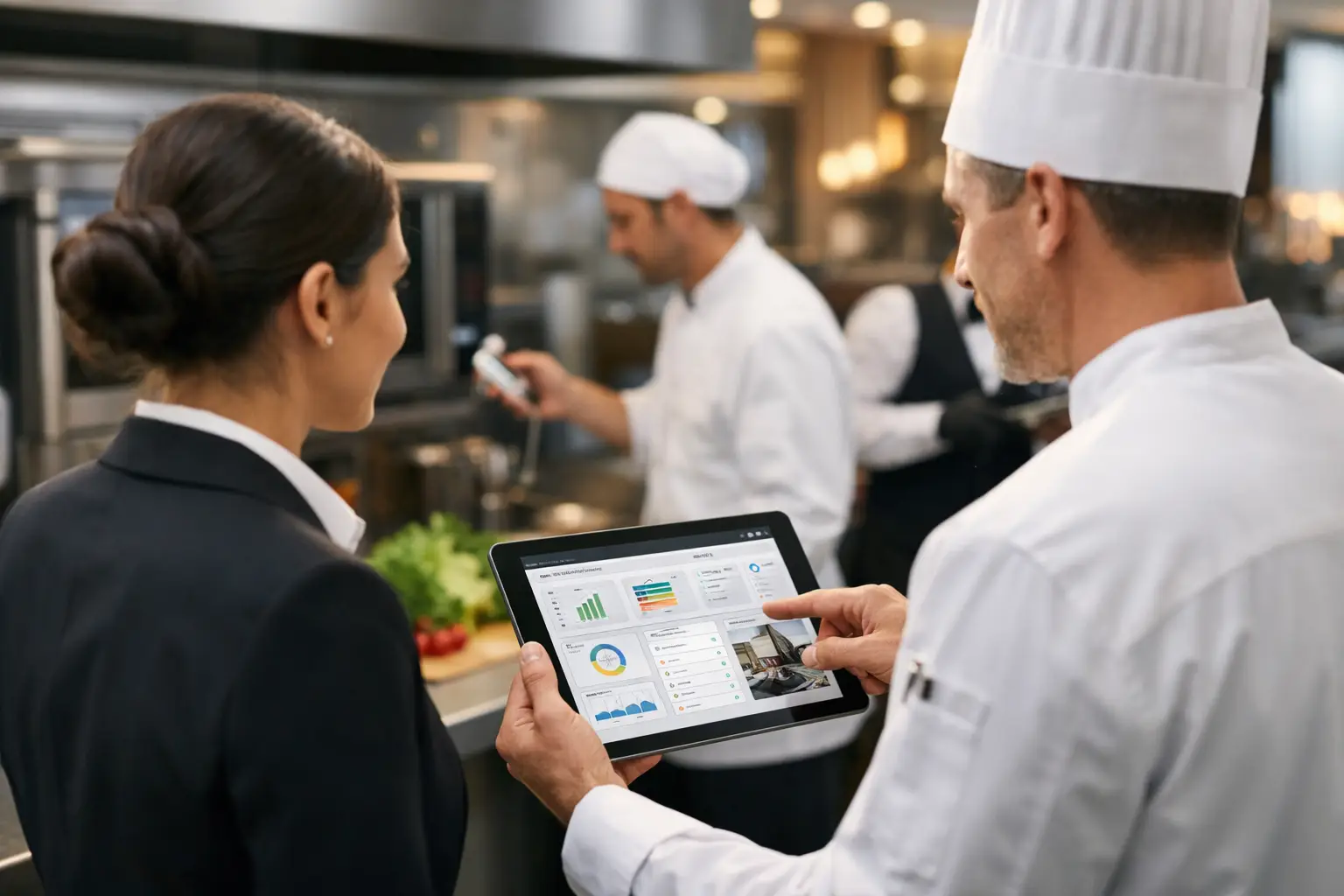
The stronger model is Hospitality Operational Intelligence: a connected operating layer that brings food safety knowledge, standards, briefings, verification, reporting, and manager action into the same working environment. Artificial intelligence can support that system, but the product value is Operational Intelligence - better-informed teams making safer, more consistent operational decisions.
In practice, a capable platform should help an operator answer questions that matter immediately. What is the approved allergen guidance for this dish? What action is required if chilled storage exceeds the permitted threshold? Which teams have confirmed the revised handling procedure? Which outlet has recurring gaps? Which managers need to intervene before an external audit identifies the issue?
That is materially different from collecting completed tasks. A completed task says a check was recorded. Operational Intelligence helps leadership understand whether the standard is known, followed, evidenced, and improving.
Food safety knowledge must be usable, not merely stored
Food safety documentation often becomes inaccessible at the point of work. It may be technically available, yet too difficult to find when a line cook, steward, server, or outlet manager needs an answer in seconds.
Teams need role-relevant guidance in clear language: allergen information for front-of-house staff, receiving procedures for stores teams, cooling and reheating rules for kitchen teams, and escalation requirements for managers. For global operators, the same standard must also be understandable across multilingual workforces without creating local interpretation gaps.
The goal is not to replace professional judgment. It is to make the approved operational standard easier to access and harder to misapply.
Briefings close the gap between policy and today’s operation
Food safety is dynamic. Menus change. Suppliers change. Equipment fails. Events create temporary production flows. Seasonal teams arrive. A food safety policy written six months ago cannot account for tonight's special event unless the relevant update reaches the people doing the work.
OI Briefings create a disciplined bridge between the standard and the current shift. A pre-service briefing can reinforce a new allergen concern, confirm a revised plating instruction, highlight a refrigeration issue, or remind a team about cross-contamination controls for a particular station.
The practical advantage is accountability with context. Managers can communicate what matters today rather than relying on a general annual training record to carry the entire compliance burden.
The Difference Between Compliance Evidence and Control
Audit readiness is often treated as a preparation exercise. Teams search for files, chase signatures, reconstruct events, and hope individual managers kept records consistently. That approach is expensive because it turns every audit into a recovery project.
A better operation builds audit readiness into normal work. Food safety evidence should show not only that checks occurred, but also what happened when a check failed. Was the issue escalated? Was product isolated? Was equipment assessed? Was a corrective action assigned and verified? Did the same issue recur?
This is where reporting becomes operational rather than administrative. Leadership does not need another spreadsheet containing hundreds of green checks. It needs a view of exceptions, repeated risks, incomplete follow-up, outlet trends, and areas where knowledge or supervision requires attention.
For example, if one property repeatedly records delayed cooling exceptions, the response may not be another reminder to complete a log. The root cause may be insufficient blast-chiller capacity, poor production sequencing, unclear ownership on late shifts, or a team that does not understand the required escalation process. The platform should help surface that pattern so an operations director can address the actual cause.
How to Evaluate Food Safety Platforms
The right platform depends on the complexity of the operation. A single independent restaurant has different needs from an international hotel group with central kitchens, room service, banquets, bars, and multiple dining concepts. However, hospitality leaders should assess every option against four practical questions:
- Can teams find approved food safety and allergen knowledge quickly during service?
- Can managers communicate changing risks and confirm that critical guidance has reached the right people?
- Can the business document exceptions, corrective actions, and verification rather than only routine completion?
- Can leadership see patterns across outlets early enough to act?
If the answer is no, the organization may have a recordkeeping tool rather than a true operational control system.
Integration also deserves careful consideration. The best approach is not always the platform with the longest feature list. It is the one that fits the operating rhythm of the business. If managers must duplicate information across separate systems, adoption falls and data quality follows. If teams cannot use the system on the floor, in the kitchen, or during a shift handover, the most polished dashboard will not protect the guest.
Building Food Safety Into Operational Leadership
Food safety performance improves when ownership is specific. Executive leadership should define non-negotiable standards and review recurring operational risk. Property and outlet leaders should turn those standards into daily behaviors. Managers should verify execution and act on exceptions. Every team member should know when to stop, ask, escalate, and document.
That structure requires more than periodic training. It requires OI Knowledge that stays current, OI Onboarding that prepares new hires for real scenarios, OI Briefings that focus teams before service, and OI Reports that help leaders see where standards are weakening.
SmartHospitality.AI is designed around this broader Hospitality Operational Intelligence model. Food safety becomes connected to service consistency, staff knowledge, audit readiness, operational reporting, and manager visibility because, in real hospitality operations, those disciplines are inseparable.
The strongest food safety culture is visible long before an inspection or a guest complaint. You see it when a server pauses to verify an ingredient instead of guessing, when a supervisor records and resolves an exception rather than hiding it, and when leaders use recurring signals to fix the operation before the next shift inherits the problem.