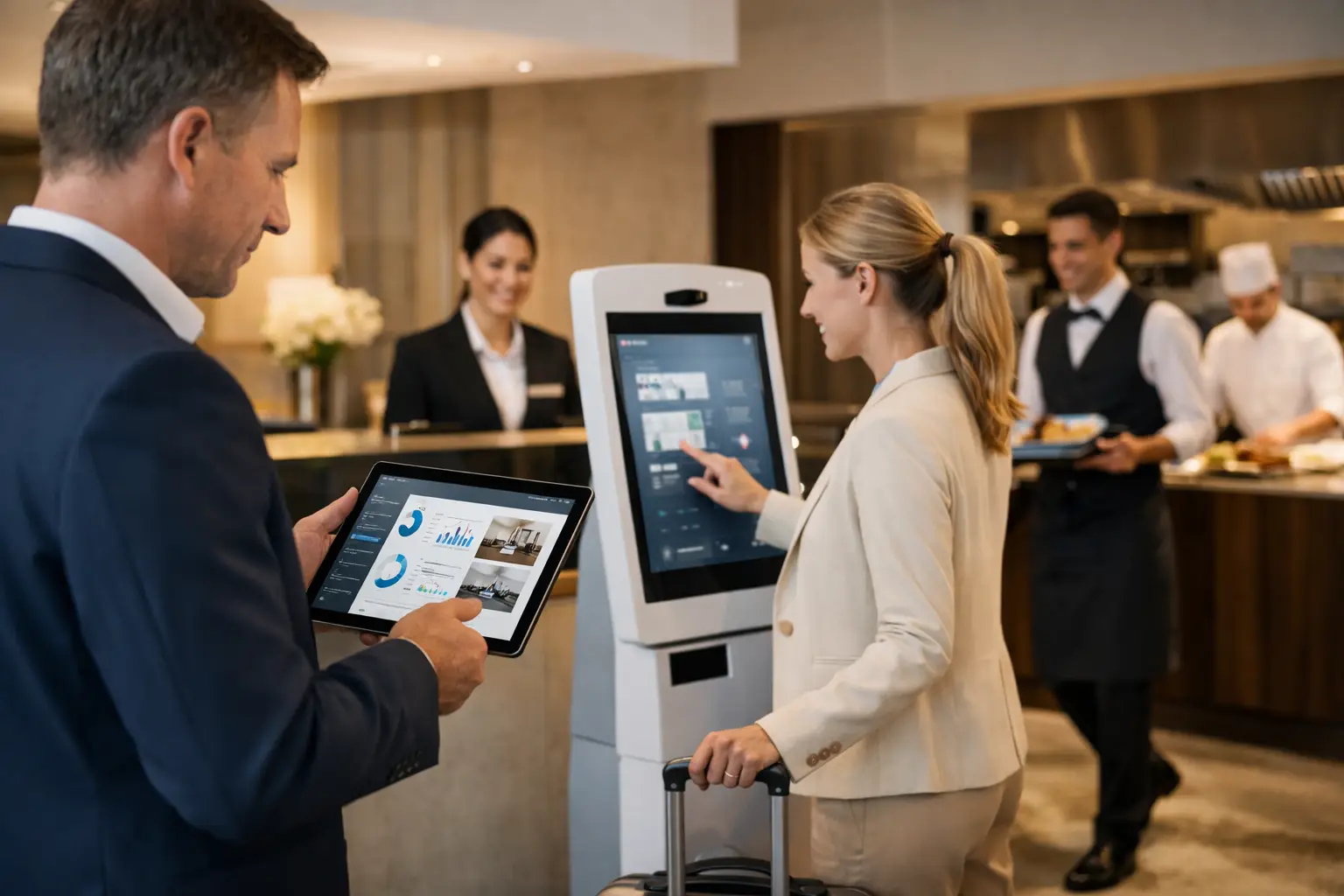
A Saturday dinner rush tells the truth faster than any boardroom deck. A new server cannot answer an allergen question with confidence. A bartender misses a premium pour upsell. A supervisor forgets a pre-shift briefing point that would have prevented a guest complaint. This is where the use of AI in hospitality industry operations stops being a trend story and becomes a performance issue.
For operators, AI matters when it reduces the daily friction that drains margin, weakens standards, and puts guest trust at risk. The real opportunity is not replacing hospitality. It is giving teams faster access to the right knowledge, tightening execution across shifts, and giving leaders visibility into what staff know, what they are missing, and where the operation is exposed.
Where the use of AI in hospitality industry actually creates value
Hospitality has never had a technology problem. It has had an execution problem. Most properties and restaurant groups already run a stack of systems for POS, labor, reservations, inventory, accounting, and messaging. Yet managers still spend hours answering repeat questions, retraining on the fly, chasing checklist completion, and discovering service failures after the guest has already felt them.
That is why the strongest use cases for AI sit inside day-to-day operations. Not as novelty features, but as operating intelligence. AI can help close knowledge gaps in real time, standardize training for multilingual teams, support shift leaders with structured pre-service communication, and surface patterns that managers would otherwise miss until they show up as lost revenue or audit exposure.
This distinction matters. A flashy chatbot on a website may look innovative. A system that helps a server confidently answer "Is this sauce dairy-free?" during live service protects trust, compliance, and check average all at once.
The highest-impact use cases for operators
The use of AI in hospitality industry settings is broad, but not every application carries the same business value. For most food and beverage leaders, the most immediate returns show up in five areas: staff knowledge support, onboarding and training, service consistency, compliance readiness, and management visibility.
Staff knowledge support during service
Frontline teams lose revenue when they hesitate. If staff cannot explain modifiers, allergens, wine pairings, premium substitutions, or menu differences between outlets, the guest experience slows down and the sale often shrinks. AI can serve as an instant knowledge layer for servers, runners, bartenders, and hosts by making approved answers available in seconds.
That speed matters most in environments with frequent menu changes, seasonal programming, banquet variations, and mixed-experience teams. Fine dining and luxury hotel outlets are especially vulnerable because the service standard is high, but turnover and cross-training demands are still real. When answers live in a manager's head, the floor bottlenecks. When knowledge is structured and instantly accessible, service sharpens.
Onboarding and training automation
Most operators know the hidden cost of inconsistent onboarding. New hires get a rushed orientation, shadow whoever happens to be on shift, and absorb a different version of standards depending on the outlet and the manager. The result is predictable: uneven guest experience, repetitive supervision, and a longer ramp to productivity.
AI can tighten this process by delivering role-specific training, reinforcing knowledge after day one, and identifying where comprehension is weak before it becomes visible on the floor. That does not eliminate the need for live coaching. It makes that coaching more targeted. A good operator does not want less human leadership. They want less wasted leadership time.
Pre-shift briefings and service execution
Pre-shift is one of the most underused performance levers in hospitality. It should align the team on covers, VIPs, 86'd items, allergy flags, service priorities, and upsell focus. In reality, it is often rushed, inconsistent, or skipped when the operation is under pressure.
AI can support structured briefings by pulling together the right points, standardizing the format across outlets, and ensuring critical information is not left to memory. That is not glamorous, but it is operationally powerful. Service consistency is built in the minutes before the doors open.
Audit readiness and compliance
Compliance exposure rarely starts as a major event. It starts with small misses that become patterns: incomplete side work, unclear accountability, missing documentation, weak allergen communication, or inconsistent opening and closing procedures. Manual checklists can help, but they often create false confidence because completion is not the same as readiness.
AI becomes useful when it does more than record tasks. It can identify recurring gaps, flag risk areas by outlet or manager, and show where standards are consistently slipping. For hotel and multi-unit operators facing brand audits, health scrutiny, and internal accountability demands, this is where AI shifts from convenience to control.
Manager visibility
One of the biggest blind spots in hospitality is not labor cost or food cost. It is leadership visibility. Senior operators often do not know where knowledge is weak, which managers coach well, which teams are under-briefed, or which outlets are carrying hidden execution risk until results deteriorate.
AI can help create a clearer view of manager performance and team readiness. That matters because operational problems are rarely isolated. Weak onboarding leads to more floor questions. More floor questions pull managers out of supervision. Reduced supervision creates service inconsistency. Service inconsistency hurts revenue and guest trust. Better visibility helps break that chain earlier.
What AI cannot fix on its own
Operators should be skeptical of oversized claims. AI will not fix a broken culture, rescue poor hiring standards, or replace floor presence from experienced leaders. If menu engineering is weak, SOPs are outdated, and managers do not enforce standards, adding AI on top will not solve the underlying issue.
It also depends on the quality of the information feeding the system. If policies are contradictory, recipe specs are stale, or service standards vary by manager, AI can scale confusion just as efficiently as it scales clarity. The technology works best when the operation has defined standards and the discipline to maintain them.
There is also a trust issue to manage. In hospitality, bad information carries real cost. A wrong allergen answer is not a minor error. An inaccurate banquet detail can damage a client relationship. That is why operators should favor controlled, approved knowledge environments over general-purpose AI tools that are not designed for live service risk.
How to evaluate the use of AI in hospitality industry operations
The right question is not, "Do we need AI?" The right question is, "Where are we losing money, consistency, or control because our teams do not have the right knowledge at the right moment?"
Start with the operational pain, not the technology category. If your property struggles with repetitive staff questions, uneven onboarding, weak pre-shift discipline, inconsistent upselling, or audit anxiety, then AI may have a clear role. If your operation is already highly standardized and leadership visibility is strong, the value case may be narrower or more specialized.
Evaluation should stay close to service-floor realities. Can the system answer role-specific questions accurately? Can it support multilingual teams? Can it reinforce standards across outlets without creating extra admin work? Can it give leaders meaningful visibility instead of another dashboard no one uses? If the answer is no, the tool may create more noise than value.
For many operators, the strongest fit is not a generic AI platform. It is a purpose-built hospitality operating system that connects knowledge, training, checklist discipline, briefings, and manager visibility into one workflow. That is where AI starts to function like a daily nervous system instead of a disconnected feature.
SmartHospitality.AI is built around that exact operational reality: closing the knowledge gaps that sit behind missed upsells, allergen risk, inconsistent onboarding, and weak manager visibility across food and beverage service.
The real shift operators should pay attention to
The hospitality businesses that gain the most from AI will not be the ones making the loudest claims about innovation. They will be the ones using it quietly, inside daily execution, to protect standards and capture more value from every shift.
That means fewer avoidable questions during service. Faster ramp time for new hires. Better upsell consistency. Stronger audit readiness. Clearer accountability from outlet leadership. None of this replaces hospitality's human core. It protects it by removing preventable failure points.
For decision-makers, that is the standard worth using. If AI helps your team perform better under real operating pressure, it belongs in the business. If it only adds another layer of software theater, it does not. The strongest systems are the ones your staff actually lean on when the room is full, the clock is moving, and there is no margin for guesswork.