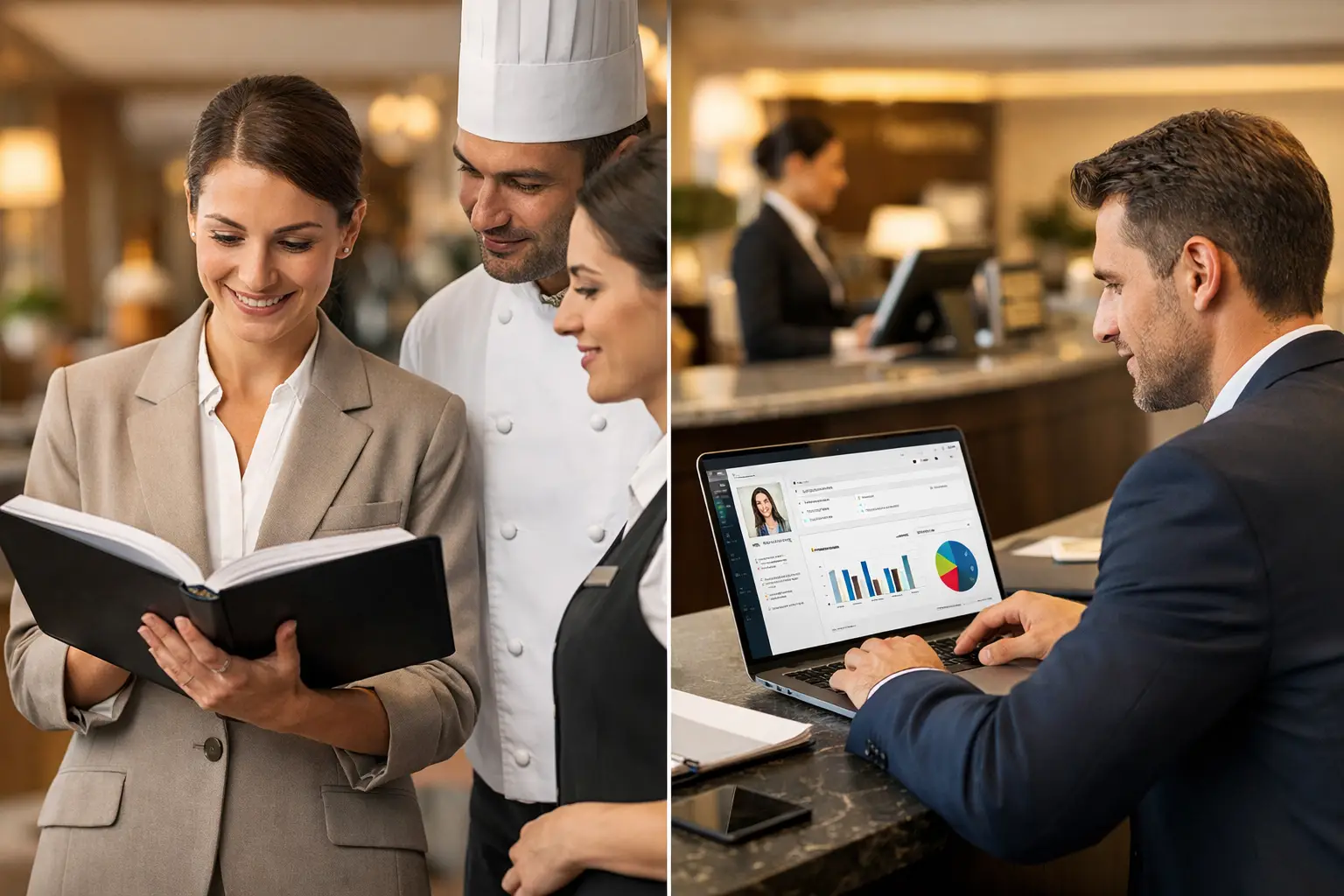
A new server is five minutes from a fully booked dinner service when a guest asks whether the sea bass sauce contains dairy, which wine best supports a gluten-free order, and whether the kitchen can accommodate both requests. The answer cannot live at the bottom of a 60-page training binder, or depend on finding the floor manager during a rush. That is the real issue behind training manuals vs AI support in hospitality: not whether teams need standards, but whether those standards are available, trusted, and usable at the exact moment service depends on them.
For hotel and restaurant leaders, the cost of inaccessible knowledge is not abstract. It appears as a missed upsell, an inconsistent welcome, a delayed recovery, an allergen exposure, or another manager interrupted to answer a question that should already be operationally clear. Manuals remain valuable. But a manual alone is a static record of how the operation intends to work. Hospitality Operational Intelligence turns that record into a working operating system for the floor.
Why Training Manuals Still Matter
A well-built training manual establishes the non-negotiables. It documents service sequence, brand language, opening and closing standards, menu descriptions, safety procedures, escalation paths, and role expectations. For a luxury hotel, it may preserve the details that make a suite arrival feel considered rather than transactional. For a restaurant group, it can ensure every outlet begins with the same foundation even when menus, concepts, and local regulations differ.
Manuals are especially useful for formal onboarding, audit documentation, and controlled policy updates. They give leaders a reference point when coaching performance and make it possible to define what “good” looks like across a dispersed operation.
The problem is not the manual. The problem is the operating conditions around it.
Hospitality teams work across split shifts, multiple languages, noisy back-of-house spaces, changing menus, seasonal promotions, and high-pressure guest interactions. A document that is accurate on Monday may be difficult to find on Friday night. A new team member may have completed training but still be unable to apply the knowledge when the question is specific, time-sensitive, or outside the examples covered in orientation.
A manual also struggles to show leaders where knowledge is breaking down. If ten servers ask the same question about a new tasting menu, the document has not necessarily failed. But the operation needs visibility that the question is recurring, that the answer may need clarification, and that a pre-shift briefing should address it before service starts.
Training Manuals vs AI Support: The Wrong Binary
The phrase “training manuals vs AI support” suggests a replacement decision. In a high-performing hospitality operation, that is the wrong decision framework.
The more useful question is this: how does the organization convert approved standards into reliable behavior during every shift?
Operational Intelligence uses approved operational knowledge as the foundation, then makes that knowledge practical in context. The AI is the engine behind the experience, but the value is Hospitality Operational Intelligence: connected onboarding, SOP access, pre-shift guidance, manager visibility, operational reporting, and decision support built around the realities of service.
A static manual answers, “What is our standard?” An OI Assistant can help a team member find the approved answer when the guest is waiting. OI Insights can show managers where questions, confidence gaps, or performance issues are concentrating. OI Briefings can turn recurring friction into a focused conversation before the next shift begins.
That distinction matters because a generic answer is not enough. A server does not need a broad explanation of food allergies. They need the operation’s current, approved allergen process, the correct escalation point, and confidence that they are following the right standard. A front desk agent does not need general advice about late checkout. They need the property’s policy, the relevant guest-service considerations, and clear next steps.
The Operational Cost of Static Knowledge
Most leadership teams can identify the visible costs of turnover: recruitment, onboarding hours, uniforms, and manager time. The larger cost often sits in the first weeks after onboarding, when employees technically have access to training but do not yet have operational confidence.
That gap creates friction across the business. Guests receive different answers from different employees. Managers become the human search engine for routine questions. Sales opportunities are missed because staff cannot confidently explain a premium product, pairing, upgrade, or experience. Compliance exposure increases when a team member guesses rather than follows the correct procedure.
Consider a multi-outlet resort launching a new cocktail program. The manual may include every recipe, garnish standard, selling point, and responsible-service requirement. Yet if bartenders repeatedly ask about substitutions, portioning, or guest language, service slows and revenue consistency weakens. If one bar sells the signature cocktail confidently while another barely mentions it, the issue is not simply individual performance. It is a knowledge-management and leadership-visibility issue.
The same pattern applies to hotel operations. Housekeeping may know the room inspection standard, but a newly promoted supervisor may need immediate guidance on documenting a defect, escalating a maintenance concern, or prioritizing an out-of-order room during peak arrivals. The process exists. The challenge is making it accessible and observable in the flow of work.
What Operational Intelligence Adds to the Manual
Hospitality Operational Intelligence does not reduce operational standards into disconnected prompts or generic recommendations. It connects the knowledge base to the daily rhythm of the business.
First, it supports role-specific access to operational knowledge. A banquet captain, concierge, room service agent, and restaurant host should not have to interpret the same dense document to find what applies to their role. They need relevant, approved guidance in language that is clear enough to use under pressure.
Second, it creates a feedback loop. When the same questions appear repeatedly, leadership can see the pattern. That can signal a weak onboarding section, a confusing SOP, an unclear menu update, or a manager coaching need. The response is then operational: improve the standard, issue a briefing, reinforce training, and monitor whether the gap closes.
Third, it strengthens shift readiness. Strong pre-shift briefings are not announcements read from a clipboard. They should prepare people for the service ahead: VIP notes, menu changes, allergen reminders, revenue priorities, guest-recovery themes, and recurring questions that need a clear answer. OI Briefings help turn operational data and knowledge gaps into more focused leadership moments.
Fourth, it improves audit readiness without treating compliance as a once-a-year event. Audit readiness is built in ordinary shifts, when employees can locate current procedures, managers can reinforce standards, and leaders can identify areas where the operation is relying on memory rather than controlled knowledge.
Where Human Leadership Remains Essential
No platform should replace the judgment of an experienced general manager, restaurant manager, chef, or department head. Hospitality is built on presence, observation, coaching, and decisions that require situational awareness.
A manager sees that a team member is technically correct but uncomfortable with guests. A chef recognizes when a menu explanation is being repeated without conviction. A front office leader notices when a policy is being followed in a way that does not match the moment. Those are leadership responsibilities.
Operational Intelligence makes that leadership more effective by removing avoidable repetition and surfacing the issues that deserve human attention. Instead of answering the same SOP question twenty times, a manager can coach service language, inspect execution, develop supervisors, and protect the guest experience.
It also requires discipline. The knowledge behind the system must be current, approved, and owned. If menu information, safety procedures, or escalation paths are not maintained, faster access simply spreads outdated guidance faster. The strongest operators assign clear ownership, review changes regularly, and use the insights generated by the operation to improve the knowledge itself.
A Practical Decision Framework for Operators
If your manuals are current, used consistently, and supported by managers who have time to coach, you may not need major change in every area. A smaller independent property with stable teams and limited complexity may benefit first from refining the manual, shortening onboarding content, and improving pre-shift communication.
But the case for Operational Intelligence becomes stronger when the organization manages multiple properties or outlets, multilingual teams, frequent menu changes, elevated compliance requirements, high turnover, luxury service expectations, or recurring manager interruptions. These conditions make knowledge retrieval, consistency, and visibility operational priorities rather than training conveniences.
Start by examining the questions managers hear every week. Which answers should staff be able to access independently? Which standards are being applied differently across shifts or locations? Where are teams losing revenue because product knowledge is weak? Which procedures create the greatest audit or guest-safety exposure when they are misunderstood?
Those questions reveal the most valuable place to connect manuals, onboarding, SOPs, and daily service intelligence. SmartHospitality.AI is designed for this operating reality: bringing approved knowledge and real-time operational visibility into one Hospitality Operational Intelligence platform.
The best manual is still worth writing. The better operating model ensures that its standards are present when a guest asks, visible when a manager needs to coach, and continuously improved when the business shows you where execution is breaking down.