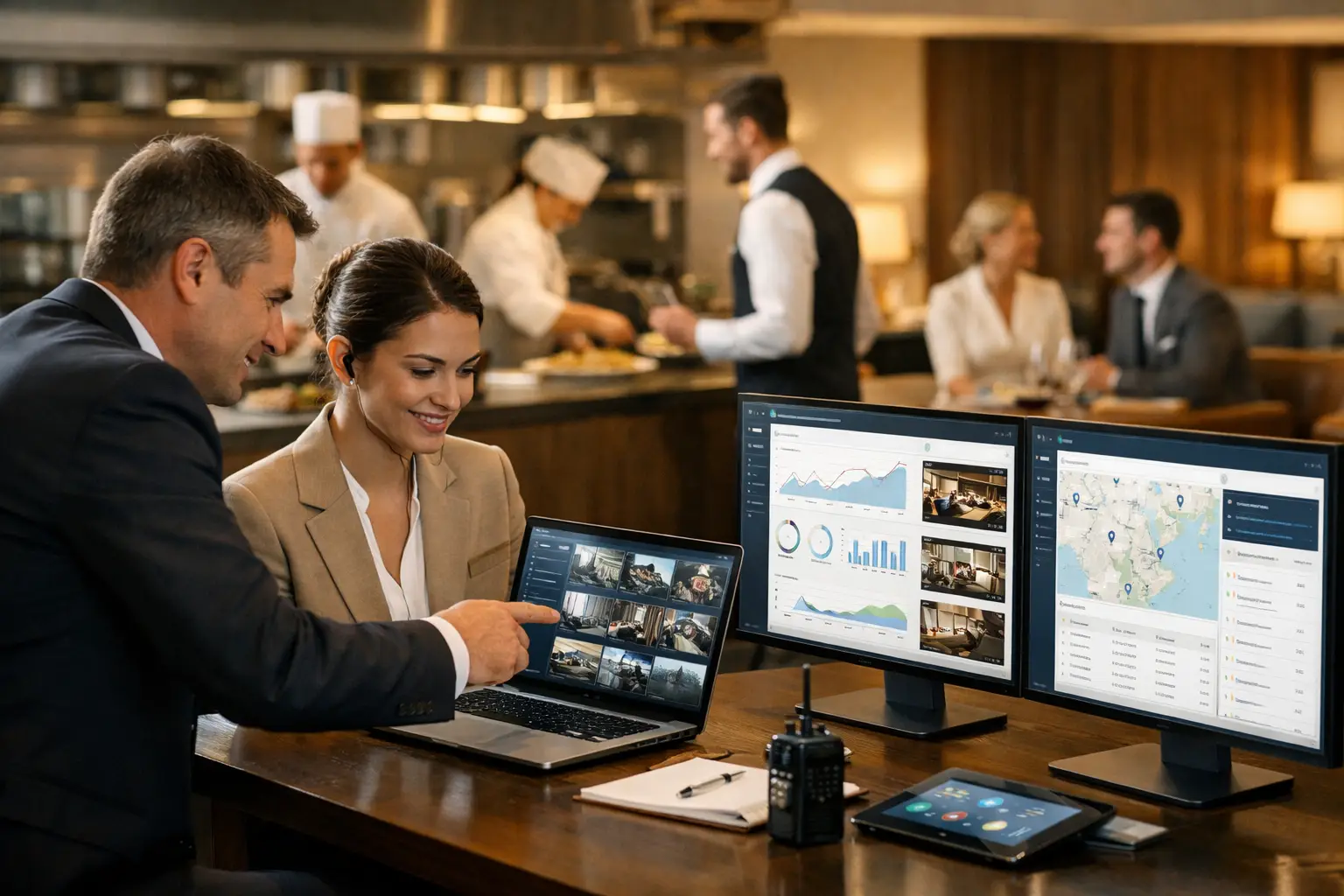
A property can have approved SOPs, completed training records, strong guest feedback, and clean audit scores—then still deliver an inconsistent Saturday night service. The issue is rarely a lack of information. It is that the information sits in separate places, reaches managers too late, or never becomes a practical instruction for the next shift. Signal fusion in hospitality operations addresses that gap by bringing the operational signals that matter into one decision-making picture.
For hospitality leaders, this is not a technology exercise. It is a control issue. A missed allergen question, an uneven upsell rate, repeated confusion over a new menu item, or a recurring room-service delay can each look minor in isolation. Together, they point to a standard that is not holding. The operator who sees the pattern early can brief, coach, and correct it before it becomes a guest complaint, revenue leak, or audit finding.
What Signal Fusion Means in Hospitality Operations
What Is an Operational Signal?
An operational signal is an observable event, change, exception, or recurring pattern that may require management attention. It could be a staff question, an incomplete onboarding milestone, a missed standard, an audit observation, a guest complaint, a sales variance, or a repeated service delay.
One signal rarely proves the cause of a problem. Its value increases when it is compared with other signals from the same role, outlet, shift, process, or period. Signal fusion turns those separate observations into a more complete operating picture.
Signal fusion is the process of connecting operational inputs that are normally reviewed separately, then interpreting them in context. In a hotel or restaurant group, those inputs may include onboarding progress, staff knowledge questions, pre-shift briefing topics, service observations, audit findings, menu changes, guest feedback themes, sales performance, and manager reports.
The goal is not to create another dashboard full of numbers. A dashboard can tell a director that beverage attachment fell by 4% in one outlet. Operational Intelligence should help answer the questions that follow: Is the team confident with the new cocktail list? Did the relevant briefing reach the right people? Are managers observing the right selling behaviors? Is the issue isolated to one shift, one outlet, or a wider knowledge gap?
That distinction matters. Data reports what happened. Hospitality Operational Intelligence connects what happened to the operational conditions behind it and gives leaders a clearer basis for action.
Why Isolated Systems Create Leadership Blind Spots
Most established hospitality businesses already have systems for training, reporting, audits, scheduling, point of sale, and guest feedback. The weakness is not necessarily the individual systems. It is the handoff between them.
Consider a new seasonal menu in a multi-outlet restaurant group. Culinary has issued the specifications. Training has circulated product knowledge. Managers have held a pre-shift briefing. Yet, servers are still giving incomplete answers about ingredients and pairings during service. At the same time, attachment to the featured items is under target and two guest comments mention uncertainty around dietary requests.
In a fragmented operation, each fact may be handled by a different person. Training sees completion. The manager hears questions on the floor. Revenue leadership sees weak sales after the week has closed. Quality sees the guest comments later. By then, the service period that exposed the problem has passed.
Signal fusion brings those signals together while managers can still influence the next shift, rather than discovering the full pattern after the opportunity to act has passed. The proper response may be a focused five-minute briefing, a revised knowledge prompt, a manager observation during the next peak period, or a temporary escalation path for allergen questions. It is rarely a broad retraining program. Precision is what prevents operational teams from wasting time while the real issue continues.
The Operational Signals That Should Be Connected
Not every available metric needs to be fused. Operators should start with the information that influences guest experience, compliance exposure, staff performance, and revenue optimization. Four signal groups usually provide the strongest foundation:
- Knowledge and readiness signals: onboarding progress, policy acknowledgments, recurring staff questions, knowledge checks, and completion of role-specific updates.
- Service execution signals: manager observations, missed standards, delayed service handoffs, briefing participation, quality checks, and recurring guest-request themes.
- Commercial signals: average check movement, category attachment, promotion uptake, upsell performance, void patterns, and outlet-level variance.
- Risk and compliance signals: audit exceptions, allergen-related questions, food safety observations, policy gaps, incident themes, and overdue corrective actions.
The value comes from the relationships between these groups. A single missed audit question may be a coaching opportunity. The same issue appearing alongside incomplete policy knowledge and repeated manager escalations is a control weakness. A weak upsell result may reflect low effort, but it may also reflect poor product confidence, unclear selling language, or a briefing that failed to reach a high-turnover team.
Leaders should also resist the temptation to treat every correlation as a cause. If guest satisfaction dips on a busy weekend, the cause could be staffing, demand mix, a menu change, maintenance disruption, or inconsistent shift leadership. Operational reasoning narrows the field and directs investigation. It does not replace sound managerial judgment.
How Signal Fusion Works in Hospitality Operations
A practical signal-fusion process has four stages.
- Collect relevant signals: Bring together the operational evidence connected to the issue, such as employee questions, briefing activity, onboarding progress, audit findings, guest feedback, manager observations, and commercial performance.
- Align the context: Compare the signals by property, outlet, role, shift, daypart, menu cycle, or relevant time period. Signals from unrelated operating conditions should not be treated as evidence of the same problem.
- Look for convergence and recurrence: Determine whether several signals point towards the same weakness and whether the pattern is repeating. One employee question may be isolated. Repeated questions combined with low confidence and audit observations indicate a more significant control gap.
- Convert the pattern into action: Decide whether the response requires clarification, coaching, a briefing update, an SOP revision, immediate escalation, or further investigation. Then monitor whether the action changes the signals during later shifts.
Within the five-stage OI Framework, the purpose is not to make every correlation look meaningful. It is to give managers enough connected evidence to investigate the right problem and select a proportionate response.
From Reports to OI Briefings and Recommendations
The most useful output of signal fusion is not a longer report. It is a better operating conversation.
A morning OI briefing for a hotel general manager might identify that breakfast service complaints increased on two consecutive days, concentrated around delayed coffee replenishment. It could also show that a recent equipment change created repeated staff questions and that the same outlet has a new cohort of team members. The briefing should direct attention to the operating need: confirm equipment procedures, assign clear station ownership, and have the outlet manager observe the first 90 minutes of the next breakfast service.
For a restaurant operations director, an OI report might show that a premium wine promotion is performing well in three locations and poorly in two. Before assuming the underperforming teams lack sales discipline, the director can examine readiness signals. Were the teams briefed on the wine story, pairing recommendations, and guest language? Are questions coming through on the product? Did the outlet experience unusual staffing changes? The intervention can then be commercial and practical, rather than a generic instruction to sell more.
This is where OI Briefings and OI Recommendations become part of the daily nervous system of the operation. They translate operational signals into priorities for the people running service. Effective Operational Decision Intelligence produces recommendations that are specific enough to act on, but not so prescriptive that they ignore local manager expertise.
Building Signal Fusion Without Creating More Administration
The operational risk is obvious: leaders can create a new reporting burden in the name of visibility. If managers must spend an extra hour tagging every floor observation, the process will fail during peak service. Signal fusion must be designed around the work already happening.
Start with a limited number of priority use cases. For many organizations, allergen safety, onboarding consistency, service standards, and upselling performance are the right starting points because they combine high business impact with visible operational signals. Establish what each leader needs to know, what action should follow, and who owns the response.
Then define the cadence. Some signals need immediate escalation, such as a serious allergen-control failure. Others belong in a pre-shift briefing, a weekly outlet review, or a monthly multi-property operating report. Treating every signal as urgent produces alert fatigue and weakens manager attention.
Data quality also matters more than data volume. If audit observations are vague, staff questions are not categorized, or managers use different definitions of a missed standard, the resulting insight will be unreliable. Clear operational language, consistent standards, and role-based reporting create the foundation for useful OI Insights.
A practical test is whether the output changes behavior. If an outlet manager receives a report but cannot identify what to coach before the next shift, the report is too abstract. If a regional director can see recurring performance gaps but has no visibility into whether corrective coaching occurred, the operating loop remains open.
What Signal Fusion Changes for Multi-Unit Leadership
For a single independent venue, experienced managers may hold much of the operation in their heads. That approach becomes fragile as the business expands across outlets, properties, languages, brands, and service formats. Knowledge leaves with employees. Standards become vulnerable to interpretation. Senior leaders receive summaries that are too late and too broad to prevent drift.
Signal fusion gives multi-unit leadership a way to see both the enterprise pattern and the local reality. A regional leader can identify whether the same knowledge gap appears across several properties. A general manager can see whether an issue is concentrated in one daypart. A department head can determine whether a standard is understood but not consistently executed.
SmartHospitality.AI is designed around this Hospitality Operational Intelligence model: connecting OI Knowledge, OI Onboarding, OI Briefings, OI Reports, and manager visibility into a single operational layer. The intelligence is only valuable when it helps operators protect standards, improve staff performance, and make decisions with greater speed and confidence.
Key Takeaways
- Signal fusion connects separate operational observations to reveal patterns that may not be visible in one system or report.
- Relevant signals can come from staff questions, onboarding, briefings, audits, guest feedback, manager observations, and commercial results.
- Several signals must be aligned by outlet, role, shift, and operating context before leaders draw conclusions.
- Signal fusion should guide investigation and action without treating every correlation as proof of cause.
- Its value is measured by whether managers can brief, coach, verify, or correct an issue before it repeatedly affects guests.
Frequently Asked Questions
What Is Signal Fusion in Hospitality Operations?
Signal fusion is the process of connecting operational information that would normally be reviewed separately. This may include staff questions, onboarding activity, briefings, audits, guest feedback, service observations, and commercial results. The objective is to identify patterns, understand where operational risk is developing, and give managers a clearer basis for investigation and action.
What Is an Example of Signal Fusion in a Restaurant?
A restaurant may see weak premium wine sales, repeated staff questions about pairings, and low product-confidence results after a new list launches. Each observation provides limited information alone. Together, they suggest that product knowledge or briefing quality may be affecting sales performance. The manager can then reinforce specific pairings and observe whether results improve.
How Is Signal Fusion Different From Normal Reporting?
Normal reporting usually presents results from one system, such as sales, training completion, guest feedback, or audit findings. Signal fusion compares several forms of operational evidence and considers their shared context. Rather than only showing what happened, it helps managers investigate why it may be happening and decide what should be checked or addressed next.
Can Signal Fusion Prove the Cause of an Operational Problem?
Not necessarily. Connected signals can indicate a strong pattern, but they do not automatically prove causation. A fall in guest satisfaction could relate to staffing, equipment, demand, training, or leadership. Signal fusion narrows the investigation and highlights the most plausible operational causes. Experienced managers still need to verify the circumstances before deciding on corrective action.
Which Hospitality Signals Should Leaders Connect First?
Begin with signals related to high-risk or high-frequency workflows. These may include allergens, onboarding readiness, guest recovery, audit findings, service delays, menu knowledge, upselling, or recurring SOP questions. Select signals that managers already use and connect them around a defined operational problem rather than attempting to combine every available metric at once.
Does Signal Fusion Create More Work for Managers?
It should not. A poorly designed process can create extra reporting and tagging, but effective signal fusion uses information already produced during operations. The goal is to reduce manual investigation by bringing relevant evidence together. Managers should only be asked to capture information that supports a clear decision, escalation, coaching action, or follow-up process.
Conclusion
The organizations that benefit most will not be the ones collecting the most information. They will be the ones that turn scattered operational evidence into a clear next action: brief this team, coach this behavior, verify this control, and follow up before the next guest experiences the gap.