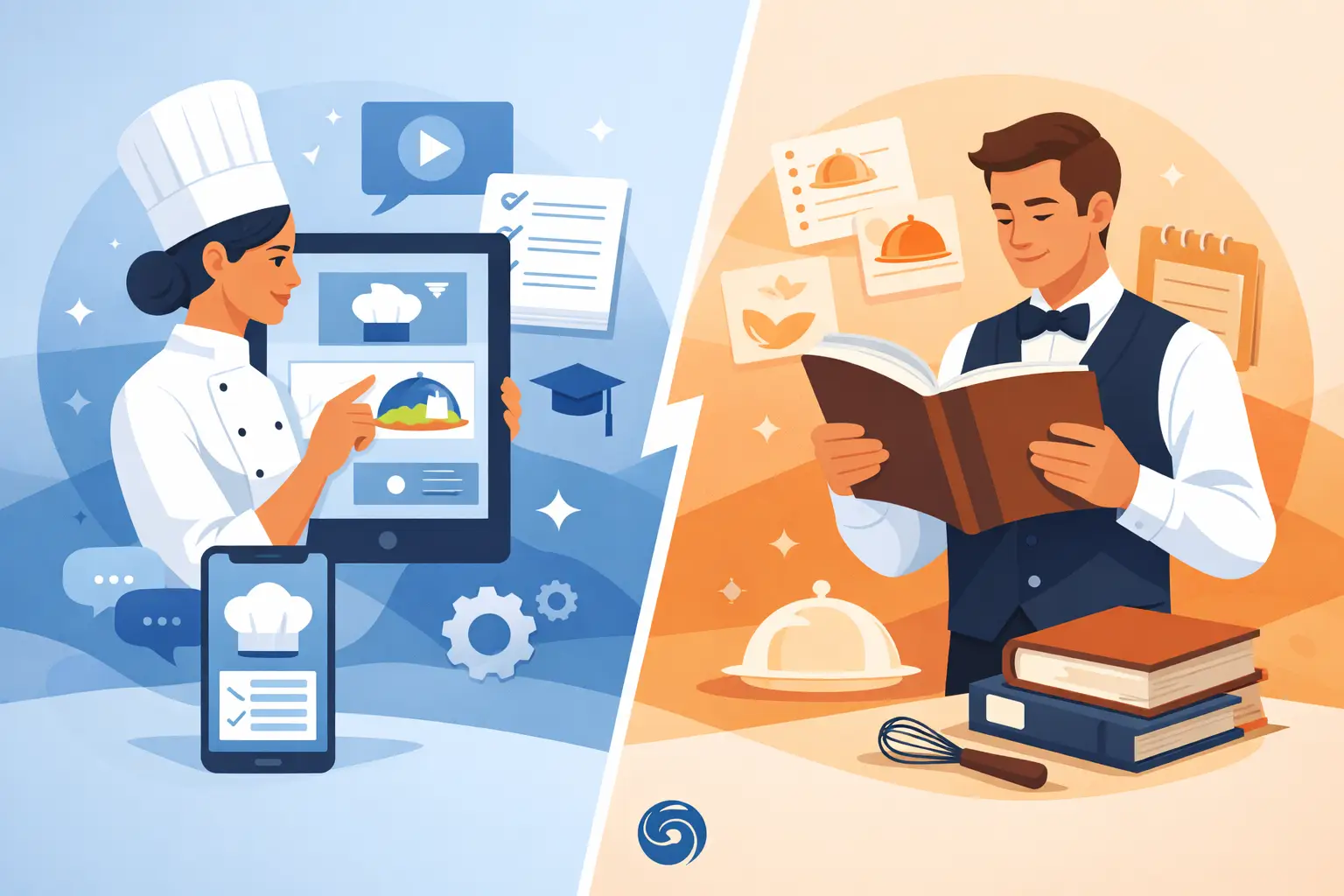
A server is three tables deep, a new hire is asking where to find the allergy matrix, and a manager is flipping through a binder that should have been replaced two menu changes ago. That is the real frame for the restaurant training app vs manuals debate. This is not a style preference. It is an operating decision that affects revenue capture, guest safety, speed to competency, and how much time leaders spend repeating themselves.
For hospitality operators, manuals have always offered one advantage: they feel complete. A printed handbook, recipe book, or SOP binder gives the impression that training exists because documentation exists. But service floors do not run on documentation alone. They run on recall, repetition, consistency, and access in the moment of need. That is where the gap opens.
Restaurant training app vs manuals: what changes operationally
The core difference is not digital versus paper. It is static information versus active operating intelligence.
Manuals are fixed. Even when they are detailed, they rely on staff finding the right page, reading it at the right time, interpreting it correctly, and remembering it under pressure. In a quiet office, that may seem reasonable. In a restaurant during pre-shift, a banquet turnover, or Friday dinner service, it breaks down fast.
A training app changes the rhythm of execution. It can deliver onboarding in sequence, reinforce knowledge with short assessments, surface answers quickly, track completion, and show managers where understanding is weak before the mistake reaches the guest. That matters because most training failures are not caused by lack of content. They are caused by lack of reinforcement and lack of visibility.
If a bartender forgets the premium spirit upsell path, if a food runner cannot answer a basic allergen question, or if a room service attendant misses a standard because they were trained verbally by three different supervisors, the cost is immediate. Manuals do not tell you where those gaps are building. An app can.
Where manuals still have value
Printed manuals are not useless. They are still workable in a few cases.
For stable operations with low staff turnover, limited menu complexity, and highly tenured managers, manuals can support baseline documentation. They are also useful as formal reference records for brand standards, health procedures, or back-office policy. Some operators prefer a physical backup for critical SOPs, and that is sensible.
But that is not the same as saying manuals are sufficient for training. Documentation is not capability. Many restaurants confuse the two.
A manual can explain wine service steps. It cannot show whether a new server actually understands the by-the-glass program, knows which bottle drives margin, or can present pairings confidently at table twelve on a busy Saturday night. In other words, manuals store information, but they do not manage performance.
Why manuals break down in modern hospitality
Most hospitality environments now operate with some mix of high turnover, multilingual staffing, menu changes, rotating promotions, audit pressure, and uneven manager bandwidth. Those conditions expose every weakness of manual-based training.
First, manuals age badly. A signature cocktail changes, a POS workflow shifts, an allergen notation is updated, and suddenly the binder is wrong. Even if leadership knows it is outdated, staff may still rely on it because it is the only visible source they have.
Second, manuals are passive. They do not prompt follow-up, confirm retention, or identify who skipped key material. A manager may assume onboarding happened because the packet was handed out. That assumption is expensive.
Third, manuals create inconsistency across outlets and shifts. One location uses the latest version, another uses an older one, and a third relies on verbal workarounds. The result is standard drift. In multi-unit groups, that turns into a brand problem quickly.
Fourth, manuals consume manager time in the least efficient way. Instead of coaching against actual knowledge gaps, managers spend hours repeating basic facts, answering the same questions, and trying to remember who has been trained on what.
That is the hidden cost most operators feel but do not always quantify. Training friction is not just an HR issue. It slows labor productivity, weakens guest confidence, and leaves leaders blind.
What a restaurant training app does better
A strong training app is not just a digital manual. If it is only a PDF viewer on a phone, the operational gain is limited. The real value comes when the system supports how restaurants actually train and execute.
It should structure onboarding by role, outlet, and task sequence so a new banquet server is not getting the same path as a fine dining captain. It should reinforce critical knowledge with checks for understanding, especially around allergens, service standards, menu details, and upselling cues. It should give managers visibility into who has completed training, who is falling behind, and which topics are creating repeated confusion.
This is where the commercial impact becomes clear. Better knowledge access improves order confidence. Better reinforcement improves menu fluency. Better visibility improves management decisions. That combination reduces service hesitation, protects standards, and helps teams capture revenue that otherwise leaks away in the form of missed add-ons, weak recommendation behavior, and preventable guest mistrust.
For operators dealing with audits or brand inspections, the difference is even sharper. A manual may prove that standards were written down. An app can show completion, refresh cadence, knowledge checks, and readiness trends. That is a very different level of control.
The compliance and allergen question
This issue deserves direct treatment because it carries the highest downside.
When a guest asks whether a dish contains a specific allergen, staff cannot rely on memory built from one orientation session and a binder they saw two weeks ago. They need immediate confidence and current information. Manuals are vulnerable here because updates are often delayed, access is clumsy, and there is no proof that each employee absorbed the change.
A training app can centralize updates, push revisions quickly, and verify that the team has reviewed critical changes. It does not remove the need for managerial discipline, but it gives leadership a practical control point. In high-risk service environments, that is not a luxury.
The manager visibility question
Most training systems fail because they stop at content delivery. Hospitality leaders need more than content. They need line of sight.
If one outlet consistently struggles with wine knowledge, if one shift is weak on allergy protocols, or if a newly promoted supervisor is not reinforcing standards, those issues should be visible early. Manuals offer almost no usable insight here. A modern app can turn training from an administrative task into a management instrument.
That is the bigger operational shift. You move from hoping the team knows to seeing what the team knows.
When the answer is not either-or
There are cases where the right move is a blended model.
Some operators keep concise physical SOP references in key work areas while using a training app for onboarding, refreshers, assessments, pre-shift reinforcement, and manager reporting. That can work well, especially in large hotels, banquets, or multi-outlet environments where teams need both immediate reference and system-wide consistency.
The mistake is treating the manual as the primary engine and the app as a nice extra. In most modern restaurant operations, that should be reversed. The app should carry the living training system, and any printed materials should support it in narrow, controlled ways.
How to decide what fits your operation
If you are choosing between a restaurant training app vs manuals, the right question is not which one is cheaper this quarter. The right question is where training failure is already costing you money or exposing you to risk.
If your operation has frequent menu changes, multiple concepts, multilingual teams, recurring guest questions, inconsistent upselling, or managers stretched across too many priorities, manuals will usually underperform. They may document standards, but they will not create enough repetition, accountability, or visibility to protect service quality at scale.
If your operation is very small, highly stable, and tightly owner-led, manuals may remain adequate for longer. Even then, you should be honest about what happens when one key manager leaves, when staffing changes, or when standards need to roll out across more than one location.
Operators who think beyond documentation usually reach the same conclusion: training needs to function as part of the daily nervous system of the business, not as a folder on a shelf. That is why platforms built for hospitality execution, such as SmartHospitality.AI, are gaining traction. They connect knowledge, training, checklists, and manager visibility in the same operating environment where service performance is won or lost.
The strongest systems are not the ones with the most pages. They are the ones that make standards usable under pressure. If your team cannot access, absorb, and apply what you teach in the middle of live service, the format is not working - no matter how polished the binder looks.