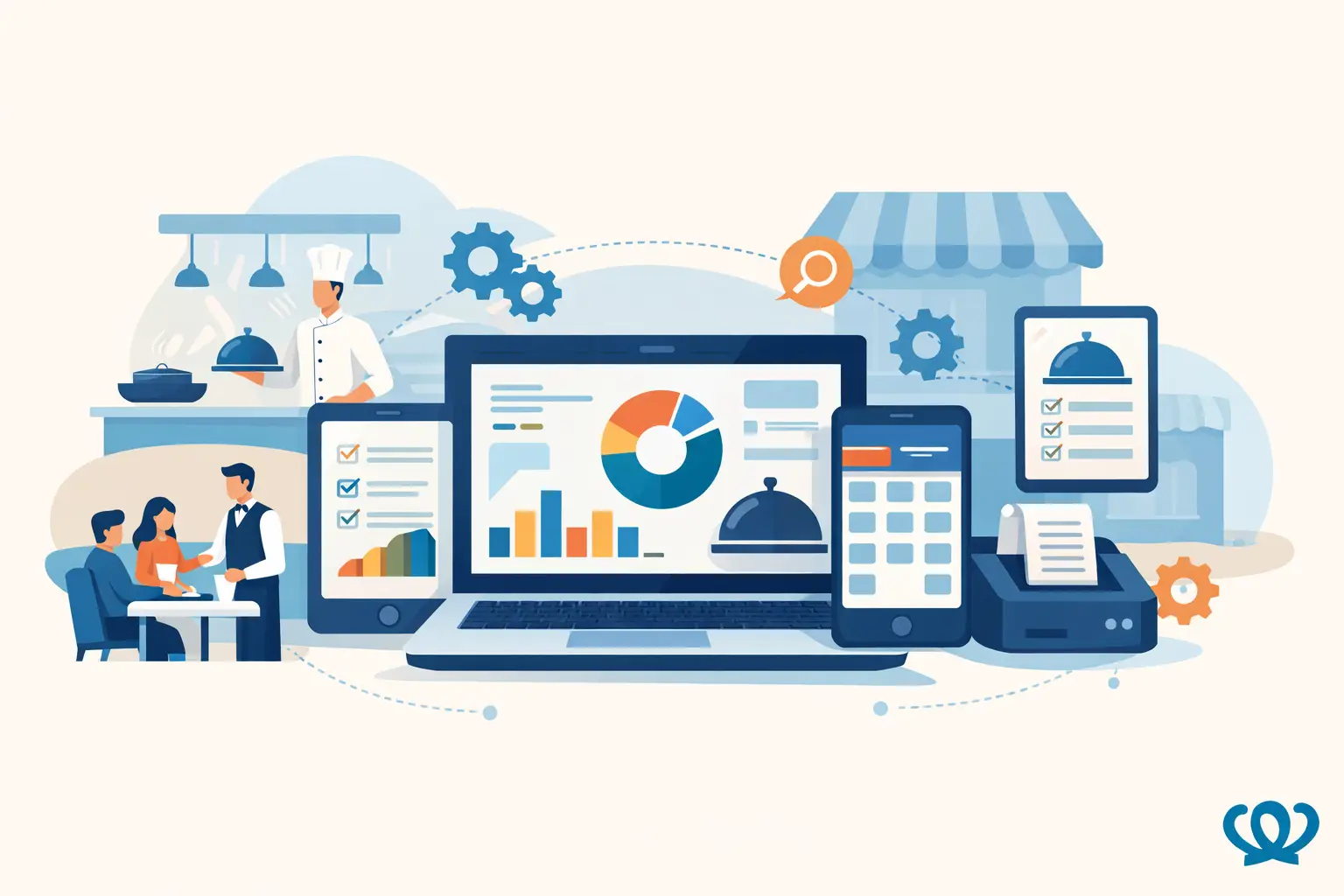
If your managers are still answering the same menu questions at 5:45 p.m., chasing missed side work at 9:30 p.m., and discovering training gaps only after a guest complaint, your software stack is not supporting operations. A serious restaurant operations software comparison should start there - not with feature grids, but with the daily points where revenue slips, standards soften, and leadership loses visibility.
Too many operators buy systems by category instead of by operating risk. They add a scheduling tool, a checklist app, a learning platform, maybe a messaging tool, then wonder why the team still misses allergen steps, forgets upsell prompts, or delivers inconsistent pre-shift execution. The problem is not only missing features. It is fragmentation. In restaurants, hotel outlets, banquets, and bars, operational failure usually happens in the space between systems.
What a restaurant operations software comparison should actually measure
Most comparisons overvalue administration and undervalue service execution. Payroll exports matter. Labor reporting matters. But if the platform does not improve what happens on the floor, in lineup, during onboarding, and under audit pressure, it is not solving the operator's real problem.
That means the right comparison criteria are different from what many buyers are shown in a demo. Start with five questions. First, does the system reduce frontline uncertainty at the point of service? Second, does it shorten time to competence for new hires? Third, does it create manager visibility without adding more manual follow-up? Fourth, does it support audit readiness and compliance discipline? Fifth, can it scale across outlets without becoming another layer of noise?
A tool can look polished and still fail these tests. Hospitality teams do not need more dashboards that explain yesterday. They need Operational Intelligence that improves the next shift.
Compare software categories by the workflow they support
Most restaurant tech decisions still happen in silos. One leader buys for labor efficiency, another for learning compliance, another for task management. That is understandable, but it creates blind spots.
POS and back-office platforms
POS and back-office systems are essential for sales, menu reporting, inventory, and basic labor control. They tell you what sold, when it sold, and often where margins are moving. They are strong at transactional truth.
Check the specific product’s capabilities. Some include learning, task or communication features; others focus on transactions. Sales records alone do not explain why service varies. Test how the platform links an outcome to current guidance, availability and management action.
Scheduling and workforce management tools
Scheduling systems help control labor cost and improve coverage. In multi-unit groups, they can bring much-needed order. Check whether the selected product also supports learning, qualifications or shift communication. Scheduling the right number of people does not by itself verify their readiness for the assigned task.
An operator may have the perfect labor deployment on paper and still run a poor service because the team is unclear on menu changes, VIP notes, service sequence, or outlet standards. Coverage is not readiness.
LMS and generic training platforms
Traditional learning systems can house SOPs, videos, quizzes, and certifications. For compliance-heavy environments, that has value. The issue is that many are too static for live restaurant operations.
Restaurants need training tied to real service conditions: menu updates, station-specific knowledge, nightly priorities, recurring guest issues, allergen handling, and manager follow-through. An LMS may support mobile access, role-based learning, assessments and on-the-job verification. Check those capabilities in the actual product instead of assuming the category is limited to static courses. See the LMS and operations platform comparison.
Checklist and task apps
Checklist software can improve consistency, especially for opening, closing, cleaning, and side work. Used well, it reduces forgotten tasks and gives managers a cleaner line of sight into completion.
But completion is not competence. A checked box does not prove that a bartender understands a new cocktail spec, that a server can explain modifiers accurately, or that a supervisor knows how to handle an audit question. Task software is useful, but on its own it can create false confidence.
Team communication tools
Messaging tools move information quickly, but speed is not the same as retention. Important operational details get buried under shift swaps, call-outs, and casual chatter. Critical menu notes or service directives may be sent, acknowledged, and still not show up in execution.
For hospitality leaders, that matters. The cost of poor knowledge transfer is not abstract. It shows up in voids, comps, low check averages, delayed service recovery, and preventable guest distrust.
Where operators should focus instead
A stronger restaurant operations software comparison looks at whether the platform acts like the business's daily nervous system. In practical terms, that means one environment where staff knowledge, training, task execution, pre-shift communication, and manager accountability reinforce each other.
This matters most in high-complexity operations. Fine dining outlets with nuanced menu language. Hotel restaurants where room service, banquets, and all-day dining run side by side. Multi-outlet groups with multilingual teams and frequent menu updates. These environments do not fail because leaders lack reports. They fail because standards break down in the handoff between information and execution.
A purpose-built hospitality system should help close that gap. It should surface what staff do not know, not just what they have completed. It should make pre-shift briefings more than announcements. It should show which managers are consistently driving readiness and which outlets are drifting before guest feedback exposes it.
The non-negotiables in a modern comparison
Knowledge support at the point of need
Frontline teams need immediate, reliable answers. A server should be able to find approved menu and pairing information quickly. Uncertain allergen answers still require the approved escalation process; avoiding a manager interruption is never a reason to guess. In high-volume periods, those interruptions multiply.
The better systems reduce that dependence by making operational knowledge accessible and current. Not buried in PDFs. Not trapped in a trainer's memory. Accessible in the flow of work, where the commercial impact is highest.
Onboarding that reaches competence faster
Many operators measure onboarding by completion. That is too low a bar. The real question is how quickly a new hire can perform to standard without dragging manager time or guest experience.
Measure the pilot’s time to supervised and independent readiness rather than assuming software will shorten it. Check whether managers can see where new hires need support. If your hosts understand reservation flow but struggle with service recovery language, or your banquet team knows setup standards but misses menu confidence, leadership should see that clearly.
Pre-shift execution, not just communication
Pre-shift is an important opportunity to connect current instructions with service. This is where upsell focus, menu changes, service priorities, VIP notes, and risk reminders should become shift behavior.
If the software treats pre-shift as a message board, it will underperform. If it structures, tracks, and reinforces priorities, it becomes commercially meaningful. Check whether the team can apply the changed instruction during that service period. Commercial outcomes also depend on guest mix, product availability and demand.
Audit readiness and compliance visibility
Audit exposure is not limited to formal inspections. Internal brand standards, allergy protocol, sanitation discipline, and documentation practices all shape risk. Operators need more than a static checklist to stay ready.
The best platforms show whether standards are being reinforced, understood, and executed over time. That is a different level of control. It moves the conversation from reactive correction to operational prevention.
Manager performance visibility
Many hospitality businesses have blind spots not at the staff level, but at the manager level. One outlet manager runs excellent lineups, coaches standards tightly, and catches drift early. Another completes forms, sends updates, and still leaves the team underprepared.
Software should make that difference visible. If leadership cannot see which managers are building readiness and which are relying on firefighting, scaling becomes guesswork.
Add hotel departments and local operating context
A hospitality operations platform may need to coordinate front office, housekeeping, engineering and food and beverage. Test a room move, a revised banquet order or an equipment outage that changes room-service availability. Who updates the approved information, who owns the guest commitment and who confirms closure?
A limited-service hotel may need a smaller workflow than a resort with multiple outlets and seasonal teams. Multi-property groups need shared standards plus local contacts, menu details and decision authority. Ask employees which language and format support each task, and test the experience on their actual devices and connection.
“Smart operations” is a useful description only if those connections work. The system still depends on current content, named owners and management judgment. Organized outdated guidance remains outdated guidance.
Use a common comparison scorecard
Score the same scenarios against every shortlisted product. Mark a capability as demonstrated, configured but untested, available at extra cost or absent. Do not treat a promised roadmap feature as delivered functionality.
| Criterion | Evidence from the pilot | | --- | --- | | Approved knowledge | Source, version, owner and an appropriate uncertainty response | | Role and language access | Usable guidance for a newer employee in the relevant outlet | | Change control | One update reaches affected teams and outdated guidance is withdrawn | | Readiness | Knowledge check and task demonstration recorded separately | | Exceptions | A live issue has urgency, ownership, due time and closure evidence | | Reporting | Current context, source freshness and comparable definitions | | Integration | Documented data flow, failure handling and reconciliation with existing systems | | Access and portability | Suitable role permissions and a usable export of content and action history |
Decide which criteria are essential before scoring. A polished reporting view should not compensate for a missing critical escalation or unusable frontline access. Request evidence for security and data-handling claims through the vendor’s documented review process; keep sensitive guest and employee records within approved access boundaries.
Pilot the total cost of ownership
Include subscriptions, devices, setup, integrations, translation review, content maintenance and manager time. Consolidation may help, but removing an existing tool is worthwhile only when the replacement covers its required workflow and records. Keep transaction and financial systems authoritative for their own data.
Choose one outlet and a small set of defined scenarios. Establish the current effort and failure points, run the pilot and inspect both adoption and results. Record duplicate entry, unanswered questions, connectivity problems and actions that cannot be verified. Agree how content and history will be exported if the pilot ends.
How to compare vendors without wasting another quarter
Do not ask for a broad demo first. Ask the vendor to walk through your actual operating pain. A menu change rolled out across multiple outlets. A new hire class with uneven language proficiency. A pre-shift process that is inconsistent by manager. An audit issue that keeps resurfacing. If the system cannot handle those moments, document the gap before reviewing less relevant features.
Push on adoption. Hospitality software often looks strong at headquarters and weak on the floor. Ask what the experience is for servers, supervisors, and outlet managers during a live shift. Ask what gets updated daily, what gets used weekly, and what typically gets ignored after launch.
Also test for consolidation value. If the platform removes the need for separate training, checklist, knowledge, and briefing tools, the economics change. Lower software sprawl matters, but the bigger gain is fewer gaps between functions. That is where real operational control improves.
The best buying decision is rarely about who has the longest feature list. It is about which system reduces avoidable questions, missed standards, slow ramp-up, and leadership blind spots fast enough to matter on the floor. Include service readiness, reliable escalation and the effort required to maintain the system in the buying decision.
The right system should feel less like another app and more like a stronger management standard - one that helps your team perform with confidence before the guest notices the difference.
SmartHospitality.AI brings knowledge, onboarding, briefings and manager follow-through into a Hospitality Operational Intelligence workflow. Compare it using the same demonstrated scenarios and costs as any other shortlisted option.