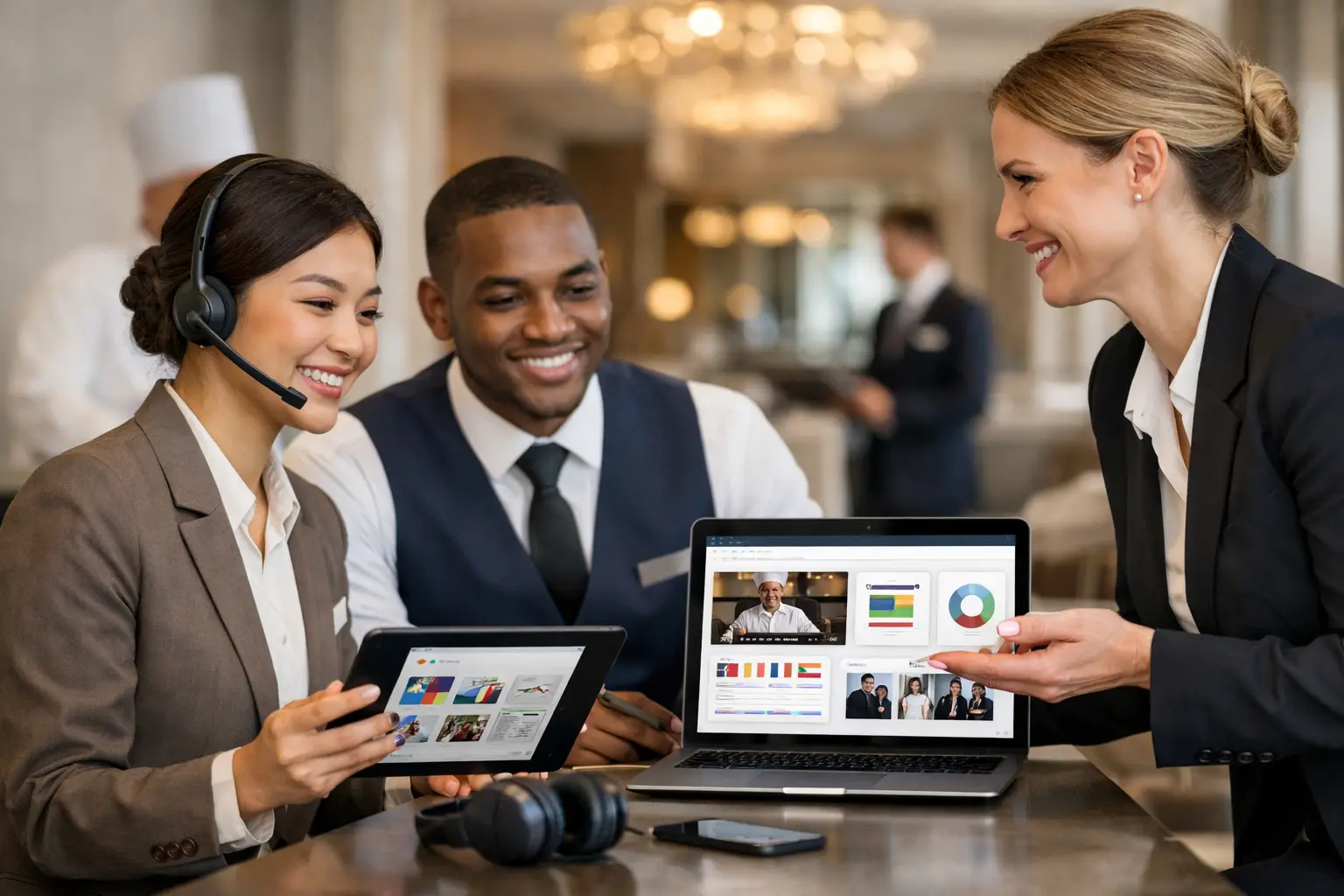
A guest asks whether a sauce contains nuts. The server understands enough English to recognize the question but not enough to interpret the recipe note correctly. The manager is handling a room service complaint, the chef is on the pass, and the answer takes three minutes to find. In hospitality, multilingual staff training tools are not a convenience feature. They are part of the operating control that protects guests, revenue, brand standards, and the team’s confidence on the floor.
For hotel and restaurant leaders, the issue is rarely that employees are unwilling to learn. The issue is that critical information is fragmented, translated inconsistently, delivered once during onboarding, and difficult to retrieve during a live shift. A policy may exist in a handbook, a recipe folder, a manager’s phone, or a pre-shift briefing that only half the team attended. That is not knowledge management. It is operational exposure.
Why language gaps become operating gaps
Hospitality is built on timing. A room attendant needs to understand chemical handling instructions before servicing a suite. A banquet server needs to identify dietary restrictions before setting a plated event. A front desk agent needs to explain a recovery procedure without escalating every issue to a supervisor. When knowledge is not available in the employee’s strongest working language, the business absorbs the delay.
That delay is costly even when it does not become a major incident. A server who cannot confidently describe a premium wine, an ingredient, or a hotel experience is less likely to make the recommendation. A new team member who is uncertain about sequence of service will imitate whoever is nearby, whether that person follows the standard or not. A manager spends the shift translating routine questions instead of coaching performance, monitoring quality, and protecting the guest experience.
The effect compounds across large teams. Consider a 150-person hotel operation where each employee loses just five minutes per shift searching for clarification or waiting for translation. Across one shift, that is 750 minutes of lost operating time. More damaging than the labor cost is the inconsistency: different answers, different service recovery decisions, and different levels of guest care from one outlet or department to the next.
What multilingual staff training tools must do in hospitality
A translated training document is useful, but it is not enough. Hospitality teams need information that is accurate, role-specific, current, and accessible at the point of work. The right system should support the complete operational cycle: OI Onboarding before the employee starts, OI Knowledge during the shift, OI Briefings before service, and manager visibility after execution.
Language support also needs to respect how hospitality work actually happens. Many team members are multilingual, but their proficiency differs by task. An employee may comfortably welcome a guest in English while preferring safety instructions, allergen details, or equipment procedures in another language. Treating language as a single employee profile field misses this distinction.
The strongest multilingual staff training tools organize knowledge around the moments that matter. For a restaurant, that may include menu descriptions, modifiers, dietary protocols, wine pairings, service sequence, opening standards, and complaint recovery. For a hotel, it may include room status procedures, VIP arrival standards, lost-property rules, maintenance escalation, spa service protocols, and emergency procedures.
The format matters as much as the translation. Dense manuals do not help a server with a guest standing at the table. Short, clearly structured answers, visual references where appropriate, and role-based guidance are more practical. Yet simplified content must never mean simplified standards. Allergen procedures, for example, require precise language, clear escalation paths, and consistent confirmation steps in every relevant language.
The difference between training delivery and Operational Intelligence
Traditional training often measures completion. Hospitality operations need to measure readiness and execution.
An employee can complete a module on champagne service and still be unable to explain the difference between two labels during dinner. A team can sign an attendance sheet for allergen training and still fail to communicate a guest request from server to kitchen. Completion records may satisfy part of an audit requirement, but they do not show whether the knowledge is available when pressure is highest.
Hospitality Operational Intelligence takes a broader view. It connects operational standards with the daily questions, decisions, briefings, and reporting that shape service. The engine behind the platform can help make knowledge easier to retrieve and present in the right language, but the operating value is not the technology alone. It is the ability to turn approved standards into consistent action across departments, outlets, and shifts.
This is especially relevant in multi-property groups. A central team may set the brand standard, while each property needs local menu information, regulations, guest profiles, and staffing realities reflected in its operating guidance. The goal is not identical wording everywhere. The goal is a controlled standard with local relevance, so teams do not create their own unofficial versions.
Build the knowledge before you translate it
Many organizations begin with translation because it feels urgent. The better first step is to identify which knowledge creates the greatest operational risk or commercial opportunity. Translating outdated, vague, or conflicting material only distributes the problem faster.
Start with the questions managers hear repeatedly. What are employees asking during pre-shift? Which guest requests cause the most escalation? Where do audits find recurring failures? Which menu items have low attachment rates because staff cannot explain them confidently? These questions reveal the knowledge gaps worth solving first.
Then establish one approved source for each critical standard. Ownership must be clear. Culinary leadership owns recipe and allergen accuracy. Operations leadership owns service sequence and recovery protocols. Human resources or training teams may coordinate onboarding, but department leaders need accountability for the content employees use on shift.
Translation should be reviewed for operational meaning, not merely grammar. A direct translation can be technically correct while failing to convey the urgency of a safety instruction or the tone expected in luxury service. Include experienced bilingual operators in the review process. Ask them whether an employee would know exactly what action to take, not whether the sentence sounds polished.
How to evaluate multilingual staff training tools
Leaders should assess tools against the conditions of a real service period, not a product demonstration. Four questions are particularly useful:
- Can a team member find an approved answer quickly during a guest interaction, in the language that supports accurate action?
- Can managers update a policy, menu detail, or service standard once and confirm that the latest version reaches the relevant teams?
- Can the organization distinguish between completed training, demonstrated understanding, repeated knowledge gaps, and operational issues requiring management attention?
- Can leadership see patterns across departments or properties without forcing managers to assemble reports manually?
There are trade-offs. A system with extensive language coverage may require more governance if each location produces its own content. Highly standardized content improves control, but it can frustrate local operators when it ignores regional regulations or guest expectations. The answer depends on the size of the group, the turnover profile, the complexity of the operation, and the risk attached to each procedure.
For a single independent restaurant, the priority may be fast access to menu, allergens, and service standards. For a resort or cruise operation, the priority may be consistent onboarding across departments, clearer handoffs, and audit readiness across a far more complex workforce. Neither needs a larger document library. Both need a daily nervous system for operational knowledge.
Make manager visibility part of the design
Training fails quietly when managers cannot see where confidence is weak. They may notice the same questions surfacing, but without a structured view, the response becomes another verbal reminder. The issue returns with the next new hire or the next busy weekend.
Operational reporting should show more than who has completed assigned content. Leaders need to understand where teams search for help, which topics trigger recurring questions, where knowledge differs by outlet, and whether a briefing produced better execution. Those signals turn training from an administrative requirement into an operating discipline.
SmartHospitality.AI approaches this through Hospitality Operational Intelligence: connecting OI Knowledge, OI Onboarding, OI Briefings, OI Insights, and OI Reports so that language access supports the wider operating system. That matters because a multilingual workforce should not create a separate management process. It should be fully included in the same standards, commercial goals, and performance conversations as every other team.
The practical starting point is simple: choose one high-risk, high-frequency service moment and make the approved knowledge clear in the languages your team uses. Measure whether questions fall, response time improves, and managers regain time for coaching. When employees can act with certainty, language stops being a barrier and becomes part of the service strength guests remember.