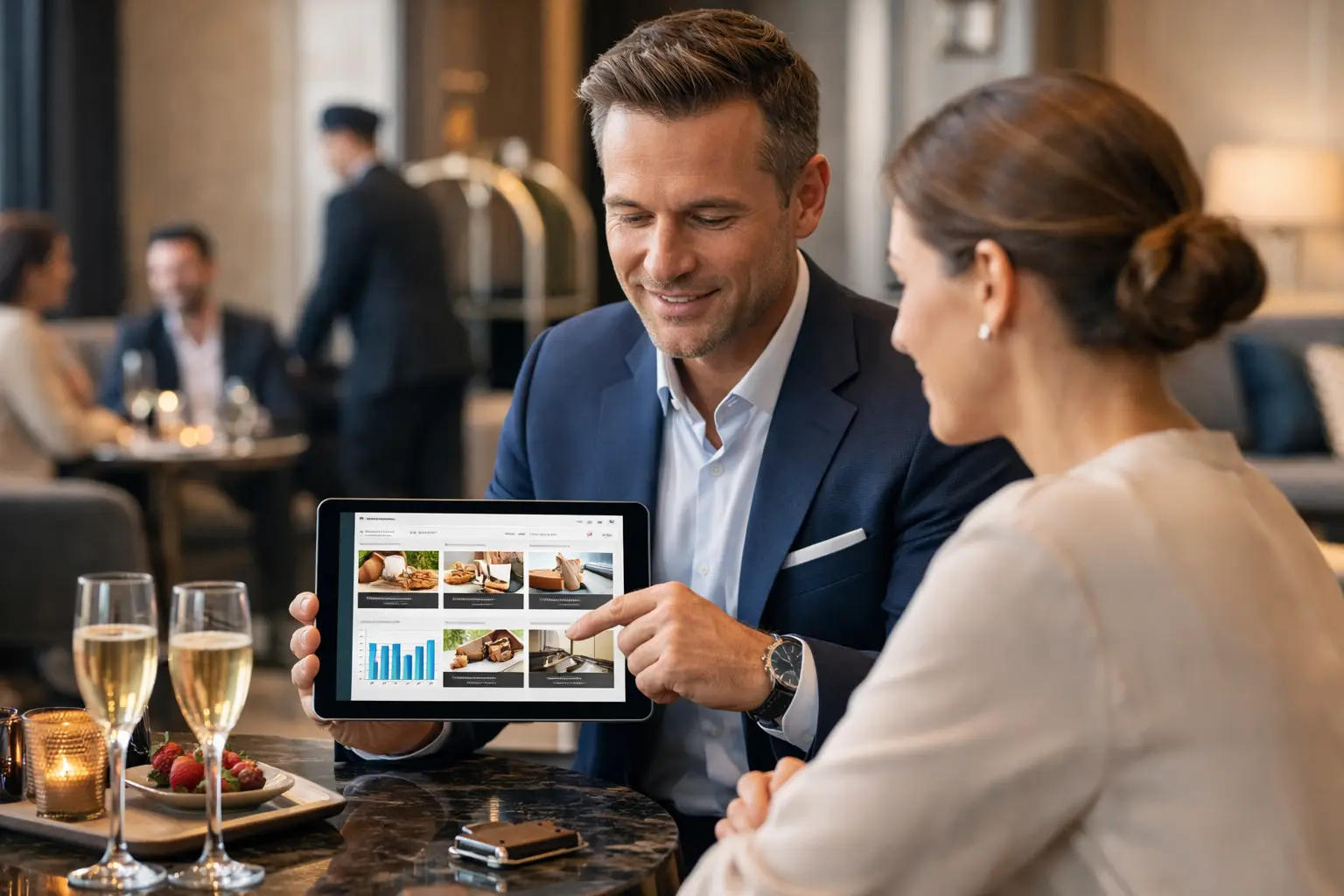
A guest asks whether the seafood special pairs better with a crisp white or a light red. The server gives a safe answer, takes the order, and moves on. The table buys neither wine. Nothing appears on an end-of-night exception report, yet the property has lost revenue that was already within reach.
That is the operational reality behind how to capture missed upsell revenue. Most hospitality businesses do not have an upsell problem because their teams lack enthusiasm. They have a knowledge, timing, and execution problem. The opportunity is present in thousands of guest interactions, but staff do not consistently recognize it, managers cannot see where it breaks down, and training is too detached from the live operation to correct it quickly.
For hotel and restaurant leaders, the question is not whether an additional dessert, premium pour, late checkout, spa treatment, or room upgrade would improve revenue. The question is whether the operation gives people the confidence and clarity to make the right recommendation at the right moment.
Missed Upsell Revenue Is Usually an Operating Failure
Upselling is often treated as a personality trait. Leaders celebrate the naturally commercial server, front desk agent, or bartender and ask everyone else to "sell more." That approach creates inconsistent results because it ignores the conditions required for an effective recommendation.
A staff member needs to know the product, understand the guest context, believe the recommendation is appropriate, and have a simple way to communicate it. If any one of those elements is missing, the interaction becomes hesitant. In luxury hospitality, hesitation is costly. Guests can sense when a recommendation is generic, forced, or poorly informed.
Consider a breakfast host who knows that a family has a late departure but does not know the property’s day-use options. Or a room service agent who can describe a dish but cannot confidently suggest a beverage, add-on, or premium substitution. Or a restaurant server who knows the menu but has not been briefed that a high-margin signature item is available only in limited quantity. These are not isolated training issues. They are gaps in operational intelligence.
The revenue leakage compounds across shifts and outlets. A 20-seat dining room that misses only three $18 beverage attachments per service gives away more than $19,000 annually at one dinner service a day. Add dessert, premium water, tasting-menu supplements, retail products, upgrades, and ancillary hotel services, and the number becomes material quickly. The exact figure depends on guest mix, price point, service model, and occupancy, but the principle is consistent: small missed moments become a major revenue line when repeated.
Find the Moments Where Upselling Breaks Down
Before asking teams to increase average check or ancillary spend, identify where opportunities disappear. Revenue reporting tells you what sold. It rarely explains why a potentially relevant offer was never made.
Start by observing the guest journey rather than reviewing only the final transaction. At the front desk, this may mean tracking whether eligible arrivals are offered upgrades, breakfast, parking, late checkout, or a relevant on-property experience. In restaurants, examine key moments such as the greeting, aperitif, menu explanation, order confirmation, entrée clearance, dessert discussion, and final round.
The useful question is not, "Did the team upsell?" It is, "Did the team recognize and handle the relevant opportunity?" A guest declining a well-framed recommendation is not a failure. A staff member failing to make a relevant recommendation because they were uncertain, uninformed, or rushed is an operational issue worth fixing.
Managers should look for patterns across four areas:
- Knowledge gaps: team members cannot explain products, availability, value differences, allergens, pairings, or service conditions.
- Briefing gaps: teams begin service without current priorities, promotions, inventory constraints, event details, or guest intelligence.
- Process gaps: the offer appears too late, is not assigned to a clear role, or is difficult to complete in the point-of-sale or property workflow.
- Leadership gaps: managers see revenue results after the shift but lack visibility into the behaviors and knowledge gaps that produced them.
This distinction matters. If the issue is poor menu knowledge, a sales contest will not solve it. If the issue is a slow handoff from reservations to the front desk, another product training session will not solve it either.
Build Recommendations Around the Guest, Not the Target
The strongest upsell is a service recommendation with commercial value, not a script delivered to every guest. A couple celebrating an anniversary may appreciate a champagne pairing or a suite category with a better view. A business traveler arriving after a delayed flight may value a fast room service option, express laundry, or a late checkout. A family at a resort may respond to a private cabana, an early dining reservation, or an activity that removes friction from the day.
This requires staff to understand both the offer and the trigger. Generic prompts such as "Would you like to add anything?" produce weak results because they transfer the work to the guest. Specific, relevant language is more effective: "Since you are checking out after the conference, I can arrange a late checkout so you can use the room through 4 p.m." The value is clear before the price becomes the focus.
There is a trade-off. Overly aggressive selling can damage trust, particularly in high-end environments where discretion is part of the experience. Teams should not recommend an expensive option simply because it carries a higher margin. They should recommend the option that genuinely improves the occasion, then communicate it with confidence. Revenue optimization and guest experience should reinforce each other, not compete.
Make Pre-Shift Briefings Commercially Useful
A pre-shift briefing often becomes a rapid checklist: staffing, reservations, allergies, VIPs, and operational notices. Those elements matter, but a briefing that does not prepare the team for revenue opportunities leaves money on the floor.
Each shift should have one or two clear commercial priorities tied to actual conditions. A restaurant may focus on a limited signature dish, a wine pairing, or a dessert that is particularly relevant to the season. A hotel may prioritize suite upgrades for a high-demand weekend, spa availability during a soft period, or experiences aligned with a local event.
The briefing should answer practical questions: What is the offer? Which guest situations make it relevant? What language can the team use? What are the availability limits? What operational details could make the recommendation unsafe or inappropriate?
For example, asking servers to promote a tasting-menu supplement without confirming stock, preparation time, and allergen guidance creates risk. Asking front desk agents to offer early check-in without real-time room status creates frustration. Commercial execution must be connected to operational reality.
This is where Hospitality Operational Intelligence has a meaningful role. OI Briefings can bring current service priorities, product knowledge, guest-sensitive reminders, and operational restrictions into one usable view for the team. The objective is not to turn every employee into a salesperson. It is to ensure every employee begins the shift informed enough to make relevant, accurate recommendations.
Turn Knowledge Into Confident Service Language
Training materials often describe products well but fail to prepare people for live conversations. A server may memorize tasting notes for six wines and still struggle when a guest asks, "What would you choose with this?" A receptionist may know upgrade categories and still be unable to explain why one room creates a better stay.
Teams need short, situational knowledge. Instead of teaching only product facts, teach the decision behind the recommendation. Explain which guest need the option solves, when not to recommend it, and how to describe the value in plain language.
Managers can test this during lineups and floor walks. Ask a team member to recommend one add-on for a family, a solo business traveler, or a guest celebrating an occasion. Then ask what they would recommend if the guest has a tight schedule, a dietary restriction, or a budget concern. These small practice moments reveal whether knowledge can be applied under service pressure.
Multilingual teams need particular attention. Translation alone does not create confidence. Staff must understand the guest-facing meaning of the offer, the standards around it, and the approved language that feels natural in their service culture. Clear OI Knowledge reduces the reliance on informal peer explanations, which often vary by outlet and shift.
Give Managers Visibility Before the Month Ends
Waiting for monthly revenue results is too late. By then, leaders may see that beverage attachment, upgrade conversion, or average check has underperformed, but they cannot easily identify whether the cause was product availability, weak knowledge, poor shift leadership, or an unsuitable target.
Managers need a tighter operating rhythm. Review a small number of relevant measures by outlet and shift: attachment rate, average check, upgrade conversion, offer acceptance, and product mix. Pair those numbers with service-floor observation and team feedback. A low dessert attachment rate may be a menu design issue, a pacing issue, or a confidence issue. The data directs attention; operational leadership determines the intervention.
Avoid measuring staff solely by accepted sales. That can encourage pressure selling and discourage teams from serving guests appropriately. Track whether teams have the knowledge, tools, and service conditions to make relevant offers. Recognize quality execution as well as revenue results.
An Operational Intelligence platform such as SmartHospitality.AI can help leaders connect training, SOPs, briefing priorities, manager observations, and OI Reports into a more complete view of performance. That is more useful than treating upselling as a standalone campaign because it exposes the daily conditions behind the number.
Create a Repeatable Recovery Cycle
Capturing missed upsell revenue is not a one-time training initiative. It is a weekly operating discipline. Set a commercial focus, equip the team with current knowledge, observe execution, review results, and refine the next briefing.
Keep the corrections specific. If agents are not offering late checkout, determine whether they lack authority, do not know availability, or do not see the guest benefit clearly. If servers are not recommending wine, find out whether the pairing guidance is too complicated, the wine list is hard to navigate, or the team fears appearing pushy. Precision prevents management from responding with broad, ineffective reminders.
The most valuable upsell opportunities are rarely hidden in a new campaign. They are already sitting inside ordinary guest conversations. When staff knowledge, shift priorities, and manager visibility operate as one daily nervous system, those conversations become more confident, more relevant, and more commercially effective.