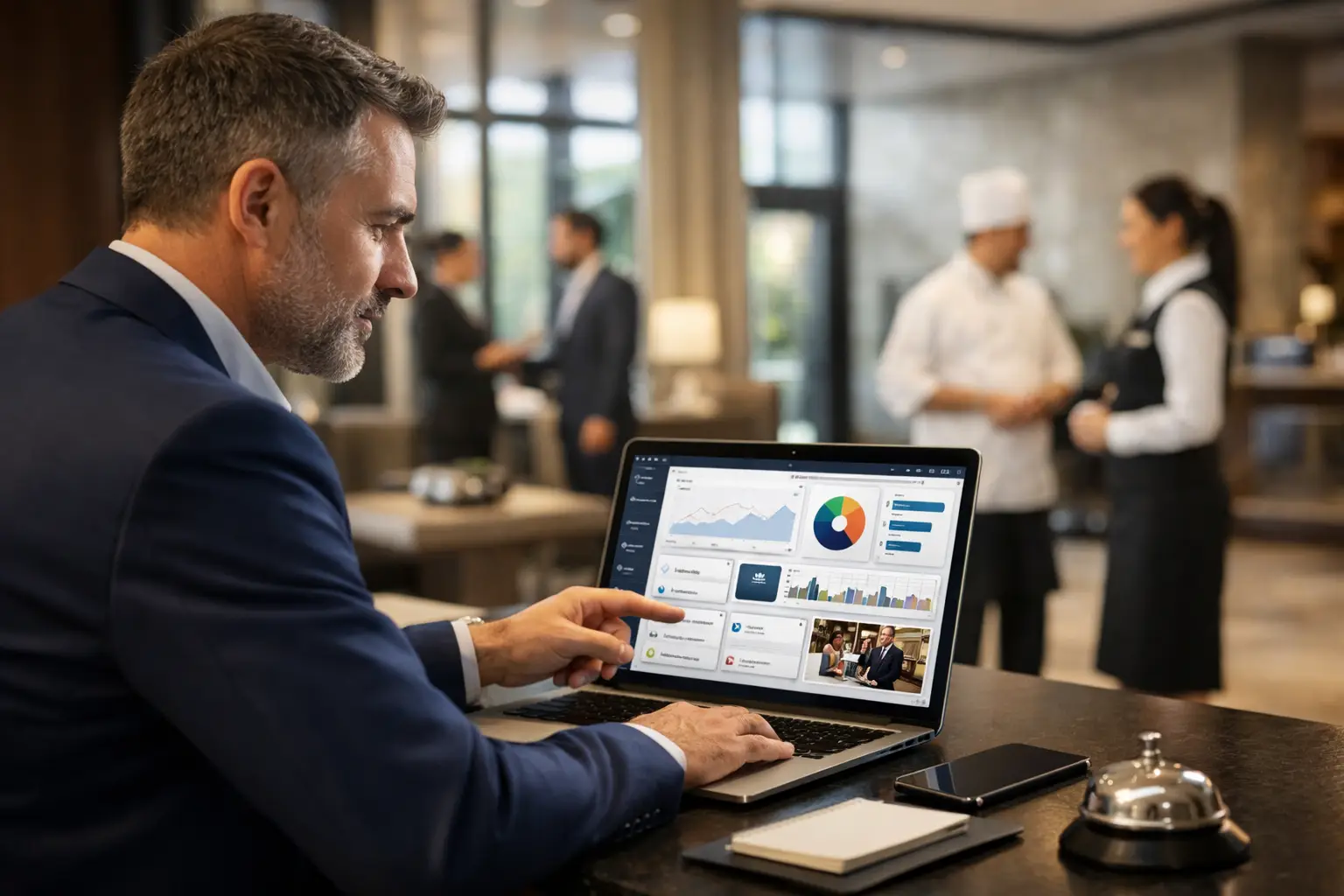
At 7:10 p.m., a restaurant’s strongest server calls out sick, a new team member is assigned to a high-value section, and a guest asks whether a sauce contains a specific allergen. None of these events is unusual. The commercial and compliance risk comes from how quickly the operation can put the right knowledge in front of the right person. That is where Hospitality's Next Operating System begins: not with another disconnected tool, but with Operational Intelligence that supports decisions at the point of service.
For hotels, resorts, cruise operators, and restaurant groups, the operating challenge is rarely a lack of documents. It is the gap between documented standards and daily execution. SOPs sit in folders. Menu updates reach some shifts but not others. Managers repeat the same answers. Audit preparation becomes a last-minute scramble. Meanwhile, service inconsistency quietly affects guest trust, reviews, upselling, and labor productivity.
What Is a Hospitality Operating System?
A hospitality operating system is the connected operational layer that helps teams access approved knowledge, prepare for each shift, apply standards consistently, and give managers visibility into daily execution.
Unlike a collection of disconnected applications, it connects what the organisation knows with what employees and leaders need to do next. Its value is measured not by how much information it stores, but by how reliably that information improves decisions during live operations.
The Operating Stack Was Built for Storage, Not Execution
Traditional hospitality systems solve individual parts of the problem. A checklist can confirm that a task was acknowledged. A training course can record completion. A shared drive can hold policies. A point-of-sale report can show yesterday’s results. Each has value, but none creates a connected view of what the team knows, what standards are being applied, where risk is developing, and what a manager should address next.
That fragmentation has a measurable cost. If a 120-cover restaurant misses just $4 in average incremental spend on 30 covers because servers cannot confidently recommend wine pairings, premium modifiers, or dessert, that is $120 in lost revenue on one service. Repeated across multiple outlets and shifts, weak knowledge management becomes a revenue leakage issue, not a training issue.
The same applies to safety and audit readiness. An allergen procedure is only effective when the team can retrieve, understand, and follow it under pressure. A manager cannot be everywhere at once, particularly across a multi-outlet hotel, restaurant group, or resort operation. Leadership needs visibility into execution without turning every manager into a full-time administrator.
Hospitality's Next Operating System Is Operational Intelligence
Hospitality Operational Intelligence, or OI, is the connected operational layer between standards and performance. It brings together OI Knowledge, OI Onboarding, OI Briefings, operational reporting, manager visibility, and decision support so the organization can move from static information to informed daily action.
The distinction between Artificial Intelligence and Operational Intelligence matters. AI may power parts of the experience, but the product category is Operational Intelligence. The purpose is not technology for its own sake. The purpose is stronger hotel operations and restaurant operations: better-prepared teams, clearer standards, faster responses, and more disciplined execution.
An effective OI platform becomes part of the daily nervous system of the operation. It helps a new bartender understand the ingredients, allergen considerations, flavor profile, and selling language for a seasonal cocktail. It gives a duty manager a clearer view of recurring knowledge gaps before they become guest complaints. It enables an operations director to identify whether a new service standard is understood consistently across outlets, properties, or regions.
Knowledge Must Work During the Shift
Operational knowledge has to be practical, current, and easy to apply in a live service environment. Long policy documents are necessary for governance, but they are not sufficient for execution. Teams need clear answers connected to real operational moments: a guest request, a menu question, a recovery situation, a pre-shift briefing, or a compliance check.
This is particularly critical in multilingual teams and high-turnover environments. Onboarding cannot depend solely on who happens to be scheduled beside a new hire. The operating system should create a more consistent baseline while allowing managers to coach the details that require judgment, presence, and hospitality instinct.
Reporting Must Lead to Action
Most hospitality leaders understand the value of Business Intelligence. The harder question is whether those reports identify the operational action required. OI Reports and OI Insights should help management distinguish between a single incident and a repeated pattern: low knowledge confidence around a new menu, incomplete understanding of an SOP, weak upselling in one outlet, or uneven audit readiness across locations.
That is a more useful form of visibility than a simple completion rate. Completion tells leaders that a process occurred. Operational Intelligence helps them assess whether the process is improving performance.
What Changes on the Service Floor
The practical impact is visible in ordinary moments. Pre-shift briefings become more focused because teams receive relevant operational updates rather than generic reminders. Managers spend less time answering repetitive questions and more time observing service, coaching behavior, and resolving exceptions. Staff can approach guest conversations with greater confidence because product knowledge, service standards, and recovery guidance are organized around the work itself.
For multi-property operators, the benefit is consistency without unnecessary rigidity. A luxury brand may require precise language and presentation standards, while a high-volume casual group may prioritize speed, modifier accuracy, and attachment sales. The operating model should reflect those differences. OI does not impose one version of hospitality on every business. It gives each organization a way to make its own standards usable, visible, and measurable.
Build Around High-Risk, High-Frequency Workflows
The best starting point is not a broad technology rollout. Start with the workflows where operational readiness matters most and where knowledge gaps create the greatest cost: allergen communication, menu and beverage knowledge, guest recovery, opening standards, brand-specific service rituals, or audit preparation. Map what teams need to know, when they need it, how managers verify execution, and what leadership needs to see.
SmartHospitality.AI was built from this operational perspective. Its value is not in adding another destination for staff to visit. Its value is in connecting the knowledge, briefings, onboarding, standards, and OI Recommendations that already determine whether service performs well or breaks down.
Key Takeaways
- Hospitality's next operating system must connect operational knowledge with daily execution.
- Disconnected training, document, checklist, and reporting tools cannot provide a complete view of operational readiness.
- Operational Intelligence helps teams apply standards while giving managers earlier visibility into recurring gaps.
- The strongest starting points are high-risk, high-frequency workflows such as allergens, guest recovery, menu knowledge, and audit preparation.
- Technology creates value only when it makes the correct operational action easier to understand and execute during service.
Frequently Asked Questions
What Is a Hospitality Operating System?
A hospitality operating system is a connected operational layer that supports how teams prepare, communicate, access knowledge, apply standards, and make decisions. It does not necessarily replace the PMS, POS, reservation system, or other core platforms. Instead, it connects operational information and workflows so employees and managers can use them more effectively during daily service.
Why Do Hospitality Businesses Need Operational Intelligence?
Hospitality businesses often have extensive SOPs, training materials, reports, and operating systems, but those resources remain disconnected. Operational Intelligence helps bridge the gap between documented standards and live execution. It gives teams more relevant support during each shift while helping managers identify recurring questions, readiness gaps, service risks, and areas requiring reinforcement.
Is Operational Intelligence the Same as a PMS or POS?
No. A PMS manages property and guest information, while a POS records sales and transactions. Operational Intelligence sits closer to execution. It helps teams access approved knowledge, prepare for service, apply operational standards, and give managers visibility into how consistently those standards are understood and followed across shifts, departments, outlets, or properties.
Does a Hospitality Operating System Replace Existing Software?
A Hospitality Operational Intelligence platform should normally work alongside existing systems rather than require the business to replace them all. Core platforms continue to manage reservations, sales, property data, labour, or finance. OI focuses on connecting the knowledge, readiness, communication, reporting, and decision support required to improve what happens during daily operations.
Which Operational Workflows Should Leaders Improve First?
Leaders should begin with workflows where uncertainty creates frequent or serious consequences. Common priorities include allergen communication, menu and beverage knowledge, guest recovery, onboarding, opening standards, VIP preparation, audit evidence, and pre-shift communication. Starting with a specific operational problem makes implementation easier to measure and prevents the project from becoming an unfocused technology rollout.
Does Operational Intelligence Replace Hospitality Managers?
No. Operational Intelligence should strengthen managers rather than replace them. It can reduce repetitive questions, improve access to approved standards, and reveal patterns requiring attention. Managers remain responsible for coaching, judgment, service recovery, quality, safety, people decisions, and exceptions that fall outside normal procedures. The goal is to give leaders better information and more time to lead.
Conclusion
Hospitality leaders do not need more noise around innovation. They need an operating intelligence layer that makes the right standard easier to execute on a busy shift, makes risk easier to see before an audit, and makes every manager more effective where it matters most: on the floor, with the guest experience in front of them.