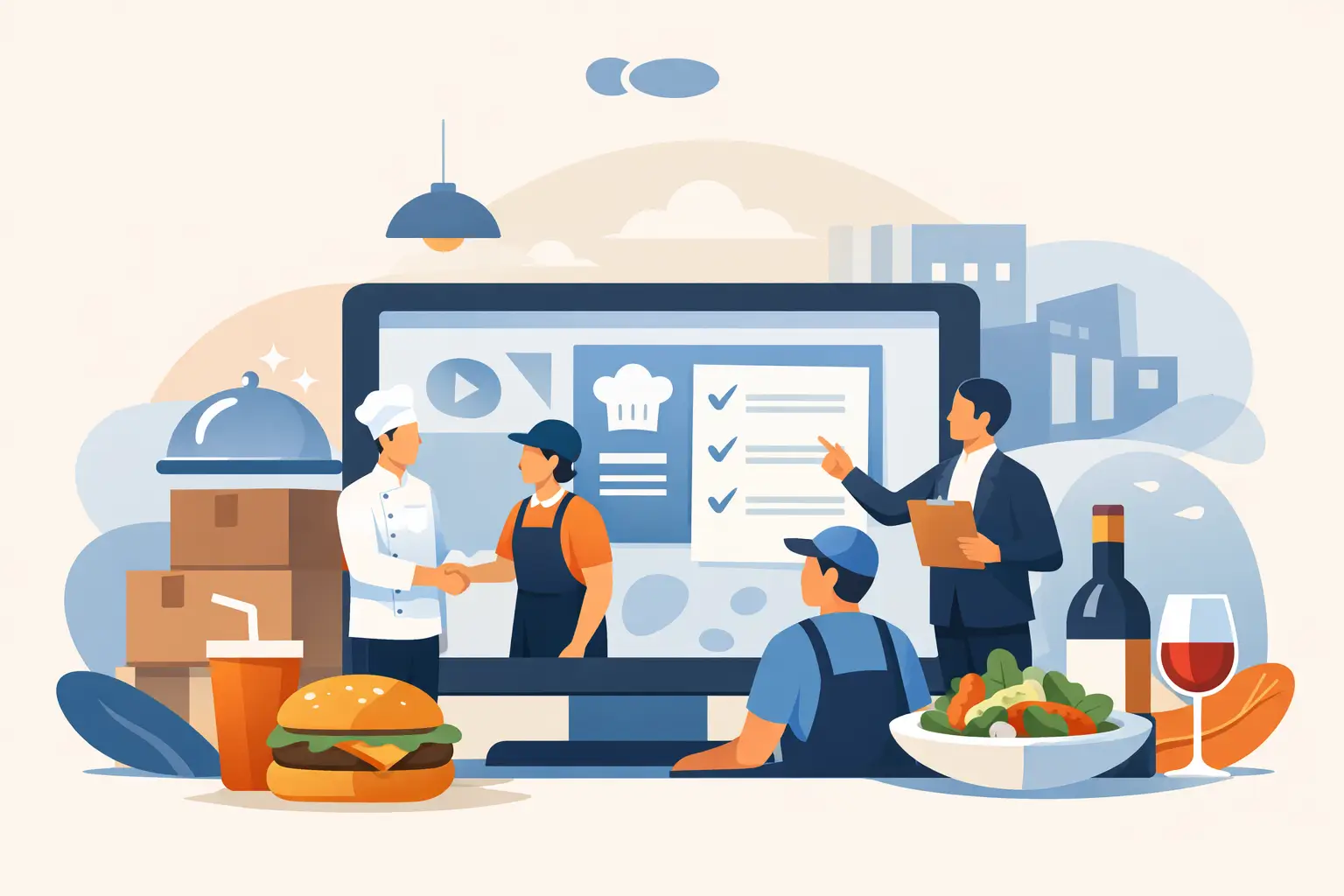
A new server is three shifts in, a guest asks about a shellfish allergy, and the answer comes with hesitation. At that point, your food and beverage onboarding guide is no longer an HR document. It is a risk-control tool, a revenue tool, and a direct reflection of management discipline.
Most operators already know onboarding matters. The harder truth is that much of it still happens through repetition, memory, and whoever happens to be the strongest person on the floor that week. That approach might hold in a small, stable team. It breaks fast in hotel restaurants, banquets, bars, room service, and multi-outlet operations where turnover, call-outs, language gaps, and service complexity are part of normal life.
What a food and beverage onboarding guide should actually do
A useful food and beverage onboarding guide should not read like a welcome packet with a few SOPs attached. It should move a new hire from uncertainty to productive readiness in a controlled, measurable way. That means the guide has to do more than explain policies. It needs to define what someone must know, by role and by day, before they are trusted to represent the operation independently.
For a server, that includes menu fluency, allergy protocol, steps of service, POS accuracy, modifier handling, upsell cues, and recovery standards. For a bartender, it expands into recipe precision, ID checks, cash handling, and speed under pressure. For banquet teams, it may center on event orders, station setup, sequence timing, and communication discipline. The guide should reflect those differences instead of forcing every role through the same generic path.
The key shift is simple - onboarding is not about orientation completion. It is about operational readiness.
Why most onboarding underperforms
Operators rarely fail because they do not care about training. They fail because the system relies on manager memory and floor availability. A strong outlet manager may explain standards well, but if that manager is covering breaks, handling a comp, fixing a staffing gap, and answering vendor calls, onboarding gets compressed into fragments.
That creates three expensive problems.
First, knowledge transfer becomes inconsistent. One server learns the eight talking points for the chef's tasting menu. Another gets two. One bartender is drilled on allergy language. Another is told to ask a manager if anything serious comes up. The guest sees the result as inconsistency, but the root issue is weak operational control.
Second, speed to competence slows down. New hires ask the same questions repeatedly because answers live in people, not in a reliable system. Managers become the daily search engine. That drains leadership time and keeps teams dependent longer than they should be.
Third, hidden revenue leakage starts early. If staff are not trained to describe high-margin items, pair beverages with confidence, or recognize guest buying signals, the outlet loses sales one interaction at a time. No single missed upsell looks dramatic. Across a month, it becomes a margin problem.
Build the guide around the first 30 days
The most effective onboarding guides are staged. Throwing everything at a new hire in two days feels thorough, but retention drops fast when information is delivered without sequence.
Days 1-3: Safety, standards, and non-negotiables
The opening stage should focus on the few things that cannot be misunderstood. That includes allergen procedure, food safety basics, guest privacy, appearance standards, attendance expectations, communication channels, and emergency escalation. In many operations, this is also the right point to establish service culture clearly. Not in vague language, but in observable behaviors. How do we greet? How quickly do we acknowledge? How do we recover after a delay or mistake?
This period should also introduce the physical environment. New hires need outlet layout, storage areas, equipment basics, sidework flow, and role handoffs. If they do not know where things live or who owns what, confidence erodes before technical service knowledge even has a chance to stick.
Days 4-14: Product knowledge and execution
This is where most operations either create professionals or create order-takers. Product knowledge should include ingredients, preparation methods, allergens, modifiers, pronunciation, portion expectations, and ideal pairings. But knowing the menu is not enough. Staff need to learn how that knowledge is used on the floor.
Can they guide a guest between two similar dishes? Can they suggest an add-on that makes sense for the occasion? Can they explain why a preparation takes longer without sounding defensive? Can they answer, with confidence, whether a sauce contains dairy or nuts? Those are operating skills, not trivia.
A good guide uses short knowledge checks and observed floor practice during this stage. If someone can repeat a menu description in pre-shift but freezes with a live table, they are not ready yet. That is not a failure. It is exactly why validation matters.
Days 15-30: Independent performance and accountability
By this point, the guide should shift from information delivery to proof of capability. The employee should be working more independently, but not invisibly. Managers should confirm accuracy, pace, guest interaction quality, compliance behavior, and sales behaviors in real service conditions.
This is also where many teams skip a critical step: documenting what the employee still does not know. Without that visibility, weak points stay hidden until they show up in a complaint, an allergen near-miss, a void pattern, or a failed audit check.
The six areas every onboarding guide must cover
A strong guide can take different forms by concept, but six areas show up in every effective version.
The first is role clarity. New hires need to know what success looks like in their specific position, not just what the company values in broad terms.
The second is product and menu knowledge. This is where revenue and guest trust meet. Weak product fluency hurts both.
The third is service execution. Steps of service, timing standards, table maintenance, handoff moments, and recovery language all need to be taught as operating behaviors.
The fourth is compliance and safety. Allergens, food handling, alcohol service, incident escalation, and outlet-specific controls belong here.
The fifth is systems knowledge. POS workflows, modifiers, check handling, room charge procedures, transfer rules, and communication tools should be taught as daily mechanics, not afterthoughts.
The sixth is performance validation. Every onboarding guide needs a way to verify readiness instead of assuming it.
Your food and beverage onboarding guide needs measurable checkpoints
A guide without checkpoints is just documentation. Operators need evidence that training happened, knowledge was retained, and standards were demonstrated on the floor.
That means attaching measurable milestones to the onboarding process. Examples include menu test scores, observed service evaluations, allergy protocol sign-off, upsell behavior tracking, POS accuracy checks, and completion of role-specific opening or closing tasks. Not every concept needs the same depth, but every role needs proof points.
This is where many generic LMS tools fall short. They can log course completion, but they often do not connect training to live hospitality execution. Hospitality leaders need more than a record that someone watched a module. They need operating intelligence on what staff know, where they hesitate, and which outlet or manager is producing the strongest readiness outcomes.
Where operators lose control
The guide itself is only half the equation. The other half is maintenance. Menus change, promotions rotate, allergens shift, banquet packages update, and local procedures evolve. If your onboarding content lives in scattered PDFs, group chats, printed binders, and manager recollection, the guide becomes outdated faster than most teams realize.
That is when onboarding starts to create false confidence. Staff think they have the right answer because they were trained, but the training no longer matches the current operation. In food and beverage, that gap is expensive. Sometimes it shows up as a missed Cabernet upsell. Sometimes it shows up as an allergen failure.
This is also why sophisticated operators are moving toward systems that combine knowledge support, training automation, checklists, pre-shift alignment, and visibility into manager follow-through. For complex hospitality environments, onboarding cannot sit in isolation from service execution. It has to connect to the daily nervous system of the operation.
What good looks like in practice
A strong onboarding program is noticeable within two weeks. New hires ask fewer repetitive questions. Managers spend less time reteaching basics. Guest interactions sound more confident. Sidework gets done with less chasing. Menu descriptions become more consistent. Audit exposure drops because critical procedures are taught and verified instead of assumed.
The commercial impact matters just as much. Staff who understand the menu and service intent sell differently. They make cleaner recommendations, protect guest trust, and capture revenue with less friction. In high-standard environments, that difference is not cosmetic. It changes check averages, review sentiment, and leadership workload.
SmartHospitality.AI was built around that reality: operators do not need more content for content's sake. They need a system that closes knowledge gaps before those gaps hit service, safety, and sales.
A food and beverage onboarding guide should make the floor calmer, sharper, and more accountable. If it is not doing that, it is paperwork. If it is, it becomes one of the few management tools that improves guest confidence and margin at the same time.
The best test is simple: when the next new hire starts on a busy Friday, does your operation rely on hope, or does it rely on a standard?
For a practical assessment of the software workflow, see hospitality onboarding automation software.