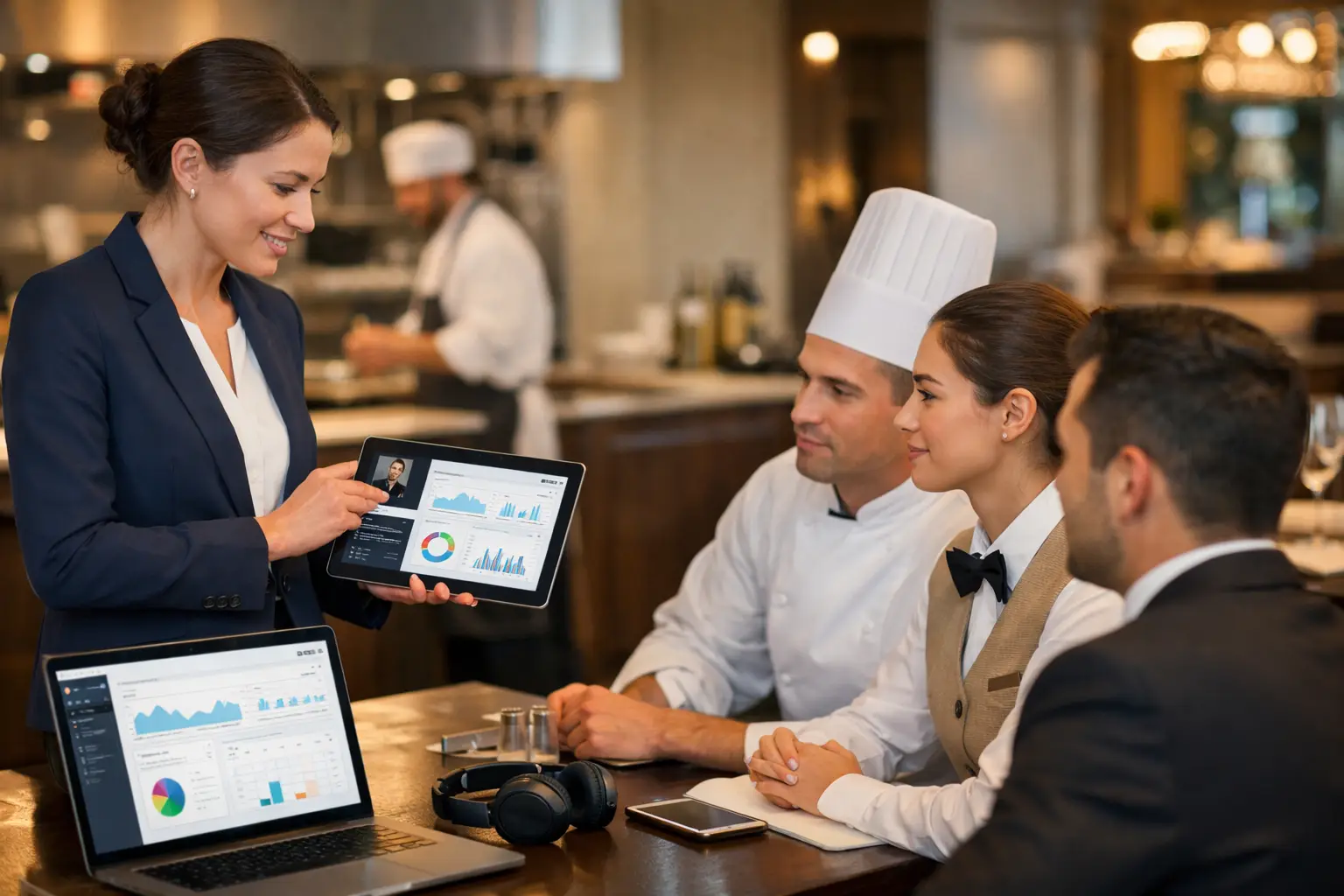
A server who cannot explain a tasting menu, confirm an allergen procedure, or recommend a wine pairing does not have a training problem in isolation. The operation has a revenue, safety, and leadership visibility problem. The best hotel restaurant training tools address that reality by putting usable knowledge into the flow of service, not burying it in a handbook, a one-time induction, or a manager's memory.
For hotel restaurants, the stakes are particularly high. A single property may run breakfast, lobby bar, all-day dining, room service, banquets, pool service, executive lounge, and fine dining under different service rhythms and standards. Teams are often multilingual, seasonal, and working across outlets. Training must protect the guest experience while helping managers see where knowledge is holding up and where it is breaking down.
What separates the best hotel restaurant training tools
A useful tool does more than distribute content. It helps a newly hired bartender find the current classic cocktail specification before a Friday rush. It gives a banquet captain a reliable answer when a guest asks how a dish was prepared. It tells an F&B director whether team members actually understand the current menu, service sequence, and allergen controls.
That distinction matters because restaurant training is not a classroom event. It is an operational system. The right platform should connect onboarding, SOPs, pre-shift preparation, knowledge checks, manager follow-up, and reporting. When these elements live in separate places, managers become the manual integration layer, repeatedly answering the same questions and trying to spot risk through incomplete signals.
The strongest options generally fall into several categories. Each has a role, but none should be selected solely because it has attractive course content or a polished mobile interface.
1. Digital learning platforms
Digital learning platforms are effective for structured onboarding, policy training, and certification records. They can organize courses by role, outlet, or job level, and they provide a more consistent starting point than paper binders or informal shadowing.
Their limitation is operational relevance. Completing a module on beverage service does not mean a colleague can confidently recommend a high-margin aperitif at 7:30 p.m. Nor does a completion report tell a manager whether staff can retrieve the right information during service. These platforms work best when formal learning is only one layer of a broader operating model.
2. SOP and knowledge-base systems
A centralized SOP library can reduce version-control problems, especially across multi-outlet hotels and restaurant groups. It gives teams a source for recipes, service standards, opening procedures, guest recovery guidance, and safety requirements.
The trade-off is adoption. A static knowledge base becomes another digital binder if content is difficult to search, poorly organized, or disconnected from daily briefings and coaching. The test is simple: can a team member find the current answer in seconds, using the language they naturally use on the floor? If not, the knowledge exists but is not operational.
3. Mobile microlearning and assessment tools
Short lessons and knowledge checks suit hospitality because training time is fragmented. A five-minute review of a new lunch menu, a quick quiz on allergen escalation, or a refresher on suggestive selling can fit before a shift far better than a 45-minute course.
These tools are valuable when assessments are tied to real responsibilities. Asking a server to memorize generic hospitality principles has limited commercial value. Asking them to identify the appropriate pairing, explain the provenance of a signature ingredient, or follow the escalation path for a severe allergy exposes practical readiness.
Assessment alone is not enough, however. If a manager cannot see patterns by outlet, role, topic, and individual, the operation collects scores without gaining direction.
4. Pre-shift briefing tools
Pre-shift briefings are where strategy becomes service behavior. The day’s VIP arrivals, menu changes, 86'd items, event timing, upselling focus, guest feedback themes, and safety reminders need to reach every relevant colleague before doors open.
A briefing tool creates consistency across shifts and outlets, particularly when managers are covering multiple teams. But it should not turn briefing into a broadcast channel. The best approach allows managers to verify comprehension and identify where a message needs reinforcement. A 90-second briefing that changes behavior is more useful than a detailed update that no one absorbs.
5. Hospitality Operational Intelligence platforms
Hospitality Operational Intelligence, or OI, brings these functions into one connected operating layer. Rather than treating training as a separate HR activity, it connects OI Knowledge, OI Onboarding, OI Briefings, operational standards, manager visibility, and OI Reports.
This is the most suitable category for operators managing complex restaurant environments because it focuses on execution. SmartHospitality.AI, for example, is designed as a Hospitality Operational Intelligence platform that helps leaders connect staff knowledge with daily operational decisions, rather than treating training as a disconnected course library.
The distinction becomes visible during service. If allergen knowledge is weak in one outlet, menu confidence is low among new hires, and upselling performance is inconsistent at dinner, leadership needs more than training completion data. It needs a clear view of the operational gap, the right intervention, and evidence that the intervention worked.
How to evaluate hotel restaurant training tools
Start with the operating problems you need to reduce. A luxury restaurant with an ambitious wine program may prioritize menu fluency and pairing confidence. A resort with seasonal hiring may need faster, role-specific onboarding. A hotel with large banqueting operations may place audit readiness, food safety, and standardized event execution first.
Then assess each tool against five practical questions:
- Can staff access accurate, role-specific knowledge quickly during the working day?
- Can managers see understanding, not just course completion?
- Can training be adapted by outlet, language, menu, and service level?
- Does the platform support pre-shift communication and reinforcement?
- Can leadership connect knowledge gaps to guest experience, compliance exposure, and revenue performance?
Integration should be judged operationally, not technically. A tool does not need to connect to every system to create value. It does need to fit the routines managers already own: onboarding, lineup, floor coaching, menu rollouts, quality reviews, and audit preparation.
Also consider content ownership. Hotel restaurants change menus, promotions, wine lists, standards, and local compliance requirements frequently. If updating a procedure requires a vendor ticket or a specialist administrator, the content will lag behind the operation. Frontline knowledge must remain current, approved, and easy to govern.
Where training tools produce measurable returns
The commercial case is often hidden in small moments. Suppose a 120-cover dinner service has 40 tables. If five tables receive no beverage recommendation because servers are unsure of the list, the revenue leakage can exceed the monthly cost of a training platform quickly. The same applies when a team cannot confidently explain supplements, tasting-menu upgrades, premium spirits, or dessert pairings.
Safety and consistency are equally material. An allergen error can create serious guest risk and lasting reputational damage. A missed banquet detail can affect hundreds of guests at once. In both cases, the issue is rarely that no SOP existed. It is that the right person did not know, retain, or apply it at the critical moment.
Managers gain time as well. When supervisors spend 15 minutes each shift repeating menu facts, locating procedures, and correcting preventable errors, that time disappears from guest-facing coaching. Training tools should reduce repetitive questions while giving managers better prompts for the conversations that genuinely require judgment.
Avoid these common selection mistakes
Do not buy a content library before defining the knowledge behaviors that matter most. Generic service modules may be useful, but they will not reflect your brand language, menu, service sequence, or guest recovery standards. Your operation's differentiators need to be trainable and measurable.
Do not confuse completion with competence. A 100 percent completion rate can coexist with poor table-side confidence, weak allergy handling, and inconsistent checks. Include scenario-based checks, manager observation, and targeted refreshers.
Finally, do not make training another isolated platform. When onboarding lives in one system, SOPs in shared folders, daily updates in messaging threads, and reporting in spreadsheets, leaders lose the operational picture. The best hotel restaurant training tools reduce that fragmentation and make knowledge visible where it affects performance.
Choose the tool that helps your teams deliver the same confident answer, recommendation, and standard of care whether the guest is dining at breakfast, in the lounge, at a wedding, or in your flagship restaurant. That is where training stops being an administrative obligation and becomes part of the operation's daily nervous system.